Hurun China Philanthropy List 2026
The Hurun Research Institute today released the Hurun China Philanthropy List 2026, a ranking of the most generous philanthropists from Greater China. This is the 23rd year of the Hurun Philanthropy List.
Hurun Research Institute releases the Hurun China Philanthropy List 2026
30 CHINESE ENTREPRENEURS DONATED MORE THAN CNY 100MN (US$15MN) EACH IN PAST YEAR, UP 16 FROM LAST YEAR; TOTAL DONATIONS MORE THAN TRIPLED TO US$1.9BN.
CHINA SEMICONDUCTOR MAKER YU RENRONG, 60, IS CHINA’S MOST GENEROUS FOR THE SECOND TIME IN THREE YEARS, WITH A US$551MN GIFT TO THE NEW UNIVERSITY IN HIS HOMETOWN OF NINGBO
‘CHINA BATTERY KING’ ZENG YUQUN OF CATL 2ND WITH US$327MN; ZHONG SHANSHAN OF NONGFU SPRING 3RD WITH US$149MN, BACK ON THE LIST FOR THE FIRST TIME SINCE THE INAUGURAL 2004 EDITION
BEIKE CO-FOUNDERS PENG YONGDONG AND SHAN YIGANG MAKE THE LIST WITH A US$60MN SHARE GIFT SETTING UP A WELFARE FUND FOR HALF A MILLION HOUSING AGENTS
EDUCATION REMAINS THE TOP CAUSE AT 69% OF THE LIST, UP FROM 60% LAST YEAR; HALF GAVE TO THEIR ALMA MATER
SHANGHAI JIAO TONG UNIVERSITY TOOK IN US$551MN FROM NINE LISTED PHILANTHROPISTS IN ITS 130TH ANNIVERSARY YEAR – ONE IN EVERY FOUR DOLLARS GIVEN TO EDUCATION
HUANG RULUN & HUANG TAO FAMILY THE ONLY PHILANTHROPISTS TO HAVE MADE ALL 23 EDITIONS SINCE 2004, WITH CUMULATIVE GIVING OVER US$1.5BN; BAOFENG’S DANG YANBAO MAKES HIS 14TH EDITION
LEADING AUTHORITY ON CHINESE PHILANTHROPY RELEASES THE HURUN CHINA PHILANTHROPY LIST 2026, THE 23RD ISSUE OF THE LIST
The Hurun China Philanthropy List 2026 at a glance
· 30 philanthropists from 16 cities each donated US$15mn or more; up 16 from last year’s 14.
· Total donations: US$1.9bn, more than triple last year’s US$570mn.
· Most generous: Yu Renrong of OmniVision Group, US$551mn, for a new university in Ningbo.
· 69% donated to education; 15 of the 30 gave to their alma mater.
· 8 of the Top 10 gave listed-company stock, not cash.
· 73% gave as individuals or families; average age 58.
· 25 of the 30 also made the Hurun China Rich List 2026.
· Exchange rate: US$1 = CNY6.72. Period covered: 1 September 2025 to 31 August 2026.
Key findings
· Shanghai-based Semiconductor maker Yu Renrong, 60, became China’s most generous philanthropist for the second time in three years, donating 30 million shares of OmniVision Group worth US$551mn to the education foundation of the Eastern Institute of Technology, a new research university he is building in his hometown of Ningbo. (See Appendix B, No 1.)
· ‘China Battery King’ Zeng Yuqun, 58, ranked 2nd with US$327mn, after CATL donated 5 million shares to Shanghai Jiao Tong University, his alma mater. (Appendix B, No 2.)
· Zhong Shanshan, 72, of Nongfu Spring parent Yangshengtang was 3rd with US$149mn of shares to a Fujian science and technology innovation laboratory. It is his first time on the list since the inaugural 2004 edition. (Appendix B, No 3.)
· Dang Yanbao, 53, of Ningxia-based energy group Baofeng ranked 4th with US$119mn in cash to his Yanbao Charity Foundation – his 14th edition of the list, giving away 10% of the company’s profits every year. (Appendix B, No 4.)
· Peng Yongdong, 47, and Shan Yigang, 53, co-founders of housing platform Beike, ranked 12th and 15th with US$34mn and US$25mn respectively, after jointly donating 10 million Beike shares worth US$60mn to set up a welfare fund covering the platform’s 500,000 employees and agents. (Appendix B, Nos 12 and 15.)
· The Huang Rulun family of Century Golden Resources ranked 9th with US$46mn, building two schools in Anhui. The family has made every one of the 23 editions since 2004 – the only philanthropists to do so – topping the list four times, with cumulative donations over US$1.5bn. (Appendix B, No 9.)
· Education was again the most popular cause: 69% of the list donated to education, up from 60% last year. 15 of the 30 gave to their alma mater.
· Shanghai Jiao Tong University, celebrating its 130th anniversary, received US$551mn from nine listed philanthropists: CATL’s Zeng Yuqun, Eastmoney’s Qi Shi, HongShan’s Neil Shen Nanpeng, Lenovo’s Yang Yuanqing, Foresight’s Chen Guangming, Friendess’s Tang Ye, Ant’s Eric Jing, Huazhu’s Ji Qi and Mindray’s Cheng Minghe. Sister school Xi’an Jiaotong University, also founded in 1896 and celebrating its 130th, received US$49mn from three: Sirui’s Wang Wenbin, 360’s Zhou Hongyi and Prisemi’s Ou Xinhua.
· 27 of the 30 are new to the list compared with last year, which had only 14 names; the three returnees are Dang Yanbao, the Huang Rulun & Huang Tao family and Beike’s Peng Yongdong.
· In terms of company headquarters, Shanghai led with 7 (23%), followed by Beijing with 6 (20%), and Zhejiang and Guangdong with 3 each (10%). By birthplace, Zhejiang produced the most (5), followed by Fujian and Anhui (4 each).
· Investment and property are the most common industry backgrounds (12% each), followed by industrial products and healthcare (9% each). Semiconductors stood out among the biggest gifts, led by Yu Renrong.
· Five of the list are deputies to China’s National People’s Congress or members of the CPPCC advisory body: Zeng Yuqun, Qi Shi, Sun Piaoyang, Zhou Qunfei and Zhou Hongyi.
· 2 women made the list.
(3 November 2026, Shanghai) The Hurun Research Institute today released the Hurun China Philanthropy List 2026, a ranking of the most generous philanthropists from Greater China. This is the 23rd year of the Hurun Philanthropy List.
Hurun Research ranked the individuals based on their cash and cash equivalent donations or legally binding commitments made in the period from 1 September 2025 to 31 August 2026. Major donations of CNY 100mn or more announced between 31 August and the publication date are also included. Donations made by a corporate were assigned to individual shareholders according to the percentage of their shareholding – on the basis that a corporate donation reduces the shareholder’s personal wealth pro rata.
This is a brief English language summary of the full Chinese press release, which can be found at www.hurun.net. For media enquiries please contact our public relations team whose contact details can be found at the end of this release. The full ranking is at Appendix A; stories of how each philanthropist made their money and how they give it back are at Appendix B.
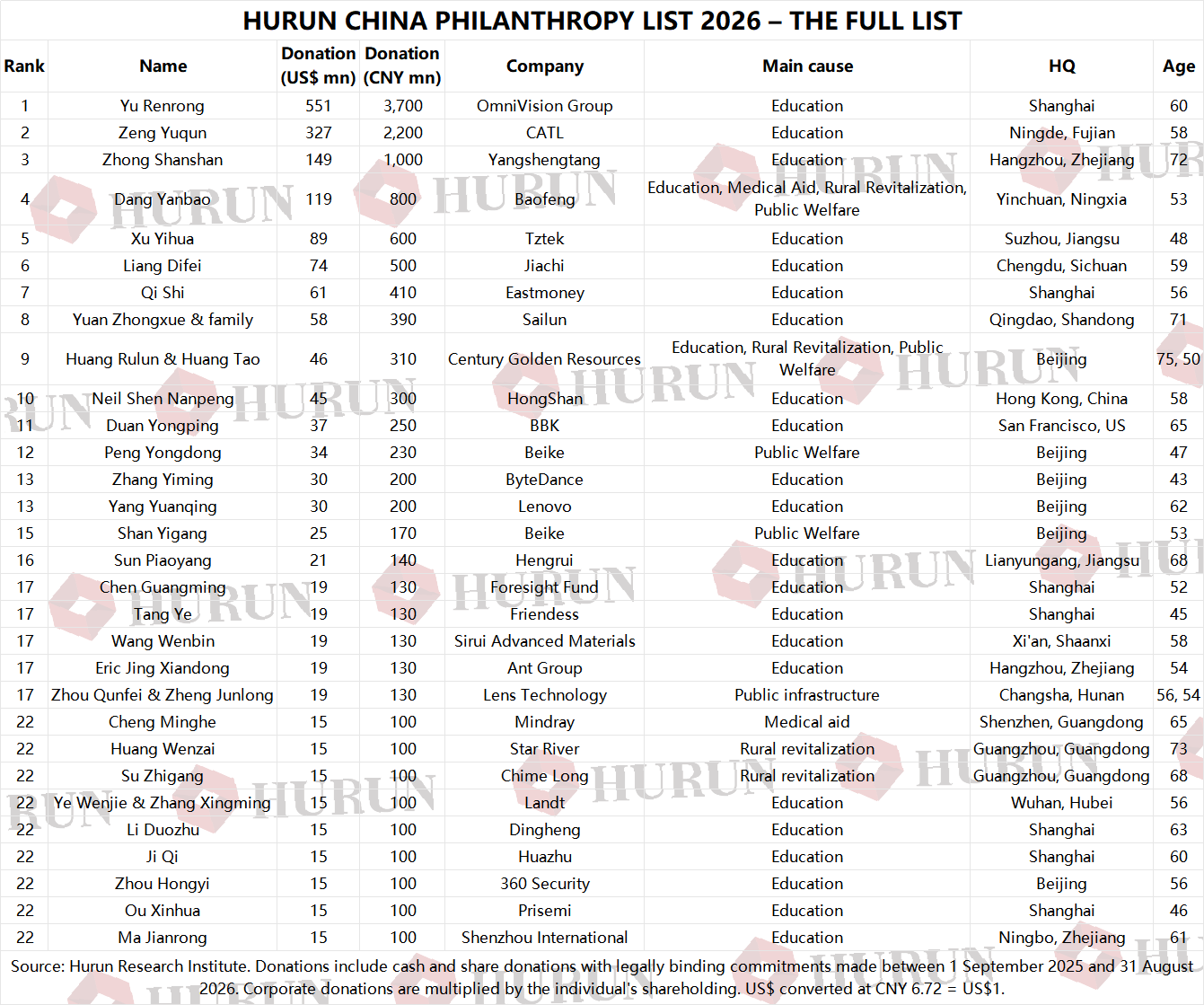
The cut-off to make the Hurun China Philanthropy List 2026 was US$15mn, equivalent to CNY100mn. The Hurun Research Institute identified 30 individuals from 16 cities who each gave more than CNY100mn in the past year, 16 more than last year’s 14. Their total donations came to US$1.9bn, more than triple last year’s US$570mn. 73% gave as individuals or families, and 27% gave through their companies. 70% of the list hail from listed companies. The average age is 58, one year younger than last year.
Rupert Hoogewerf, Chairman and Chief Researcher of Hurun Report, said:
“The number of entrepreneurs donating more than US$15mn has rebounded sharply, more than doubling from last year. The main reason is that the Hurun China Rich List grew 30% the year before, and we have found that charitable giving tends to mirror the previous year’s wealth creation. The latest Hurun China Rich List released last week, grew to a new world record, with over 1500 individuals making the CNY 5bn cut-off. On this trend, expect China big philanthropy to keep growing over the next two years.”
“The list reflects a structural shift in Chinese philanthropy, with a generational changing of the guard: the era dominated by property and internet tycoons is giving way to hard-tech industrialists. Founders from semiconductors, batteries and smart equipment – Yu Renrong, Robin Zeng Yuqun, Xu Yihua of Tztek and Liang Difei of Jiachi – are the core force of this year’s list, converting the dividends of China’s industrial upgrading into support for education and research.”
“The global philanthropy conversation this year has been dominated by ‘giving while living’: the Giving Pledge turned fifteen amid fresh scrutiny of how much its signatories have actually given away, Bill Gates committed to distributing his fortune within twenty years, and MacKenzie Scott of Amazon has set a new pace of giving. China is writing its own version of this story – its biggest givers are donating in their prime, mostly in their fifties and sixties, while their companies are still growing.”
“Yu Renrong is building a new university from scratch in his hometown of Ningbo, the Eastern Institute of Technology. He is one of its main founders and donors, with cumulative donations now exceeding US$890mn, making him one of the fastest-growing cumulative givers of recent years.”
“Education was again the most popular cause, with 69% of the list giving to education, up more than eight percentage points from last year. For Chinese entrepreneurs, the first port of call is their alma mater: half of this year’s philanthropists gave to the university where they studied. Shanghai Jiao Tong University alone received US$551mn from nine entrepreneurs on the list – for every four dollars donated to education, one dollar went to SJTU.”
“Beyond education, healthcare and public infrastructure are important destinations. A standout this year is the ‘Healthy Home Guardian Fund’ set up by Beike co-founders Peng Yongdong and Shan Yigang – a rare mega-gift aimed at the welfare of half a million front-line housing agents rather than a university.”
“Where Western billionaires debate ‘strategic philanthropy’ and the role of foundations, China’s entrepreneurs are voting with their stock certificates: this year’s mega-gifts were paid for in shares and aimed at universities – from Cao Dewang’s US$1.5bn Fuyao University of Science and Technology and Yu Renrong’s Eastern Institute of Technology to Zhong Shanshan’s planned US$6bn university in Hangzhou. Charitable trusts are also emerging as a vehicle for succession planning, pioneered by the likes of Midea’s He Xiangjian and Fuyao’s Cao Dewang.”
“Giving through a dedicated foundation has become the core vehicle for China’s top philanthropists to build long-term giving. This year Zhong Shanshan donated US$149mn to the Xiang’an Innovation Laboratory foundation and Dang Yanbao US$119mn to his Yanbao foundation. Over time these platforms enable steady, recurring giving: Dang has funded his foundation every year for over a decade; Yu Renrong’s cumulative gifts through the Eastern Institute of Technology foundations have passed US$890mn; Zhong Shanshan, Zeng Yuqun and Duan Yongping all give through their own foundations.”
“China’s charity federations remain a mature channel for large, targeted donations. This year China’s recently crowned Richest Self-Made Woman Lens Technology’s Zhou Qunfei gave US$19mn to the Yongzhou Charity Federation to upgrade the city’s stadium. The channel has produced landmark gifts: in 2010 Wanda’s Wang Jianlin donated US$149mn to the China Charity Federation for the rebuilding of Nanjing’s Porcelain Tower heritage site, a then-record personal donation in China.”
“Donations aimed at education and family legacy are mostly made in a personal capacity – nearly 70% – while gifts tied to industrial programmes, regional aid and charity-federation projects tend to be made by the company. Many entrepreneurs combine the two: share donations from the company plus personal cash.”
“Several of this year’s philanthropists also sit at the top of the Hurun China Rich List, including Yu Renrong, Robin Zeng Yuqun, Zhong Shanshan and Zhang Yiming. Their donations are modest relative to their wealth but huge in absolute terms.”
“Shanghai, with its rich university resources and venture capital ecosystem, was home to the most philanthropists, at 23% of the list, followed by Beijing at 20%, then Zhejiang and Guangdong at 10% each.”
“Investment and property are the most common industry backgrounds this year, including HongShan’s Shen Nanpeng, BBK’s Duan Yongping and Foresight’s Chen Guangming. Semiconductors stood out among the biggest gifts, with OmniVision’s Yu Renrong and Prisemi’s Ou Xinhua – a sign of how seriously China’s hard-tech entrepreneurs take education and research.”
“We once published a Hurun Global Century Philanthropists report, and one finding stuck with me: several entrepreneurs donated large shareholdings in their companies, and those companies are still thriving today – Rolex in Switzerland, the Tata Group in India. And in China, I recently came across another one: Ma Yunsheng, chairman of Jingbo Holdings, donated a controlling stake of more than 50% of his company to the Shandong Le’an Cixiao Charity Foundation that he founded. Since its establishment, the foundation has spent over US$89mn on poverty relief, education, scientific research, medical facilities, traditional Chinese culture, and care for the young and elderly.”
“Alongside the big one-off gifts are the marathon givers. The Huang Rulun family has made all 23 editions of the list since 2004 – the only philanthropists to do so, topping it four times and giving over US$1.5bn cumulatively. Dang Yanbao has made 14, giving away 10% of his company’s profits every year. This kind of sustainable, year-in-year-out giving is the backbone of Chinese philanthropy.”
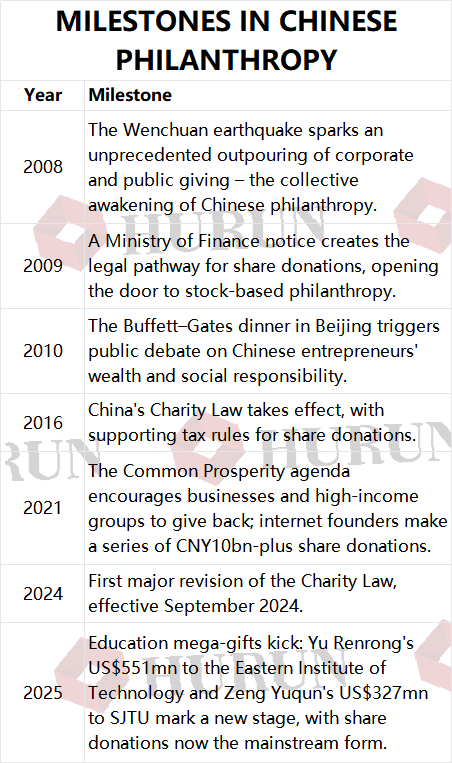
“Since our first list in 2004, the Hurun China Philanthropy List has witnessed many important moments for charity in China: the outpouring of giving after the 2008 Sichuan earthquake, the 2009 policy breakthrough on share donations, the 2010 Buffett-Gates dinner in Beijing, China’s Charity Law in 2016, Common Prosperity from 2021, and now a new era of mega-gifts to higher education led by share donations.”
“This year 30 entrepreneurs made the list with donations of US$15mn or more – roughly in line with ten years ago. Yet the Hurun China Rich List 2026 shows the number of Chinese entrepreneurs worth US$745mn or more is now almost double what it was a decade ago. And across the 23 editions of this list, 30 is only the sixth-highest count. Most Chinese entrepreneurs are still focused on wealth creation – most believe that building the business well comes before giving.”
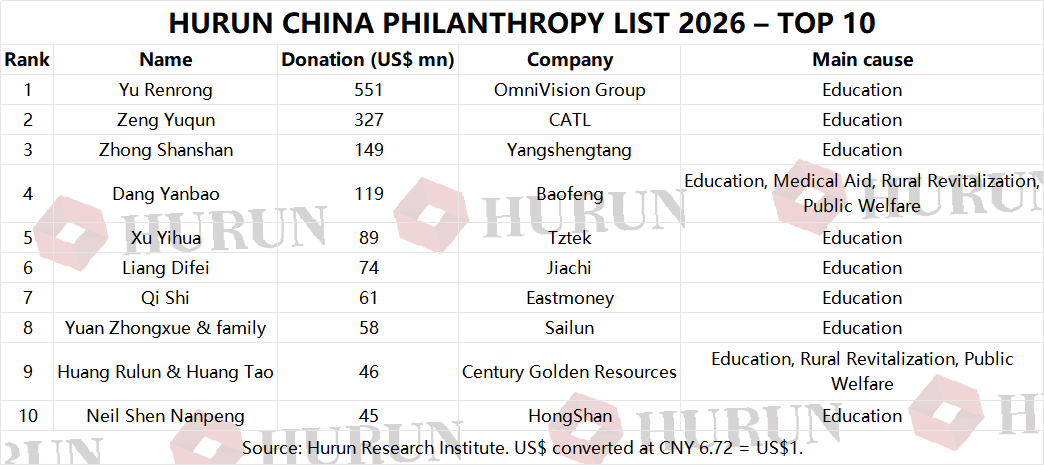
HURUN CHINA PHILANTHROPY LIST 2026 – TOP 10
THE LEADING PHILANTHROPISTS
How each of them made their money – and how they give it back – is told in full in Appendix B.
Yu Renrong, 60, OmniVision Group, US$551mn. The Tsinghua-trained engineer turned chip distributor turned chip designer, whose 2019 acquisition of US image-sensor pioneer OmniVision made his company the world number three in camera chips. Second time topping the list, after 2024. (Appendix B, No 1.)
Zeng Yuqun, 58, CATL, US$327mn. Built the battery maker that powers one in three of the world’s electric vehicles; his gift went to Shanghai Jiao Tong University, where he graduated in 1989. (Appendix B, No 2.)
Zhong Shanshan, 72, Yangshengtang / Nongfu Spring, US$149mn. Former construction worker and journalist who became China’s bottling-water king; has separately announced plans to donate US$6bn over the next decade to build a new university in Hangzhou. (Appendix B, No 3.)
Dang Yanbao, 53, Baofeng, US$119mn. Built a coal-to-chemicals and green-hydrogen group in the Ningxia desert; gives 10% of profits to his Yanbao foundation every year, funding scholarships for hundreds of thousands of students. 14th edition of the list. (Appendix B, No 4.)
Xu Yihua, 48, Tztek, US$89mn. Microsoft Research Asia alumnus whose machine-vision company supplies Apple; gave shares to Suzhou’s education foundation and the Tsung-Dao Lee foundation. (Appendix B, No 5.)
Liang Difei, 59, Jiachi, US$74mn. University professor whose stealth-materials research became a STAR Market company; gave shares back to his university, UESTC, at its 70th anniversary. (Appendix B, No 6.)
Qi Shi, 56, Eastmoney, US$61mn. Built China’s leading online investing platform; gave shares to his alma mater SJTU. (Appendix B, No 7.)
Yuan Zhongxue & family, 71, Sailun, US$58mn. Turned his rubber-science teaching career into a global tyre maker; the family gave shares to his old university, QUST. (Appendix B, No 8.)
Huang Rulun & Huang Tao, 75 & 50, Century Golden Resources, US$46mn. Property pioneers and the only philanthropists on all 23 editions of the list, with cumulative giving over US$1.5bn; this year built two schools in Anhui. (Appendix B, No 9.)
Neil Shen Nanpeng, 58, HongShan, US$45mn. Co-founder of Ctrip and Home Inns turned China’s most famous venture capitalist; funded a HongShan College at his alma mater SJTU. (Appendix B, No 10.)
Duan Yongping, 65, BBK, US$37mn. The godfather of Chinese consumer electronics (OPPO, vivo) and legendary value investor, long one of China’s biggest education givers; signed a US$33mn gift to Beijing Normal University. (Appendix B, No 11.)
Peng Yongdong, 47, Beike, US$34mn. The former IBM consultant who took Lianjia online and co-founded housing platform Beike, which he has chaired since founder Zuo Hui’s death in 2021; co-donated shares to a welfare fund for half a million housing agents. (Appendix B, No 12.)
Zhang Yiming, 43, ByteDance, US$30mn. China’s richest person and the youngest on the list; topped up his Fangmei education fund for vocational and arts education in his hometown of Longyan. Sixth edition. (Appendix B, No 13.)
Yang Yuanqing, 62, Lenovo, US$30mn. The man who bought IBM’s PC business; funded AI research and talent at his alma mater SJTU. Third edition. (Appendix B, No 13.)
Shan Yigang, 53, Beike, US$25mn. Co-founded a Dalian housing brokerage at 26, joined Lianjia in 2007 and co-founded Beike in 2018; co-donated the shares behind the ‘Healthy Home Guardian Fund’. First time on the list. (Appendix B, No 15.)
Sun Piaoyang, 68, Hengrui, US$21mn. Turned a state drug factory into China’s leading innovative pharma; gave cash and shares to his alma mater, China Pharmaceutical University. (Appendix B, No 16.)
CAUSES
Education remained the most popular cause: 69% of the list donated to education, up more than eight percentage points from 60% last year. Half of the list – 15 individuals – gave to their alma mater. Other causes: medical aid attracted 2 philanthropists (6%), including Mindray’s Cheng Minghe and multi-cause giver Dang Yanbao; rural revitalization 4 (11%), including Guangdong’s Huang Wenzai and Su Zhigang plus multi-cause givers Dang Yanbao and the Huang Rulun family; public welfare 4 (11%); public infrastructure 1 (3%).
Eleven universities and education institutions each received US$15mn or more from listed philanthropists in the past year: the Eastern Institute of Technology in Ningbo (US$551mn, from Yu Renrong); Shanghai Jiao Tong University (US$551mn across nine donors); the Tsung-Dao Lee and Suzhou education foundations (US$89mn, from Xu Yihua); UESTC in Chengdu (US$74mn); the Qingdao University of Science and Technology (US$58mn); Xi’an Jiaotong University (US$49mn across three donors); Beijing Normal University (US$33mn); China Pharmaceutical University (US$21mn); and East China Normal University, Fudan University and Shaoxing University with US$15mn each.
The twin 130th anniversaries of the Jiaotong universities – Shanghai and Xi’an, sibling schools both founded in 1896 – helped drive the alumni giving boom this year. An anonymous alumnus couple also gave US$15mn to Xi’an Jiaotong in January 2026, which is not counted as their identities could not be confirmed from public information.
WHERE THEY COME FROM
By company headquarters, Shanghai led with 7 philanthropists (23%), followed by Beijing with 6 (20%), and Zhejiang and Guangdong with 3 each (10%). The 30 philanthropists come from 17 cities; one, Duan Yongping, is based in San Francisco.
By birthplace, Zhejiang produced the most philanthropists with 5 (19%), followed by Fujian and Anhui with 4 each (15%), Hunan with 3, and Jiangsu and Guangdong with 2 each. Fujian-born philanthropists – led by Zeng Yuqun, Zhang Yiming and the Huang Rulun family – have consistently punched above their weight on the Hurun Philanthropy List relative to their share of the Hurun China Rich List.
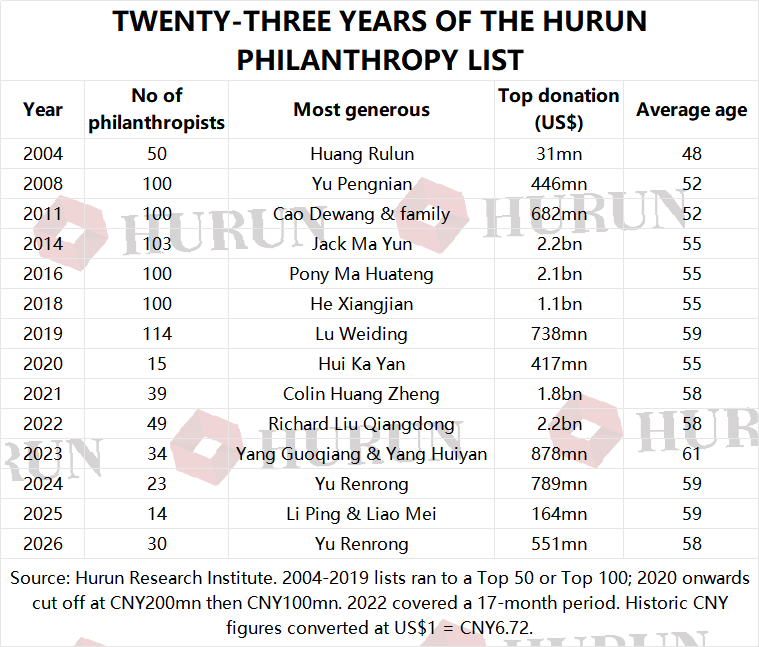
TWENTY-THREE YEARS OF THE HURUN PHILANTHROPY LIST: THE LONG-TERM TRENDS
The Hurun Philanthropy List began in 2004 as a Top 50 list, expanding to a Top 100 list. As wealth numbers grew, Hurun Research set a cut-off of CNY100mn (US$15mn). In 2019, Hurun Research broadened the scope to include individuals from Hong Kong, Macao and Taiwan.
Donations mirror wealth creation
Total donations peaked at US$10.8bn in 2022, when four internet founders each gave more than US$1.5bn after the launch of Common Prosperity, before falling sharply through 2025 as the Hurun China Rich List shrank for three consecutive years. With the rich list rebounding 30% last year, philanthropy has followed: donations more than tripled this year to US$1.9bn.
Education: from one cause among many to the dominant one
Education has been the most popular cause for Chinese big philanthropy, reaching 69% of the list this year. The driver is alma mater giving – donations to the universities where founders studied – and increasingly the building of whole new universities: Cao Dewang’s US$1.5bn Fuyao University of Science and Technology, Yu Renrong’s Eastern Institute of Technology in Ningbo, and Zhong Shanshan’s planned US$6bn university in Hangzhou.
From cash to shares
Where early lists were dominated by cash gifts, the biggest donations of the past five years have almost all been transfers of listed-company stock, enabled by the 2009 policy breakthrough on share donations and the 2016 Charity Law tax provisions. Eight of this year’s Top 10 gave shares. Hurun Research values share donations at the closing price on the day the shares change hands.
From property to tech
Property tycoons were the largest group of big givers as recently as 2022. The mega-donations have now shifted to hard-tech founders – semiconductors, batteries, electronics, advanced manufacturing – mirroring the shift in China’s wealth creation. By headcount, investment and property services remain the most common backgrounds on the list, at 12% each, showing where the family offices and cash are.
The marathon givers
Most do big one-off gifts. Only a handful do sustained giving. Beijing-based real estate developers turned investors Huang Rulun & Huang Tao father and son has made all 23 editions of the list – the only philanthropists to do so – with cumulative donations exceeding US$1.5bn. Dang Yanbao has made 14 editions, giving away 10% of Baofeng’s profits every year. Huang Wenzai of Star River has made 11.
The cumulative givers
14 living Chinese philanthropists have now donated more than US$1.5bn over their lifetimes. Seven have passed US$2.2bn: Midea’s He Xiangjian, Xiaomi’s Lei Jun, Hong Kong’s Li Ka-shing, JD.com’s Richard Liu Qiangdong and Zhang Zetian, Tencent’s Pony Ma Huateng, Alibaba’s Jack Ma Yun, and Country Garden’s Yang Guoqiang & Yang Huiyan. Seven more have passed US$1.5bn: Taiwan-born Alibaba co-founder Joe Tsai Chongxin, Fuyao’s Cao Dewang, Anta’s Ding Shizhong family, Century Golden Resources’ Huang Rulun & Huang Tao family, Pinduoduo’s Colin Huang Zheng, Meituan’s Wang Xing and Evergrande’s Hui Ka Yan. 88 living philanthropists have now given more than US$74mn cumulatively.
Among the big philanthropists no longer with us, Yu Pengnian, Tin Ka Ping, Stanley Ho, Henry Fok and Wang Yung-ching each gave more than US$745mn over their lifetimes, while Run Run Shaw, Bao Yugang, Zhuang Shiping and Rong Yiren each gave more than US$1.5bn.
MILESTONES IN CHINESE PHILANTHROPY
MAJOR DONATIONS NOT COUNTED
Zeng Yuqun announced a further donation of 1.5 million CATL shares to a Shanghai Jiao Tong University–CATL advanced research institute in Ningde, with a market value of around US$63mn, at the World Energy Storage Conference. As the transfer had not been completed by the cut-off date, it is not included in this year’s list.
An anonymous alumnus donated US$75mn to Renmin University of China for a sports centre on its new Tongzhou campus. As the donor could not be identified from public information, the donation is not included in the list.
An anonymous alumnus couple donated US$15mn to Xi’an Jiaotong University on 10 January 2026, ahead of its 130th anniversary. As the couple could not be identified from public information, the donation is not included in the list.
A ‘Mr Huang’ donated US$15mn to his alma mater China West Normal University in Sichuan. As the full identity could not be confirmed from public information, the donation is not included in the list.
METHODOLOGY
To put together a comprehensive list of the largest philanthropists of China is an almost impossible task. However, we believe that the Hurun Philanthropy List, published since 2004, is the most serious and authoritative effort to date, identifying the individuals and highlighting the causes they donate to.
To make this list, the Hurun Research Institute surveyed more than 2000 of China’s most successful entrepreneurs from the recently released Hurun China Rich List 2026 and the Hurun Global Rich List 2026, meticulously cross-referencing the results with media reports, press conferences and charitable foundation archives. In the course of the research, Hurun Research Institute attended non-profit industry conferences and events, and met with scholars, experts, senior media figures, industry practitioners and philanthropists themselves. Some entrepreneurs prefer to keep their giving private; figures on the list should be treated as minimum donations.
Hurun Research includes cash and cash equivalents pledged with legally binding commitments for the period from 1 September 2025 to 31 August 2026, as well as major donations of US$15mn or more announced between 31 August and the publication date. When comparing previous lists, please note that for corporate donations Hurun Research multiplied the donation by an individual’s shareholding in the company. Share donations are valued at the closing price on the day the shares change hands. By “Chinese entrepreneurs” we mean entrepreneurs born and raised in China, wherever they live now.
ABOUT HURUN INC.
Encouraging entrepreneurship and value creation through quality lists and research
Oxford, Shanghai, Mumbai
Established in the United Kingdom in 1999, Hurun is a research and media group, promoting entrepreneurship through its lists and research. Widely regarded as an opinion-leader in the world of business, Hurun generated 8 billion views on the Hurun brand in 2024, mainly in China and India, and recently expanding to the UK, US, Canada and Australia.
Best-known for the Hurun Rich List series, telling the stories of the world’s successful entrepreneurs in China, India and the world, Hurun’s other key series focus on young businesses and entrepreneurs, through the Hurun Unicorns Index, two Hurun Future Unicorns indices, the Hurun Uth series and the Hurun Pioneers series.
Other lists include the Hurun 500 series, ranking the most valuable companies in the world, China and India, the Hurun Global High Schools List, ranking the world’s best independent high schools, the Hurun Philanthropy List, ranking the biggest philanthropists, and the Hurun Art List, ranking the world’s most successful artists alive today.
For further information, see www.hurun.net.
FOR MEDIA INQUIRIES, PLEASE CONTACT:
Hurun Report
Anna Dai, Editor-in-Chief
Mobile: +86 151 0210 3129
Email: anna.dai@hurun.net
APPENDIX A: HURUN CHINA PHILANTHROPY LIST 2026 – THE FULL LIST
APPENDIX B: THE STORIES BEHIND THE GIVING
How China’s 30 most generous philanthropists made their money – and how they are giving it back.
1. Yu Renrong, 60, OmniVision Group – US$551mn
Born in Ningbo, Zhejiang, Yu Renrong graduated from Tsinghua University with a degree in electronic engineering and spent the 1990s as an engineer and then a distributor of electronic components. In 2007 he founded Will Semiconductor in Shanghai, moving from chip distribution into chip design. His bold move came in 2019, when WillSemi acquired OmniVision, the US pioneer of CMOS image sensors, catapulting the company into the global top three for camera chips used in smartphones and cars, behind only Sony and Samsung. The group was renamed OmniVision Group in 2025. Yu is worth CNY42bn on the Hurun China Rich List 2026.
Yu is building a university from scratch in his hometown: the Eastern Institute of Technology in Ningbo, a new research university he has funded since 2021. This year he donated 30 million OmniVision shares worth CNY3.7bn to the university’s education foundation, his single biggest gift yet. It follows share donations worth CNY835mn in 2023 and CNY5.3bn in 2024 – which made him China’s most generous philanthropist that year. His cumulative donations have now passed CNY6bn, making him one of the fastest-growing cumulative givers of recent years. This is the third time he has made the Hurun Philanthropy List and the second time he has topped it.
2. Zeng Yuqun, 58, CATL – US$327mn
Zeng Yuqun was born in a mountain village in Ningde, Fujian, and graduated from Shanghai Jiao Tong University in 1989 before earning a PhD from the Chinese Academy of Sciences. In 1999 he co-founded ATL, which became the world’s leading maker of lithium batteries for smartphones. In 2011 he spun the electric-vehicle battery business out into CATL, based in his hometown of Ningde. Today one in three electric vehicles in the world runs on a CATL battery, and the company is the undisputed global leader in EV and energy-storage batteries. Zeng is worth CNY385bn and ranked No 3 on the Hurun China Rich List 2026.
This year CATL donated 5 million shares to the Shanghai Jiao Tong University Education Development Foundation – worth CNY2.2bn once attributed to Zeng’s shareholding – repaying the university where it all started for him. It is Zeng’s second time on the Hurun Philanthropy List: in 2022 he donated CNY1.4bn, also to support university education and research.
3. Zhong Shanshan, 72, Yangshengtang / Nongfu Spring – US$149mn
Zhong Shanshan, born in Shaoxing, Zhejiang, in 1954, did odd jobs as a construction worker before becoming a reporter at the Zhejiang Daily in the 1980s, interviewing over 500 entrepreneurs. In 1988 he went to Hainan to try business himself, and after a stint as a Wahaha distributor founded Yangshengtang in 1993, selling health supplements. In 1996 he founded Nongfu Spring – “We don’t manufacture water; we are porters of nature” – which he took public in Hong Kong in 2020, briefly making him Asia’s richest person. He also controls vaccine maker Wantai Biological. Zhong is worth CNY410bn and ranked No 2 on the Hurun China Rich List 2026.
Zhong donated 33 million Nongfu Spring shares he directly holds – worth CNY1bn – to the science and technology development foundation of the Xiang’an Innovation Laboratory in Fujian, backing applied research. Remarkably, this is his first appearance on the Hurun Philanthropy List since the very first edition in 2004. More is coming: last year Zhong announced plans to donate CNY40bn over the next decade to build a new university in Hangzhou. He has also set up education foundations in Hangzhou named after his late father Zhong Ziyi.
4. Dang Yanbao, 53, Baofeng – US$119mn
Dang Yanbao was born in Yinchuan, Ningxia, and built Baofeng from a local coal trader into one of China’s largest coal-to-olefins producers, turning coal into the chemical building blocks for plastics. Baofeng listed in 2019 and has since become a pioneer of green hydrogen, building one of the world’s largest solar-powered hydrogen plants in the Ningxia desert. Dang is worth CNY150bn and ranked in the Top 25 of the Hurun China Rich List 2026.
Dang is the marathon man of Chinese philanthropy. In 2011 he and his wife Bian Haiyan set up the Ningxia Yanbao Charity Foundation, and he has committed to giving away 10% of Baofeng’s profits every year – funding scholarships that have supported hundreds of thousands of students from poor families across Ningxia. This year he donated CNY800mn in cash to the foundation, his 14th time on the Hurun Philanthropy List, taking his cumulative donations towards CNY4bn.
5. Xu Yihua, 48, Tztek – US$89mn
Xu Yihua earned his PhD in computer science from the Beijing Institute of Technology and spent four years as a researcher at Microsoft Research Asia, working on artificial intelligence. In 2005 he founded Tztek – the name means “accurate every day” – to make machine-vision equipment, the “eyes” of smart factories. He moved the company to Suzhou in 2009, won Apple as a customer in 2012, and in 2019 Tztek was in the first batch of companies to list on Shanghai’s new STAR Market. In 2021 it acquired Germany’s MueTec to enter wafer inspection for semiconductors.
Xu, at 48 one of the youngest on this year’s list, donated a total of 8 million Tztek shares worth CNY600mn: 1.6 million to the Suzhou Education Development Foundation and 6.4 million to the Suzhou Tsung-Dao Lee education and science foundation, named after the Nobel physicist with ancestral roots in Suzhou. It is his first time on the Hurun Philanthropy List.
6. Liang Difei, 59, Jiachi – US$74mn
Liang Difei, born in Lianyuan, Hunan, is the scholar-entrepreneur of this year’s list. After a bachelor’s in metal materials from the Beijing Institute of Technology, he took his master’s at the University of Electronic Science and Technology of China (UESTC) in Chengdu in 1996 and stayed on as a researcher, spending three decades on electromagnetic wave-absorbing materials. In 2008 he co-founded Jiachi with two fellow UESTC professors – Deng Longjiang, an academician of the Chinese Academy of Engineering, and Xie Jianliang – to commercialise their lab’s research into stealth and electromagnetic-compatibility materials. Jiachi listed on the STAR Market in December 2024 and is now China’s leading maker of electromagnetic functional materials.
In July 2026, at UESTC’s 70th anniversary, Liang donated 10 million Jiachi shares worth CNY500mn to the university’s education development foundation – the company literally giving back to the laboratory that created it. First time on the list.
7. Qi Shi, 56, Eastmoney – US$61mn
Qi Shi, a Shanghai native and materials engineering graduate of Shanghai Jiao Tong University, founded Eastmoney in 2004 as a financial information portal. He rode China’s retail investing boom brilliantly: the fund sales platform Tiantian became one of the country’s biggest, and a 2015 brokerage acquisition turned Eastmoney into a full-service online securities group. Qi is worth CNY73.5bn on the Hurun China Rich List 2026.
Qi donated 20 million Eastmoney shares worth CNY410mn in his own name to his alma mater, Shanghai Jiao Tong University. He has also set up the Shanghai Eastmoney Public Welfare Foundation. First time on the list.
8. Yuan Zhongxue & family, 71, Sailun – US$58mn
Yuan Zhongxue, born in Shandong in 1955, spent years teaching at the Qingdao University of Science and Technology – the cradle of China’s rubber industry – before turning entrepreneur. He founded rubber equipment and software maker MESNAC in 2000 and tyre maker Sailun in 2002. Sailun has grown into one of the world’s top tyre manufacturers, pioneering “liquid gold” tyres that cut rolling resistance, with factories across China, Vietnam and Cambodia.
This was a family affair: Sailun donated 31.6 million shares to the education foundation of Yuan’s old university, QUST, while his wife Yang Dehua and son Yuan Song donated a further 6.3 million shares in their own names – CNY390mn in all. First time on the list.
9. Huang Rulun & Huang Tao, 75 & 50, Century Golden Resources – US$46mn
Huang Rulun was born in Lianjiang, Fujian, in 1951, and went to the Philippines in 1986 to seek his fortune before returning to China in 1991. He built Century Golden Resources into a property empire famous for mega-developments – Beijing’s Century City housed tens of thousands – plus shopping malls, hotels and mining. His son Huang Tao, born in 1976, now runs the group. The family is worth CNY33bn.
The Huang family are the marathon champions of Chinese philanthropy: they have made every single one of the 23 editions of the Hurun Philanthropy List since 2004 – the only philanthropists to do so – topping it four times, with cumulative donations exceeding CNY10bn. This year the group built and handed over two schools – the Yuejiahu middle and primary schools – in Fuyang, Anhui, worth CNY270mn, among other gifts to education and poverty relief.
10. Neil Shen Nanpeng, 58, HongShan – US$45mn
Born in Jiaxing, Zhejiang, Shen Nanpeng studied at Shanghai Jiao Tong University before a Yale MBA and a career in investment banking in New York and Hong Kong. He co-founded Ctrip in 1999 and Home Inns in 2002, taking both to Nasdaq, then in 2005 founded Sequoia China – renamed HongShan in 2023 – which became China’s most successful venture capital firm, backing Meituan, Pinduoduo, ByteDance, DJI and JD.com among many others. Shen is worth CNY42bn.
Shen gave CNY300mn to his alma mater Shanghai Jiao Tong University to establish a “HongShan College” building fund – a residential college on campus. It is his fourth time on the Hurun Philanthropy List, after appearances in 2016, 2017 and 2021.
11. Duan Yongping, 65, BBK – US$37mn
Born in Nanchang, Jiangxi, Duan Yongping studied radio engineering at Zhejiang University, then took a master’s at Renmin University. In 1989 he took over a loss-making factory in Guangdong and turned it into Subor, the famous learning-machine brand. In 1995 he founded BBK, whose offshoots became OPPO and vivo – today two of the world’s biggest smartphone makers. Duan moved to California around 2001 and became a legendary value investor, making a fortune on NetEase in 2002; he was an early mentor and backer of Pinduoduo’s Colin Huang Zheng.
Duan has been giving for two decades, mostly to education, through his Xinping and Enlight foundations. In 2006 his US$30mn gift to Zhejiang University set a then-record for a Chinese university. This year he formally signed a CNY220mn donation agreement with the Beijing Normal University Education Foundation, part of CNY250mn in total giving.
12. Peng Yongdong, 47, Beike – US$34mn
Born in Wuhu, Anhui, in 1979, Peng Yongdong studied electrical engineering at Zhejiang University before taking a Tsinghua–MIT international MBA. He spent four years at IBM China as a senior strategy consultant, where a 2008 consulting project introduced him to Zuo Hui, the founder of the Lianjia estate agency. Peng joined Lianjia in 2010 and drove its move online, then in 2018 co-founded Beike with Zuo, building it into China’s largest housing transactions and services platform, listed in New York in 2020. After Zuo’s untimely death in 2021, Peng took over as chairman and steered Beike to a dual primary listing in Hong Kong. Peng is on the Hurun China Rich List 2026 with a wealth of CNY8bn.
On 24 February 2026, Peng and fellow Beike co-founder Shan Yigang jointly donated 10 million Beike shares – worth some US$60mn – to set up the “Healthy Home Guardian Fund”, a welfare fund for Beike’s roughly 500,000 employees and platform service providers, covering critical illness, disability and children’s education. Attributed by shareholding, Peng’s share counts as US$34mn. It is his second consecutive year on the list.
13. Zhang Yiming, 43, ByteDance – US$30mn
The youngest member of this year’s list, Zhang Yiming was born in Longyan, Fujian, in 1983 and studied software engineering at Nankai University. After early startups, he founded ByteDance in 2012, building Toutiao’s AI-powered news feed and then Douyin and TikTok – making ByteDance the world’s most valuable unicorn and the first Chinese consumer internet company to go truly global. Zhang stepped back from the CEO role in 2021. He is China’s richest person, worth CNY670bn on the Hurun China Rich List 2026.
Zhang has made the Hurun Philanthropy List six times, with a soft spot for his hometown: through the Fangmei Education Development Fund in Longyan he has funded schools, vocational training and arts education since 2019. This year he added a further CNY200mn to the fund for vocational and arts education projects.
13. Yang Yuanqing, 62, Lenovo – US$30mn
Born in Hefei, Anhui, Yang Yuanqing studied computer science at Shanghai Jiao Tong University and joined Legend – a small computer distributor – in 1989. Rising through sales, he became CEO in 2001 and chairman in 2004, and in 2005 led the audacious acquisition of IBM’s PC business that turned Lenovo into the world’s largest PC maker, a title it still holds. Yang is worth CNY26bn.
Yang has been a steady benefactor of his alma mater SJTU. This year he donated CNY200mn to support artificial intelligence research and talent development at the university – fitting for a man now betting Lenovo’s future on AI PCs. Third time on the list, after 2021 and 2024.
15. Shan Yigang, 53, Beike – US$25mn
Born in 1973, Shan Yigang co-founded the Dalan Haowangjiao housing brokerage in Dalian in 1999, serving as its vice president, before joining Beijing Lianjia in 2007, where he was closely involved in the company’s strategic decisions. In 2018 he co-founded Beike with Zuo Hui and Peng Yongdong, serving as an executive director, and helped take it public in New York and Hong Kong. Shan is on the Hurun China Rich List 2026 with a wealth of CNY5bn.
Shan co-donated the 10 million Beike shares behind the “Healthy Home Guardian Fund” with Peng Yongdong; attributed by shareholding, his share counts as US$25mn. The fund provides critical-illness payouts, disability support and education grants for the children of Beike’s employees and platform agents – a rare large gift aimed at front-line service workers rather than a university. First time on the list.
16. Sun Piaoyang, 68, Hengrui – US$21mn
Sun Piaoyang, born in Zhenjiang, Jiangsu, graduated from China Pharmaceutical University and was assigned to a state-owned drug factory in Lianyungang. Taking the helm in 1990, he bet on R&D and innovative drugs, turning Hengrui into China’s leading oncology and innovative pharmaceutical company, which listed in Hong Kong in 2025. His wife Zhong Huijun built Hansoh Pharmaceutical. Sun is worth CNY69bn.
Sun gave CNY150mn – CNY100mn in cash plus Hengrui shares – to the China Pharmaceutical University Education Development Foundation, his alma mater, for discipline building, innovative drug research and top talent training. After the shareholding adjustment this counts as CNY140mn. Third time on the list.
17. Chen Guangming, 52, Foresight Fund – US$19mn
Chen Guangming, born in Zhejiang in 1974 and a graduate of Shanghai Jiao Tong University, made his name at Orient Securities’ asset management arm, where his “Dongfanghong” funds made him one of China’s best-known value investors. In 2018 he founded Foresight Fund, whose launches have repeatedly broken subscription records in China’s mutual fund industry.
Chen donated CNY130mn in his own name to SJTU to establish the Foresight Youth Science & Technology Award, supporting young researchers, medical aid and business education. He has also set up the Shanghai Foresight Public Welfare Foundation. First time on the list.
17. Tang Ye, 45, Friendess – US$19mn
Tang Ye, born in 1981, founded Friendess with fellow Shanghai Jiao Tong University students in 2007, almost straight out of college. The company makes the control systems – the “brains” – of laser cutting machines, and is the world leader in its niche, powering the laser cutters of smart factories worldwide. Friendess listed on the STAR Market in 2019. Tang is worth CNY8.5bn.
Tang donated 1 million Friendess shares worth CNY130mn to SJTU, his alma mater. At 45 he is one of the two youngest on this year’s list. First time on the list.
17. Wang Wenbin, 58, Sirui Advanced Materials – US$19mn
Born in Xi’an, Wang Wenbin studied metal materials at Xi’an Jiaotong University from 1987, spending nights in the lab, then worked as a technician at a state machinery factory. In 1995 he quit to found Sirui, determined to break the foreign monopoly on copper-chromium contact materials – the parts at the heart of every medium- and high-voltage vacuum switch. Three decades on, Sirui is the world’s largest maker of high-strength, high-conductivity copper alloys, supplying ABB, Siemens and Schneider, and listed on the STAR Market in 2022.
Wang has long chaired XJTU’s materials alumni association and co-built a joint copper-materials innovation centre with the university. At XJTU’s 130th anniversary he donated CNY130mn to his alma mater. First time on the list.
17. Eric Jing Xiandong, 54, Ant Group – US$19mn
Born in Chuzhou, Anhui, Jing Xiandong graduated from Shanghai Jiao Tong University and joined Alipay in 2009 as its CFO. He became CEO of Ant Group and then chairman, presiding over the world’s largest digital payments platform – over a billion Alipay users – and steering Ant through its restructuring into a financial technology holding company.
Jing donated CNY130mn in cash and Ant Group shares in his own name to his alma mater SJTU. It is his second time on the Hurun Philanthropy List, after 2017.
17. Zhou Qunfei & Zheng Junlong, 56 & 54, Lens Technology – US$19mn
Zhou Qunfei’s story is China’s most famous rags-to-riches tale. Born into poverty in a Hunan village in 1970 – her mother died when she was five and her father was blinded in an accident – she went to Shenzhen as a migrant worker at 15, polishing watch glass by day and studying at night. She started her own workshop in 1993 and founded Lens Technology in 2003, which came to make the glass covers for the iPhone and most of the world’s smartphones. Its 2015 listing made her the world’s richest self-made woman; her husband Zheng Junlong is her long-time partner in the business.
The couple donated 3.9 million Lens Technology shares to the Yongzhou Charity Federation – Zhou’s home prefecture – to fund the upgrading of Yongzhou’s stadium, a rare public-infrastructure gift on this year’s education-dominated list.
22. Cheng Minghe, 65, Mindray – US$15mn
A biomedical engineering graduate of Shanghai Jiao Tong University, Cheng Minghe co-founded Mindray in Shenzhen in 1991 with Li Xiting and Xu Hang. Starting by distributing imported patient monitors, Mindray built its own devices and is now China’s largest medical equipment maker – monitors, ultrasound, ventilators and lab diagnostics sold in 190 countries – listed on the ChiNext after an earlier decade on the NYSE.
Cheng donated US$15mn in his own name to his alma mater SJTU, this year directed to medical aid. It is his second time on the list, after 2023. He gives through his Jiahe Fund foundation.
22. Huang Wenzai, 73, Star River – US$15mn
The oldest member of this year’s list, Huang Wenzai was born in Guangzhou in 1953 and founded Star River in Panyu in the 1990s. His “Star River Bay” luxury developments set the benchmark for high-end Chinese housing, expanding from Guangzhou to Shanghai, Beijing and beyond. Huang is worth CNY13bn.
Huang is one of the most durable philanthropists in China: this is his 11th time on the Hurun Philanthropy List since 2010. Every year on Guangdong’s Poverty Alleviation Day he pledges nine-figure sums to rural revitalization – CNY100mn again this year – through the Guangdong Star River Charity Foundation.
22. Su Zhigang, 68, Chime Long – US$15mn
Su Zhigang, born in Panyu, Guangzhou, in 1958, started out selling pork, then opened a restaurant in 1989 that made his first fortune. In 1997 he gambled it on a safari park – Chimelong – and went on to build Asia’s leading theme park group: Guangzhou Chimelong and the vast Hengqin Ocean Kingdom in Zhuhai, holder of multiple world records. Su is worth CNY10bn.
Like Huang Wenzai, Su marks Guangdong’s Poverty Alleviation Day every year with a major pledge – CNY100mn this year for rural revitalization. This is his fifth time on the Hurun Philanthropy List.
22. Ye Wenjie & Zhang Xingming, 56, Landt – US$15mn
Ye Wenjie, born in 1970, studied computer science at East China Normal University in Shanghai, then returned to Wuhan to work as a hardware engineer in the city’s electronics and battery companies. In 1998 he joined Wuhan Land Electronic, which he went on to lead: Landt makes the precision charge-discharge test equipment used by battery laboratories and manufacturers worldwide – a quiet picks-and-shovels winner of the battery boom. The company listed on the Beijing Stock Exchange in 2023.
Ye and his wife Zhang Xingming donated CNY100mn in their own names to Ye’s alma mater, East China Normal University, to set up a science and technology innovation fund. First time on the list.
22. Li Duozhu, 63, Dingheng – US$15mn
Born in Anhui in 1963, Li Duozhu founded the Dingheng Group in Shanghai, building it into one of China’s leading chemical tanker operators, shipping liquid chemicals and specialty cargoes around the world.
Li donated CNY100mn in his own name to Fudan University to endow the Dingheng Education Development Fund, supporting the university’s new department of atmospheric and oceanic sciences – a shipping man investing in the science of the oceans and the weather. First time on the list.
22. Ji Qi, 60, Huazhu – US$15mn
Ji Qi, born in Nantong, Jiangsu, studied mechanical engineering at Shanghai Jiao Tong University and became one of China’s most successful serial entrepreneurs: he co-founded Ctrip in 1999 and Home Inn in 2002 – both Nasdaq-listed – before founding Huazhu in 2005. Starting with the budget Hanting brand, Huazhu is today one of the world’s largest hotel groups with over 10,000 hotels. Ji is worth CNY26bn.
Ji donated CNY100mn in cash to his alma mater SJTU. He has previously set up the Shanghai Hanting Social Welfare Foundation. First time on the list.
22. Zhou Hongyi, 56, 360 Security – US$15mn
Born in Huanggang, Hubei, Zhou Hongyi took his bachelor’s and master’s in computer science at Xi’an Jiaotong University. He founded 3721, an early Chinese search company, sold to Yahoo in 2003, then in 2005 founded Qihoo 360 and disrupted the antivirus industry by giving security software away free – building China’s biggest cybersecurity company, listed in New York in 2011 and in Shanghai since 2018. In recent years Zhou has become one of China’s most-followed entrepreneur-influencers, championing AI.
At Xi’an Jiaotong University’s 130th anniversary this year, Zhou donated CNY100mn to his alma mater. He also runs the Beijing Qihoo 360 Public Welfare Foundation. First time on the list.
22. Ou Xinhua, 46, Prisemi – US$15mn
Ou Xinhua, born in 1980, graduated in electronic science and technology from Xi’an Jiaotong University in 2002 and took a master’s in microelectronics at the Xi’an Microelectronics Technology Institute. After a few years as an engineer and technical director at Shanghai and Suzhou chip companies, he founded Prisemi in Shanghai at the end of 2009, designing the power semiconductors – protection devices, MOSFETs, power management chips – inside smartphones and consumer electronics. Prisemi listed on the STAR Market in 2021.
At 46, Ou is one of the youngest on this year’s list. He donated CNY100mn in his own name to Xi’an Jiaotong University at its 130th anniversary – one of three XJTU alumni on this year’s list, alongside Wang Wenbin and Zhou Hongyi. First time on the list.
22. Ma Jianrong, 61, Shenzhou International – US$15mn
Born in Shaoxing, Zhejiang, Ma Jianrong started as a textile worker and took over his family’s knitwear factory around 1990. He built Shenzhou International into the world’s largest vertically integrated knitwear manufacturer – from yarn to finished garment – and the biggest single supplier to Uniqlo, Nike and Adidas, with factories across China, Vietnam and Cambodia. Shenzhou listed in Hong Kong in 2005. Ma is worth CNY21.5bn.
Ma donated CNY100mn to Shaoxing University to endow the Shenzhou–Shaoda development fund, investing in the university of his home city. It is his second time on the Hurun Philanthropy List – his first appearance was twenty years ago, in 2006.
Source: Hurun Research Institute; company filings and public records. Donations valued at announcement or transfer date.