Hurun Germany Unicorn Index 2026
This report is part of the Hurun Global Unicorn Index 2026 — the definitive, real-time ranking of the world's 1,603 most valuable startups across 52 countries and 299 cities.
HURUN GERMANY
UNICORN INDEX 2026
Comprehensive Research Report
The Engine of European Deep Tech Finds Its Ambition
37 unicorns · €117 billion
Hurun Research Institute · September 2026
The fourth report in the Hurun global unicorn series for 2026
Germany has long been underestimated as a startup ecosystem. The world looks at Silicon Valley and sees speed; it looks at Germany and sees caution. But what Germany has built is something more durable — 37 unicorns worth €117 billion, built on engineering depth, technical differentiation, and genuine market need. The Zeitenwende has unlocked a new dimension: defence technology, once taboo, is now Germany's fastest-growing sector. AI, once the preserve of American giants, is now being built by German founders with global ambition. Germany is not just catching up. Germany is finding its own path.
— Rupert Hoogewerf, Chairman and Chief Researcher, Hurun Research Institute
WHY UNICORNS MATTER
Why does a country's unicorn count matter? Because unicorns are a leading indicator of innovation capacity, capital formation, and talent concentration. Countries with more unicorns tend to have higher productivity growth, stronger R&D output, and more resilient economies. They are not merely a scoreboard of private wealth creation — they are a thermometer of economic dynamism.
The 1,603 global unicorns tracked in the Hurun Global Unicorn Index 2026 are collectively worth $8 trillion — 8% of global GDP. Each unicorn represents thousands of high-skilled jobs, hundreds of millions in tax revenue, and a multiplier effect on the broader economy. A single unicorn spawns dozens of angel investors, who fund the next generation of startups, which produce the next generation of unicorns. It is a virtuous cycle.
Germany's 37 unicorns worth €116.5 billion represent not just private wealth creation, but a signal that the German economy is successfully transitioning from industrial manufacturing to digital and AI-driven innovation. The world's most advanced economies are those that can convert engineering excellence into entrepreneurial dynamism — and Germany's unicorn count is proof that this conversion is happening at scale.
FOR OUR READERS
This report is part of the Hurun Global Unicorn Index 2026 — the definitive, real-time ranking of the world's 1,603 most valuable startups across 52 countries and 299 cities. The Hurun Index is the only list that uses a single, comparable definition of a unicorn everywhere in the world: unlisted companies founded in the 2000s, valued at $1 billion or more. This Germany report takes that same global standard and applies it to the German ecosystem, giving Germany's story the context it deserves: not just a national report, but the Germany chapter of the world's most authoritative startup ranking.
Germany's most ambitious founders have always left first for America, not Britain. An estimated 50,000 Germans work in Silicon Valley, and every confirmed case on this report's diaspora ledger is American or Canadian, not British: Peter Thiel, born in Frankfurt in 1967, emigrated to the United States as an infant and became one of the most consequential technology investors and founders in history — co-founding PayPal, founding Palantir Technologies (now worth over $300 billion — more than twice the combined value of all 37 German unicorns), and making the first outside investment in Facebook. His career is a stark reminder of what German-born talent can achieve when it finds the capital, culture, and risk appetite of Silicon Valley. Germany did not lose Thiel to London. It lost him to California. London matters as the second destination — its deeper capital markets, more liquid IPO pipeline, and English-language ecosystem draw German scale-ups and their later-stage money — but the founder drain runs across the Atlantic. The German ecosystem has still not fully answered why its most ambitious founders so often feel they must leave to scale. While the ecosystem has produced 37 unicorns at home, Germany must compete not only to attract capital, but to retain its most ambitious entrepreneurs.
This report is targeted at multiple audiences, each with a different role to play in Germany's unicorn ecosystem:
• For the German government: this report is evidence that the Zeitenwende — the turning point in German strategic thinking — is producing real economic results. The decision to embrace defence technology investment, to fund AI research at scale, and to create regulatory frameworks that support innovation rather than hinder it is bearing fruit. Eleven new unicorns entered the index this year, the largest cohort in German history. Defence technology, once a taboo subject for venture capital, is now Germany's fastest-growing unicorn sector. AI companies are attracting capital from the world's most prestigious investors. But the next challenge is ensuring that Germany remains the best place in Europe to scale a company — which requires more late-stage capital, a functional IPO pipeline, and policies that retain the country's best founders.
• For German entrepreneurs: these 37 companies are your proof that Germany can build billion-dollar startups. From Florian Seibel founding two simultaneous defence unicorns to Jan Oberhauser building n8n into a €4.8 billion workflow automation giant in just six years, the German ecosystem rewards technical depth, engineering excellence, and the patience to build for the long term. The average German unicorn founder started their company at age 34 — often after years of academic research or corporate experience. Germany's path to unicorn status may be slower than Silicon Valley's, but it is built on foundations of genuine technical differentiation.
• For investors worldwide — from Silicon Valley venture capitalists and New York growth funds to London hedge funds, Paris family offices, Dubai sovereign wealth funds, and Singapore asset managers: Germany is the most undervalued major startup ecosystem in Europe. While the world's attention has focused on London and Paris, Germany has quietly built 37 unicorns worth €116.5 billion — more than Benelux and the Nordics combined. Germany offers the deepest engineering talent pool in Europe, a manufacturing base that no other European country can match, and a regulatory environment that is increasingly supportive of deep tech and defence innovation. The companies built here — Helsing, Trade Republic, Celonis, Black Forest Labs — are solving problems of genuine global significance. Germany is the engine of European deep tech, and the investment opportunity has never been greater.
• For those who only read negative news about Germany: be proud. Germany has built 37 unicorns worth €116.5 billion — more than the Netherlands (11), Switzerland (8), and Sweden (6) combined. Germany ranks fifth globally, behind only the United States (806), China (381), the United Kingdom (80), and India (61). This is not an ecosystem in decline. It is an ecosystem that is accelerating. The number of German unicorns has grown by over 40% year-on-year. The total value has surged by over 35%. Germany is now producing one new unicorn every five weeks — and the pipeline has never been stronger.
Germany's unicorn ecosystem is different from Silicon Valley's. It is different from London's. It is built on engineering excellence, manufacturing heritage, and a cultural commitment to building things that last. The founders of Germany's unicorns are not 19-year-old dropouts with a PowerPoint deck. They are PhDs, engineers, and industry veterans who have spent years mastering their craft. Helsing's founders built their AI defence systems on years of academic research. Celonis's process mining engine was developed over a decade. Black Forest Labs' generative video AI emerged from the same research group that created Stable Diffusion. This is not an ecosystem of hype. It is an ecosystem of substance.
WHY THE HURUN INDEX IS DIFFERENT
This report differs from other ecosystem rankings in five ways:
· A census, not a score. The Hurun Germany Unicorn Index is a national cut of the Hurun Global Unicorn Index 2026 — one consistent census of all 1,603 of the world's unicorns across 52 countries and 299 cities, defined by a single standard (unlisted companies founded in 2000 or later, valued at US$1 billion or more) and tracked since 2017.
· Founder-level research. We profile the people, not just the companies — ages, universities, prior employers and the 'founder factories' that produced them (Section 5).
· The diaspora ledger. We track the billion-dollar businesses built by German-born founders abroad (Section 5.7 and Appendix C) — Palantir, Shopify and the rest — the counterfactual that national rankings ignore.
· The graduates. We follow companies beyond unicorn status, grading every German tech IPO and exit from BioNTech to CureVac on the German school scale (Section 7 and Appendix B) — an ecosystem is judged on what its companies become, not just what it mints.
· A policy agenda. We close with findings for each of our audiences — including a concrete, costed policy agenda for the federal and state governments (Section 8).
How to read this index. Five house terms recur throughout. Unicorn — an unlisted company founded in 2000 or later, worth US$1 billion or more. Graduate — a unicorn that has left the index through an IPO or acquisition; graduation is the point of the ecosystem, not a loss to it. Demoted — a company that has fallen below US$1 billion. The diaspora ledger — the billion-dollar companies built by German-born founders abroad. Founder factories — the universities and companies that repeatedly produce unicorn founders.
2026: THE YEAR GERMAN TECH FOUND ITS AMBITION — IN THREE BUCKETS
Homegrown Unicorns
The 2026 index was not compiled in a quiet year. Germany welcomed eleven new unicorns — the largest cohort in its history, worth a combined €29.4 billion. Three of them — STARK Defence, Quantum Systems and Isar Aerospace — were born of the Zeitenwende, while the year's biggest riser, Helsing, re-rated to become Europe's defence-AI champion. n8n went from unicorn to a €4.8 billion valuation in a single year, and Dash0 set the all-time German founding-to-unicorn speed record at three years. NEURA Robotics put the Swabian factory town of Metzingen on the map of the global robotics industry, and Black Forest Labs proved that Europe has not lost the generative AI race.
German Founders Abroad
The second bucket left. Peter Thiel, born in Frankfurt in 1967, founded Palantir in the United States — now worth more than US$300 billion, more than twice the combined value of all 37 German unicorns on this index. Andy Bechtolsheim, born in Bavaria, co-founded Arista Networks in California — now worth over US$200 billion. Tobias Lütke, born in Koblenz, founded Shopify in Canada — now worth more than US$100 billion. Bastian Lehmann built Postmates in San Francisco and sold it to Uber for US$2.65 billion. They are not headquartered in Germany, and that is the retention question that Section 5.7 and Appendix C take up.
Foreign Founders in Germany
The third bucket chose Germany. 40% of Germany's unicorns have at least one non-German founder — Latvian-born Eugene Danilkis built Mambu in Berlin; founders from more than a dozen countries have made Berlin, Munich, and beyond their base. Germany has become one of Europe's most international founder bases. The attraction is proven; the retention is the next battle.
This report captures the ecosystem at that moment: 37 unicorns, eleven of them new, a defence technology sector worth €25.1 billion that did not exist four years ago, a robotics category led from a town famous for suits — and a diaspora of German-born founders abroad whose companies are worth more than the home list itself.
EXECUTIVE SUMMARY
The report in 60 seconds:
· Germany has 37 unicorns worth €116.5 billion — fifth in the world and the undisputed leader of continental Europe, ahead of France (36) and more than the Netherlands, Switzerland and Sweden combined.
· Eleven new unicorns in a single year — the largest cohort in German history, worth €29.4 billion — and three of them are defence technology companies created by the Zeitenwende.
· German-born founders abroad have built more value than the entire home list: Palantir alone, worth over US$300 billion, is worth more than twice all 37 German unicorns combined. Retention is the national question.
· The growth capital is not German: domestic investors participate in fewer than 15% of late-stage rounds — the scale-up gap is the ecosystem's single biggest vulnerability.
· The forecast: 50 unicorns by 2030, 100 by 2032 — if Germany fixes late-stage capital, the Frankfurt listing pipeline and the female-founder gap.
37 — Active Unicorns | €116.5bn — Total Valuation |
11 — New Entrants in 2026 | 5th — in the World |
The dashboard above is the headline: a 40% increase in count and a 35% increase in total value year-on-year. These companies collectively employ over 50,000 people directly — and tens of thousands more indirectly through suppliers, partners, and service providers. Germany holds the fifth position globally, behind the United States (806), China (381), the United Kingdom (80), and India (61), and ahead of France (36), cementing its position as the leading continental European unicorn hub — with more unicorns than the Netherlands (11), Switzerland (8), and Sweden (6) combined.
Key findings of this report:
Metric | Value |
Active unicorns | 37 (+11 year-on-year) |
Total value | €116.5 billion (+35%) |
Global rank | 5th — behind the US, China, UK and India |
New entrants | 11 — the largest cohort in German history |
Decacorns | 2 — Helsing (€16.6bn), Trade Republic (€13.8bn) |
Largest sector by value | FinTech — 6 unicorns, €25.7bn |
Fastest-growing sector | Defence & Aerospace — 4 unicorns, €25.1bn |
Pure-AI unicorns | 5 — worth over €25bn combined |
Robotics | 2 unicorns, €7.3bn — a new industrial category |
Unicorn cities | 13 — Berlin 18, Munich 7, twelve beyond |
Average founder age at founding | 34 |
Average time to unicorn | 4.2 years |
Average valuation | €3.1 billion |
International founders | 40% of unicorns have a non-German founder |
Female founders | under 5% — the ecosystem's largest gap |
Direct employment | 50,000+ (100,000+ indirect) |
Source: Hurun Research Institute, Germany Unicorn Index 2026.
The verdict: scale is proven — density, diversity and domestic capital are the gaps.
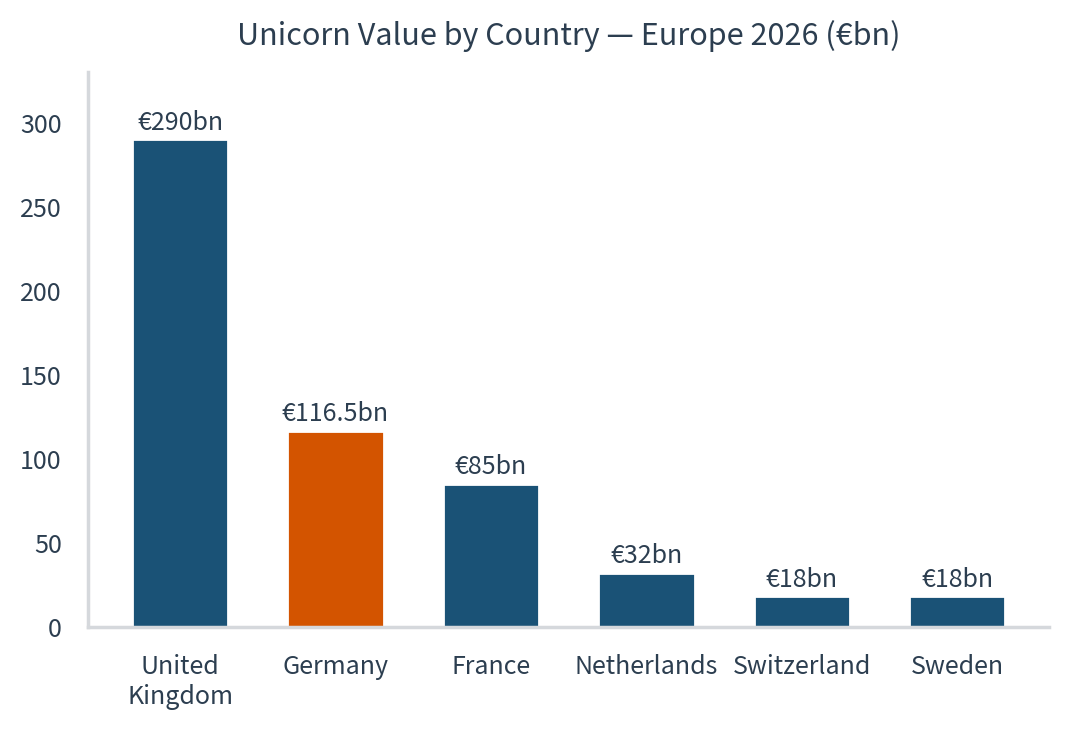
European unicorn value by country, € billion, 2026 — Source: Hurun Research Institute, Germany Unicorn Index 2026
40% of Germany's unicorns have at least one non-German founder — the country is a talent magnet. Keeping its own founders at home is the harder battle. --- |
The most striking feature of Germany's 2026 unicorn cohort is the defence technology surge. Four years after Chancellor Olaf Scholz declared the Zeitenwende — a fundamental shift in German security policy following Russia's invasion of Ukraine in February 2022 — defence technology has moved from a taboo subject to Germany's most dynamic startup sector. Helsing, valued at €16.6 billion, is now one of Europe's most valuable AI companies. STARK Defence and Quantum Systems, both founded by the same entrepreneur (Florian Seibel), entered the index simultaneously. Isar Aerospace is building rockets that will carry European satellites to space. This is not merely a sectoral trend. It is a structural transformation of the German startup ecosystem, directly catalysed by the Zeitenwende.
The AI sector is equally significant. Germany now has five pure AI unicorns — Helsing, Black Forest Labs, Parloa, DeepL, and Dash0 — with a combined value of over €25 billion. Black Forest Labs, founded in Freiburg in 2024 by the team behind Stable Diffusion, is Germany's most valuable generative AI company and proof that Europe has not lost the race in generative AI. n8n, the workflow automation platform founded by Jan Oberhauser in Berlin in 2019, went from unicorn to a €4.8 billion valuation within a year — one of the fastest re-ratings in German history — backed by OpenAI, Microsoft, NVIDIA, and Jeff Bezos.
The robotics sector has emerged as a major new category with the entry of NEURA Robotics at €6.4 billion. Headquartered in Metzingen — the same town as Hugo Boss — NEURA Robotics is Germany's most valuable robotics company, building 6,000 humanoid robots in 2026 with an order book approaching €1 billion. Combined with Agile Robots (€0.9bn), the German robotics unicorn sector is now worth €7.3 billion — a genuine industrial AI category.
The FinTech sector remains robust with 6 unicorns worth €25.7 billion, led by Trade Republic (€13.8bn) and Mambu (€4.9bn). Berlin's concentration of 18 unicorns — 49% of the national total — makes it the dominant hub, though Munich's 7 unicorns demonstrate the strength of Bavaria's SaaS and deep tech ecosystem.
Challenges remain, and this report does not flinch from them. Fewer than 5% of German unicorn founders are women. Domestic investors participate in fewer than 15% of late-stage rounds. Celonis — the country's first decacorn — has been honestly re-priced from €12.0 billion to €6.6 billion, and N26 stands at €2.8 billion against a €7.5 billion peak. No German unicorn has yet listed in Frankfurt. And the most valuable company ever built by a German-born founder — Palantir — is American. This report counts what is real, including the uncomfortable parts.
Germany's unicorn ecosystem is entering a new phase. For years, Germany was known for solid, B2B SaaS companies — Celonis, Personio, commercetools. That foundation remains strong. But what is new is the emergence of genuinely world-beating companies in AI, defence, and robotics. Helsing is competing with Anduril. Black Forest Labs is competing with OpenAI. Trade Republic is competing with Robinhood. NEURA Robotics is building Germany's answer to Tesla Optimus. These are not German champions in a protected market. These are global competitors on the world stage. The Zeitenwende has done more than change defence policy. It has changed the psychology of German entrepreneurship.
— Rupert Hoogewerf, Chairman and Chief Researcher, Hurun Research Institute
01
GLOBAL CONTEXT — GERMANY IN THE WORLD
Fifth in the world, first on the continent — and the density gap is the opportunity.
Where Germany stands in the world. Germany ranks fifth in the Hurun Global Unicorn Index 2026 with 37 unicorns worth €116.5 billion — behind the United States (806), China (381), the United Kingdom (80) and India (61), and ahead of France (36). That is 0.44 unicorns per million people — level with France, behind Switzerland, the UK and Singapore. The verdict in one sentence: Germany is the undisputed leader of continental European tech by count and value; its challenge is no longer standing, but scale. The tables that follow unpack it.
1.1 The Global Unicorn Landscape
The Hurun Global Unicorn Index 2026 identified a record 1,603 unicorns worldwide, based in 52 countries and 299 cities, with a total value of $8 trillion — up 43% driven almost entirely by the AI boom. The US (806) and China (381) together account for 74% of the world's unicorns. Germany, as the fifth-ranked country with 37, holds 2.3% of the global total — a figure that reflects both the scale of the challenge and the opportunity for growth.
Rank | Country | Unicorns | Total Value ($bn) | % of Global Count |
1 | United States | 806 | $4,800 | 50.3% |
2 | China | 381 | $1,600 | 23.8% |
3 | United Kingdom | 80 | $315 | 5.0% |
4 | India | 61 | $195 | 3.8% |
5 | Germany | 37 | $126 | 2.3% |
6 | France | 36 | $96 | 2.2% |
7 | Canada | 24 | $58 | 1.5% |
8 | Singapore | 20 | $55 | 1.2% |
9 | Israel | 17 | $72 | 1.1% |
10 | Netherlands | 11 | $42 | 0.7% |
Source: Hurun Research Institute, Global Unicorn Index 2026
The verdict: fifth of 52 countries — behind the US, China, the UK and India; ahead of everyone else on earth.
1.2 Germany's Global Standing
Germany outperforms all continental European peers — fifth globally, ahead of France (36), the Netherlands (11), Sweden (6), and Switzerland (8), and with more unicorns than those three combined. The gap underscores Germany's position as the undisputed leader of continental European deep tech.
Germany's total unicorn value of €116.5 billion exceeds that of France alone (€88bn) and is more than three times that of the Netherlands (€32bn). The gap to the top four — the US (806), China (381), the UK (80), and India (61) — is real, but Germany's trajectory is upward. The 11 new entrants in 2026 represent the largest annual cohort in German history. Germany's defence tech surge, AI acceleration, robotics breakthrough, and continued strength in B2B SaaS position it well for continued growth.
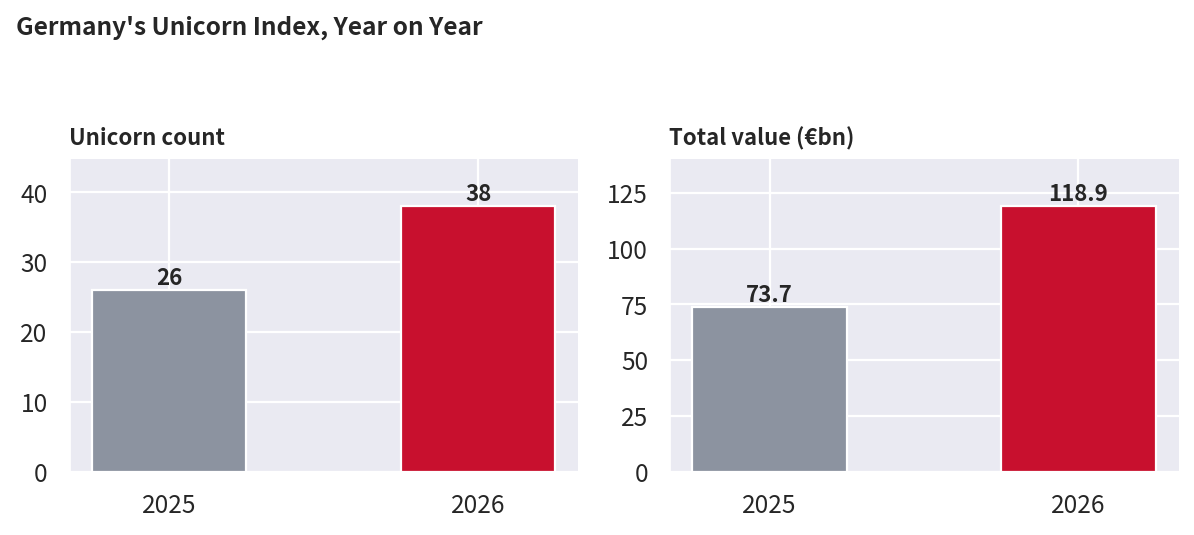
German unicorn count and total value, 2021–2026 — Source: Hurun Research Institute, Germany Unicorn Index 2026
Germany's ecosystem is characterised by quality over quantity. The average German unicorn is valued at €3.1 billion — higher than the global average of €2.9 billion ($3.1 billion). Germany has three companies valued above €5 billion (Helsing, Trade Republic, NEURA Robotics) and eleven above €2 billion. This concentration of value reflects the depth of Germany's engineering talent and the B2B focus of its startups, which tend to build sustainable revenue streams rather than pursuing rapid user acquisition.
The global unicorn landscape is dominated by the US and China. The US has 806 unicorns, China has 381, and Germany has 37. The gap is real, but Germany's story is not about catching the US. It is about becoming the undisputed leader of continental Europe — the place where deep tech, defence technology, robotics, and industrial AI are built. Germany has the universities, the manufacturing base, and now the political will. The question is whether it can convert those advantages into the capital, talent, and IPO pipeline that its unicorns need to scale.
— Rupert Hoogewerf, Chairman and Chief Researcher, Hurun Research Institute
1.3 The European Landscape
Within Europe, Germany leads the continental pack but faces intensifying competition:
Rank | Country | Unicorns | Key Sectors | Leading Companies |
1 | United Kingdom | 80 | FinTech, AI, Life Sciences | Revolut, Nscale, ElevenLabs |
2 | Germany | 37 | SaaS, FinTech, AI, Defence, Robotics | Helsing, Trade Republic, Celonis, NEURA Robotics |
3 | France | 36 | AI, Deep Tech, FinTech | Mistral AI, Dataiku, BlaBlaCar |
4 | Netherlands | 11 | FinTech, E-Commerce, SaaS | Adyen, Mollie, MessageBird |
5 | Switzerland | 8 | Biotech, FinTech, Robotics, Cyber Security, ClimateTech | SonarSource, Nexthink, Scandit, Climeworks |
6 | Sweden | 6 | FinTech, Gaming, SaaS | Epidemic Sound, Einride |
Source: Hurun Research Institute, Germany Unicorn Index 2026.
The verdict: Germany out-counts and out-values every continental rival — Europe's unicorn economy has a German centre of gravity.
Germany's advantage over France is most pronounced in B2B SaaS, defence technology, and robotics. France's ecosystem is led by Mistral AI in generative AI and a strong consumer internet presence (BlaBlaCar, Doctolib). Germany's ecosystem is more heavily weighted toward enterprise software, industrial AI, robotics, and — increasingly — defence. The two countries represent different models of European tech: France's is more consumer-facing and state-supported; Germany's is more enterprise-focused and market-driven.
The Netherlands, with 11 unicorns, punches above its weight on a per-capita basis but lacks the depth and scale of Germany's ecosystem — the Hurun Benelux Unicorn Index 2026 profiles all eleven. Switzerland has 8 unicorns spanning biotech, FinTech, robotics, and climate technology — led by SonarSource, Nexthink, Scandit, and Climeworks. The Swiss ecosystem benefits from proximity to both German and French markets, and its focus on deep tech and precision engineering mirrors Germany's own strengths. Sweden's 6 unicorns reflect the country's gaming and FinTech heritage, but its most celebrated startup — Klarna — is no longer a unicorn: it listed on the New York Stock Exchange in September 2025 at a valuation of $15.1 billion. That even Europe's most valuable fintech chose New York to go public underlines the IPO challenge examined in Section 8.
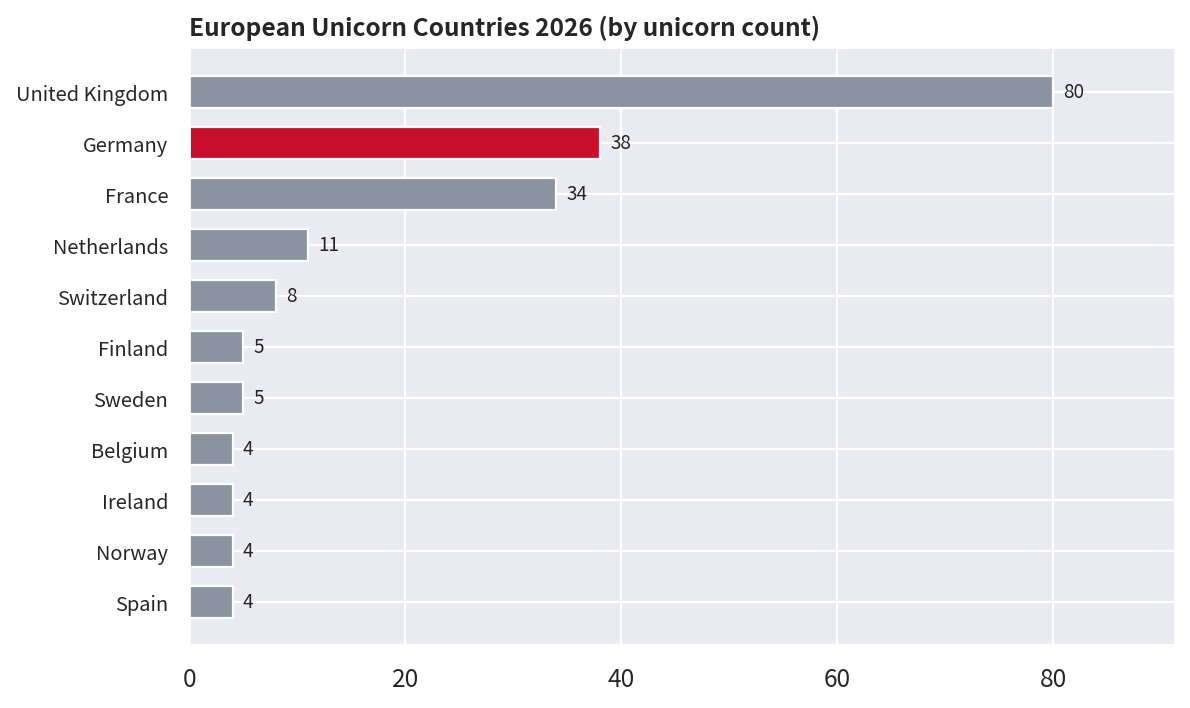
European unicorns by country, 2026 — Source: Hurun Research Institute, Germany Unicorn Index 2026
1.4 Germany vs the European Union
Germany's 37 unicorns worth €116.5 billion represent 35% of the total unicorn value in continental Europe. The UK (80 unicorns, €290bn) remains Europe's largest ecosystem by both count and value, but Germany leads the continental pack.
Country | Unicorns | Total Value (€bn) | Key Sectors | Top Company |
United Kingdom | 80 | €290bn | FinTech, AI, Life Sciences | Revolut (€53bn) |
Germany | 37 | €116.5bn | SaaS, FinTech, AI, Defence, Robotics | Helsing (€16.6bn) |
France | 36 | €88bn | AI, Deep Tech, Consumer | Mistral AI (€10bn) |
Netherlands | 11 | €32bn | FinTech, E-Commerce, SaaS | Mollie (€6bn) |
Switzerland | 8 | €18bn | Biotech, FinTech, Robotics | SonarSource |
Sweden | 6 | €18bn | FinTech, Gaming | Epidemic Sound |
Source: Hurun Research Institute, Germany Unicorn Index 2026.
The verdict: more than the Netherlands, Switzerland and Sweden combined — and still only two-fifths of Britain.
Germany's advantage over France is most pronounced in B2B SaaS, defence technology, and robotics. France's ecosystem is led by Mistral AI in generative AI and has a stronger consumer internet presence. Switzerland's 8 unicorns reflect the country's strength in biotech, FinTech, and precision robotics. Sweden's 6 unicorns no longer include Klarna, which graduated via a $15.1 billion New York IPO in September 2025 — a reminder of where Europe's best companies choose to list. The two countries represent complementary models of European tech: France's is more consumer-facing and state-supported; Germany's is more enterprise-focused and market-driven.
Switzerland has 8 unicorns spanning biotech, FinTech, robotics, and climate technology — a smaller but highly efficient ecosystem that benefits from proximity to both German and French markets. Sweden has 6 unicorns with a strong gaming and FinTech heritage, but the country has not produced a new unicorn in several years.
The value gap mirrors the count gap: Germany is the economic engine of European tech, and the distance to its continental peers is widening.
1.5 Per Capita: Level with France, Behind the UK
Absolute counts favour big countries; density per capita reveals how efficiently an ecosystem converts people into unicorns. On that measure Germany sits in the middle of the pack — the strongest large continental economy, but well behind the small, dense ecosystems.
Country | Unicorns | Population (m) | Unicorns per Million |
Singapore | 20 | 6.0 | 3.3 |
United States | 806 | 335 | 2.4 |
Israel | 17 | 9.8 | 1.7 |
United Kingdom | 80 | 69 | 1.2 |
Switzerland | 8 | 9.0 | 0.9 |
Netherlands | 11 | 18 | 0.6 |
Sweden | 6 | 10.6 | 0.6 |
France | 36 | 68 | 0.5 |
Germany | 37 | 84 | 0.44 |
Source: Hurun Research Institute, Germany Unicorn Index 2026. Populations rounded; 2026 estimates.
The verdict: Germany wins on scale, not density — per capita is the opposition's best statistic.
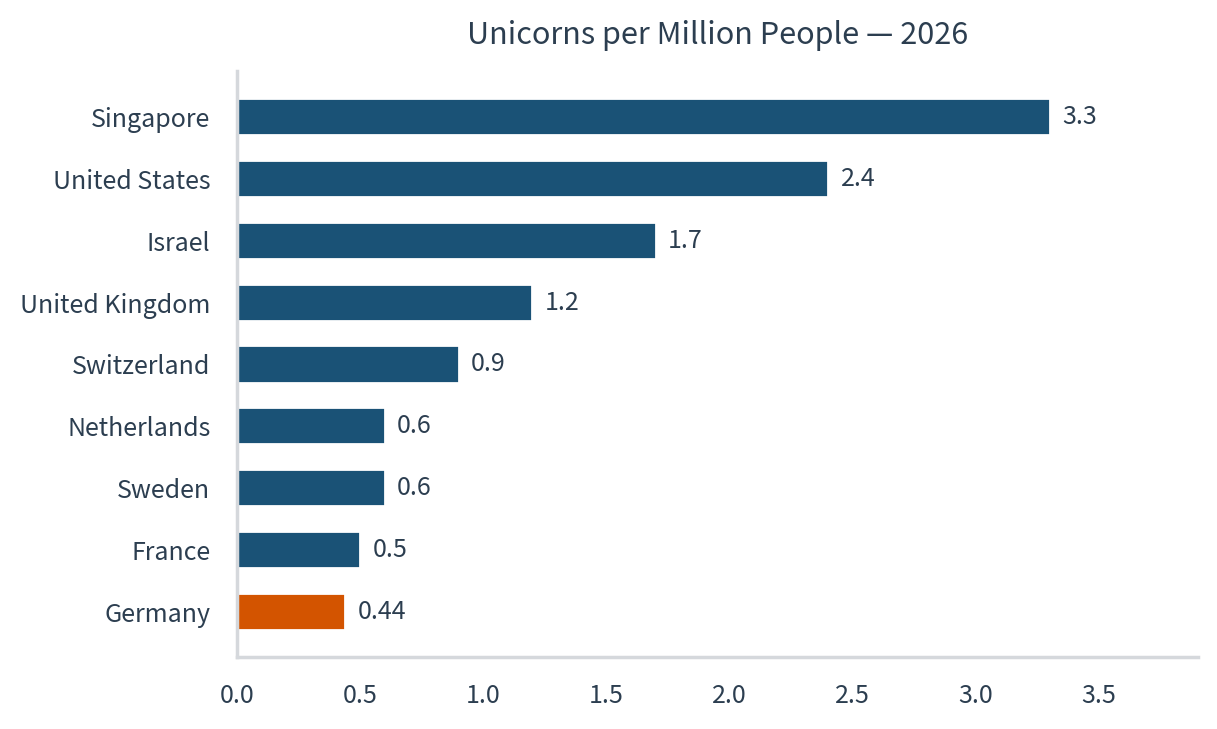
Unicorns per million people, selected countries, 2026 — Source: Hurun Research Institute, Germany Unicorn Index 2026
0.44 unicorns per million people — level with France (0.5), behind the UK (1.2) and Switzerland (0.9). Germany wins on scale, not density. --- |
1.6 Germany vs the United States: The Scale Challenge
The gap between Germany and the United States is vast and, in the near term, unbridgeable. The US has 806 unicorns — 22 times Germany's count — with a total value of €4.4 trillion — 38 times Germany's value.
This gap reflects structural differences in the two economies:
Capital Depth: The US venture capital market is 10 times larger than Germany's. American startups can raise larger rounds, from larger funds, with larger follow-on reserves. A German Series C might raise €50 million. An American Series C might raise $500 million.
Market Size: The US is a single, homogeneous market of 330 million people with a single language, single currency, and single regulatory framework. Germany is part of a fragmented European market of 450 million people with 24 languages, multiple currencies (even within the Eurozone, regulations vary), and complex cross-border compliance.
Talent Pool: The US attracts technical talent from every country in the world. Silicon Valley alone has several times more AI researchers than Germany's largest hubs. American universities produce more computer science graduates, more PhDs, and more entrepreneurs per capita than German universities.
IPO Pipeline: The US has deep, liquid public markets for high-growth technology companies. The NASDAQ and NYSE attract listings from around the world. Germany's Frankfurt Stock Exchange has made progress with its Scale and Prime Standard segments but remains far less attractive for high-growth tech listings.
But the gap is not the whole story. Germany has advantages that the US cannot replicate:
Manufacturing Depth: Germany's manufacturing base — automotive, machinery, chemicals, industrial equipment — provides a customer base and a talent pool for industrial AI, robotics, and automation that no other country can match.
Engineering Culture: Germany's apprenticeship system, technical universities, and industrial research labs produce engineers with practical skills that American universities often do not teach.
European Market Access: A German startup can serve 450 million consumers and 20 million businesses across the European single market — a market that, in aggregate, rivals the US in size and wealth.
Defence Technology: The Zeitenwende has created a defence technology opportunity in Europe that does not exist in the US, where the defence market is dominated by established contractors. European governments are actively seeking startup alternatives.
That is the strategic frame for this entire report: to compete with America and China, Germany needs hundred-billion-dollar unicorns — and ultimately a trillion-dollar one. Section 7 returns to that question — and answers it.
1.7 Germany vs China: Different Models, Different Strengths
China has 381 unicorns — 10 times Germany's count — with a total value of €1.5 trillion. The Chinese ecosystem is dominated by AI (DeepSeek, ByteDance), e-commerce (SHEIN), and FinTech (Ant Group).
Germany and China represent fundamentally different models of tech development. China's ecosystem is characterised by:
State Direction: The Chinese government actively directs capital, talent, and policy toward strategic technology sectors — AI, semiconductors, quantum computing, and biotechnology. German government intervention is more limited, though growing.
Scale: China's domestic market of 1.4 billion people provides a scale that no European country can match. A Chinese consumer app can reach 100 million users faster than a German app can reach 1 million.
Manufacturing Integration: Like Germany, China has deep manufacturing capabilities. But China's manufacturing is more tightly integrated with its tech ecosystem — companies like DJI (drones), BYD (electric vehicles), and Xiaomi (consumer electronics) blur the line between manufacturing and technology in ways that German companies have not yet achieved.
Capital Availability: Chinese startups have access to enormous pools of domestic capital, from state-backed funds, technology conglomerates, and wealthy individuals. German startups must compete for the attention of international investors.
Germany's relative strengths versus China include:
Regulatory Trust: European regulation, while sometimes burdensome, creates a trust advantage. German companies benefit from GDPR, consumer protection laws, and labour standards that create trust with European and global customers.
Deep Tech Research: Germany's basic research institutions — Max Planck, Fraunhofer, Helmholtz — are world-class and produce fundamental breakthroughs that Chinese institutions are still developing.
European Alliances: Germany's position at the centre of the European Union provides access to markets, talent, and capital across 27 countries. China has no equivalent alliance structure.
1.8 The European Unicorn Cities: Berlin vs Paris vs London
Among European cities, London remains the dominant unicorn hub with 60 unicorns. Paris ranks second with 32 unicorns — 89% of all French unicorns in one city — ahead of Berlin with 18. Amsterdam and Munich are joint fourth with 7 unicorns each.
Rank | City | Unicorns | Total Value (€bn) | Key Strengths |
1 | London | 60 | €200bn | FinTech, AI, Life Sciences |
2 | Paris | 32 | €79bn | AI, Consumer, Deep Tech |
3 | Berlin | 18 | €67bn | FinTech, AI, SaaS, Defence |
4 | Amsterdam | 7 | €28bn | FinTech, E-Commerce |
4 | Munich | 7 | €22bn | SaaS, Enterprise Software, Robotics |
Source: Hurun Research Institute, Germany Unicorn Index 2026.
The verdict: London and Paris lead on count; Berlin leads the continent on value per unicorn.
Berlin's position as the third-largest unicorn city in Europe — behind London and Paris — is a remarkable achievement for a city that, 30 years ago, was divided by the Wall and economically depressed. Paris now leads on count (32) and concentration; Berlin counters with value per unicorn — an average of €3.7 billion against Paris's €2.5 billion — and Germany counters with breadth: thirteen unicorn cities against France's five.
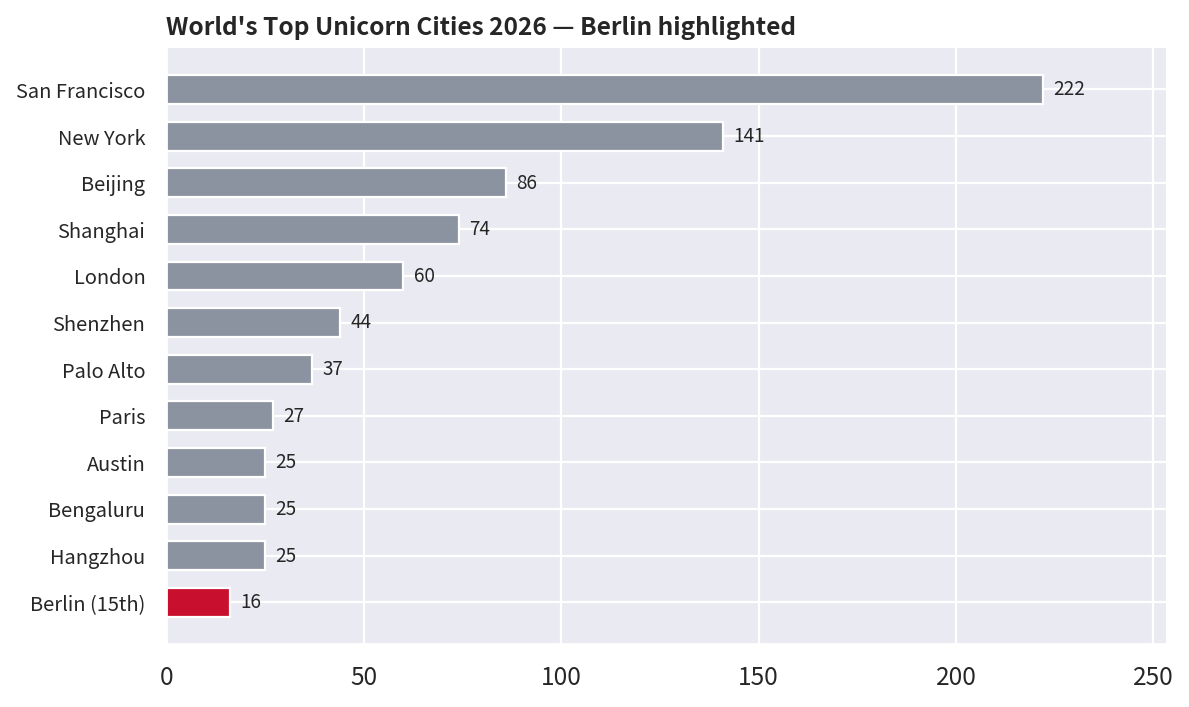
The world's leading unicorn cities, 2026 — Source: Hurun Research Institute, Germany Unicorn Index 2026
Paris has pulled ahead on count, powered by deliberate state investment through La French Tech, the French Tech Visa, and Bpifrance (the public investment bank). Mistral AI, France's generative AI champion, is valued at €11.7 billion — more than Black Forest Labs and DeepL combined, twice over. The competition between Berlin and Paris for the title of continental Europe's unicorn capital will intensify in the coming years.
1.9 The US Opportunity and Threat: Capital, Talent, and Control
American capital has been the primary driver of German unicorn growth. The most active investors in German unicorns — Sequoia, Accel, Lightspeed, General Catalyst, Founders Fund — are all American. Their participation brings not just capital but validation, network effects, and access to the world's largest technology market.
The US opportunity for German startups is genuine. American investors bring:
Larger Check Sizes: American funds can write larger checks at later stages, enabling German companies to scale faster than they could with European capital alone.
Global Networks: American VC firms have portfolios that span the world's largest technology companies. A German startup backed by Sequoia gains access to Sequoia's network of founders, executives, and partners.
US Market Access: American investors often help their portfolio companies enter the US market — the world's largest and most lucrative technology market. For German SaaS and AI companies, US market entry is often critical to achieving unicorn scale.
Valuation Benchmarks: American funding rounds set valuation benchmarks that European rounds often cannot match. A German company that raises from Sequoia at a $5 billion valuation may be able to raise its next round at $10 billion — a trajectory that might be impossible with only European investors.
But American involvement in the German ecosystem is not without risks — and the threats are the mirror image of the opportunities.
But American involvement in the German ecosystem is not without risks.
Talent Drain: American technology companies — Google, Microsoft, Meta, OpenAI, NVIDIA — are aggressively recruiting German AI talent. Salaries in Silicon Valley for AI researchers are 3-5x higher than in Berlin or Munich. German AI PhDs who might have founded the next Helsing or Black Forest Labs are instead moving to Palo Alto and San Francisco.
Acquisition Drain: American companies have acquired multiple German technology companies in recent years — some at valuations below their potential, others simply to acquire talent and technology. The risk is that Germany's most promising startups are acquired by American giants before they can become independent global champions.
Governance Pressure: American investors often demand governance structures — board control, veto rights, liquidation preferences — that favour American interests over German ones. The risk is that German startups become, in effect, American companies with German offices.
Market Prioritisation: American investors often pressure portfolio companies to prioritise the US market over European markets. The risk is that German startups become American companies that happen to have been founded in Germany.
1.10 The China Challenge: Competition and Capital
Chinese investment in German technology has declined significantly in recent years due to geopolitical tensions, regulatory scrutiny (particularly around the EU's investment screening framework), and Germany's own increasingly cautious approach to Chinese technology partnerships.
This decline is a mixed blessing. On the one hand, reduced Chinese investment means reduced access to one of the world's largest capital pools. On the other hand, it reduces the risk of technology transfer, intellectual property concerns, and geopolitical dependency that have troubled German policymakers.
The more significant China challenge is competition. Chinese companies — particularly in AI, electric vehicles, and robotics — are scaling rapidly and entering European markets. DeepSeek, the Chinese AI company that entered the global unicorn list at $50 billion, demonstrates that Chinese AI can compete at the highest global level. BYD and other Chinese EV manufacturers are gaining market share in Germany. The risk is not that China invests in German startups. The risk is that Chinese companies outcompete German startups in their own markets.
1.11 GDPR and Innovation: The Regulatory Balance
Germany's position at the forefront of European data protection regulation — GDPR was heavily influenced by German privacy law — creates both opportunities and challenges for the startup ecosystem.
The Opportunity: GDPR has created a "trust advantage" for German companies. In a world of increasing concern about data privacy, German companies benefit from a reputation for responsible data handling. This is particularly valuable in enterprise SaaS, where data security is a primary purchasing criterion.
The Challenge: GDPR compliance adds cost, complexity, and friction to startup operations. Product development must include privacy-by-design. Data processing agreements must be negotiated with every customer. Cross-border data transfers require legal review. For early-stage startups with limited resources, these requirements can be burdensome.
The question for German policymakers is whether GDPR can be enforced in a way that protects privacy without stifling innovation. The current balance appears broadly correct — German startups have not been prevented from achieving unicorn status by GDPR. But as AI companies increasingly depend on large-scale data processing, the regulatory framework will need to evolve.
So Germany stands fifth in the world, first on the continent. What it actually builds is Section 2.
SECTION 2: THE GERMAN UNICORNS
The following table lists Germany's most valuable unicorns — the crown jewels of the German startup ecosystem — followed by the complete 2026 ranking of all 37. Together the crown jewels account for over €70 billion in value, 61% of the entire German unicorn total. The story of each of the 37 companies — its founders, its technology, and what it reveals about the German ecosystem — is told in Appendix A.
Rank | Company | Valuation (€bn) | Sector | City | Founded |
1 | Helsing | €16.6bn | AI/Defence | Berlin | 2021 |
2 | Trade Republic | €13.8bn | Discount Broking | Berlin | 2015 |
3 | Personio | €7.8bn | HR | Munich | 2015 |
4 | Celonis | €6.6bn | Process Mining | Munich | 2011 |
5 | NEURA Robotics | €6.4bn | Cognitive/Humanoid Robotics | Metzingen | 2019 |
6 | Mambu | €4.9bn | Banking | Berlin | 2011 |
7 | n8n | €4.8bn | Workflow Automation | Berlin | 2019 |
8 | STARK Defence | €3.4bn | Defence Technology | Berlin | 2024 |
9 | Quantum Systems | €3.2bn | UAS/Drones | Gilching | 2015 |
10 | Black Forest Labs | €3.0bn | Generative AI | Freiburg im Breisgau | 2024 |
10 | Flix | €3.0bn | Booking/Travel | Munich | 2011 |
Source: Hurun Research Institute, Germany Unicorn Index 2026.
The verdict: two decacorns and a €3 billion traffic jam at rank 10 — the top of the German list has never been this dense.
The Complete 2026 Ranking
The complete 2026 ranking of all 37 German unicorns — by valuation, city, sector, and year founded — follows. Joint rankings are indicated where companies share the same valuation.
Rank | Company | Valuation (€bn) | Valuation ($bn) | City | Sector | Founded | Change |
1 | Helsing | €16.6bn | $18.0bn | Berlin | AI/Defence | 2021 | +€11.6bn |
2 | Trade Republic | €13.8bn | $15.0bn | Berlin | Discount Broking | 2015 | +€8.7bn |
3 | Personio | €7.8bn | $8.5bn | Munich | HR | 2015 | Unchanged |
4 | Celonis | €6.6bn | $7.2bn | Munich | Process Mining | 2011 | -€5.3bn |
5 | NEURA Robotics | €6.4bn | $7.0bn | Metzingen | Cognitive/Humanoid Robotics | 2019 | New |
6 | Mambu | €4.9bn | $5.3bn | Berlin | Banking | 2011 | -€0.1bn |
7 | n8n | €4.8bn | $5.2bn | Berlin | Workflow Automation | 2019 | New |
8 | STARK Defence | €3.4bn | $3.65bn | Berlin | Defence Technology | 2024 | New |
9 | Quantum Systems | €3.2bn | $3.5bn | Gilching | UAS/Drones | 2015 | New |
10 | Black Forest Labs | €3.0bn | $3.3bn | Freiburg im Breisgau | Generative AI | 2024 | New |
10 | Flix | €3.0bn | $3.3bn | Munich | Booking/Travel | 2011 | Unchanged |
12 | Contentful | €2.8bn | $3.0bn | Berlin | Content Platform | 2013 | Unchanged |
12 | N26 | €2.8bn | $3.0bn | Berlin | Challenger Bank | 2013 | -€2.4bn |
12 | Parloa | €2.8bn | $3.0bn | Berlin | Conversational AI | 2020 | New |
12 | Worldcoin | €2.8bn | $3.0bn | Erlangen | Crypto/Identity | 2019 | Unchanged |
16 | Autodoc | €2.4bn | $2.6bn | Berlin | Auto Parts E-Commerce | 2008 | Unchanged |
17 | Enpal | €2.3bn | $2.5bn | Berlin | Solar Leasing | 2017 | Unchanged |
18 | 1Komma5 | €2.2bn | $2.4bn | Hamburg | Renewable Energy | 2021 | Unchanged |
19 | Raisin | €2.0bn | $2.2bn | Hamburg | Savings Marketplace | 2012 | +€1.0bn |
20 | Forto | €1.9bn | $2.1bn | Berlin | Logistics Platform | 2016 | Unchanged |
20 | Isar Aerospace | €1.9bn | $2.1bn | Ottobrunn | Rockets | 2018 | New |
20 | Sennder | €1.9bn | $2.1bn | Berlin | Digital Freight | 2015 | Unchanged |
23 | DeepL | €1.8bn | $2.0bn | Cologne | Translation | 2017 | Unchanged |
23 | GetYourGuide | €1.8bn | $2.0bn | Berlin | Travel Experiences | 2009 | Unchanged |
25 | commercetools | €1.7bn | $1.9bn | Munich | Cloud Commerce | 2010 | Unchanged |
26 | Scalable Capital | €1.3bn | $1.4bn | Munich | Asset Management | 2014 | Unchanged |
27 | Choco | €1.1bn | $1.2bn | Berlin | Supply Chain | 2018 | -€0.1bn |
28 | Amboss | €1.0bn | $1.1bn | Berlin | Medical Knowledge | 2012 | Unchanged |
28 | CMBlu Energy | €1.0bn | $1.1bn | Alzenau | Non-Lithium Batteries | 2014 | New |
28 | FINN | €1.0bn | $1.1bn | Munich | Car Subscription | 2019 | New |
28 | Osapiens | €1.0bn | $1.1bn | Mannheim | ESG/Compliance | 2014 | New |
28 | Staffbase | €1.0bn | $1.1bn | Chemnitz | Internal Communications | 2014 | Unchanged |
33 | Agile Robots | €0.9bn | $1.0bn | Munich | Industrial Automation | 2018 | Unchanged |
33 | Dash0 | €0.9bn | $1.0bn | Solingen | AI Observability/Agent0 | 2023 | New |
33 | Omio | €0.9bn | $1.0bn | Berlin | Travel Booking | 2013 | Unchanged |
33 | OneFootball | €0.9bn | $1.0bn | Berlin | Football Content | 2008 | Unchanged |
33 | Taxfix | €0.9bn | $1.0bn | Berlin | Tax Filing | 2016 | Unchanged |
Source: Hurun Research Institute, Germany Unicorn Index 2026.
The verdict: read the Change column — eleven new faces are the year's story.
The Movers of 2026 — Risers, New Faces and Drops
Eleven German unicorns added significant value over the past year — and two of the country's most celebrated companies were re-priced downward, honestly, in full view of the market. The risers are ranked by value added; the eleven new faces — the largest cohort in German history — follow; and the drops are examined without flinching, because an index that cannot say "this was overpriced" is not a ranking — it is marketing.
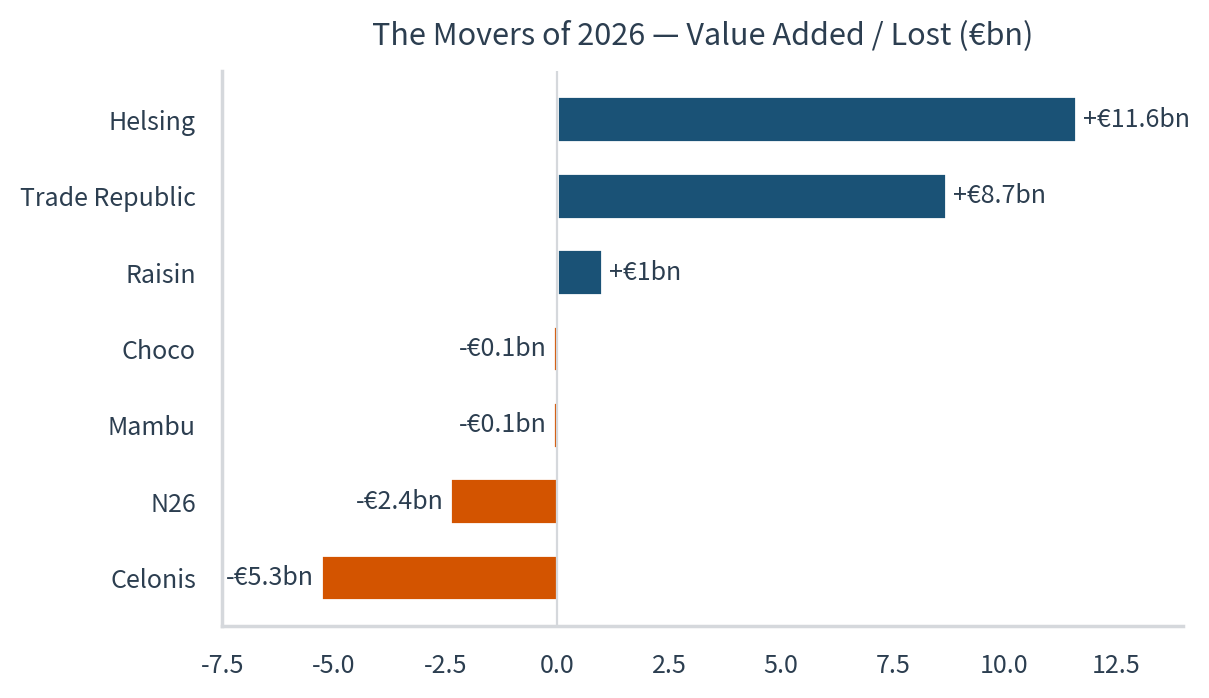
The movers of 2026 — value added and re-priced, € billion — Source: Hurun Research Institute, Germany Unicorn Index 2026
The risers.
Rank | Company | Value Added (€bn) | Valuation (€bn) | Sector | Years to Unicorn |
1 | Helsing | +€11.6bn | €16.6bn | AI/Defence | 5 years |
2 | Trade Republic | +€8.7bn | €13.8bn | FinTech | 5 years |
3 | Raisin | +€1.0bn | €2.0bn | FinTech | 7 years |
Source: Hurun Research Institute, Germany Unicorn Index 2026.
The verdict: €21.3 billion of new value in three companies — the year's risers are defence AI and retail investing.
Helsing's €11.6 billion increase — €1.6bn (2024) to €5.0bn (2025) to €16.6bn (2026) — is the largest absolute rise ever recorded for a German unicorn (profile: Story A1). Trade Republic's €8.7 billion reflects the maturation of European retail investing (Story A2); Raisin's €1.0 billion is methodical, regulated compounding (Story A19).
Helsing's €11.6 billion increase in value is not just a number. It is a signal that the market believes European defence technology is a genuine investment category — not a policy footnote. For decades, European venture capital avoided defence technology. The returns were uncertain, the ethics were complicated, and the governments were not serious buyers. The Zeitenwende has changed all three. Helsing has proven that defence technology can generate venture-scale returns, that ethical AI in defence is possible, and that European governments are now serious customers. That is worth €11.6 billion — and counting.
— Rupert Hoogewerf, Chairman and Chief Researcher, Hurun Research Institute
The new faces.
Rank | Company | Valuation (€bn) | Sector | City | Founded | Time to Unicorn | Key Investors |
1 | NEURA Robotics | €6.4bn | Cognitive/Humanoid Robotics | Metzingen | 2019 | 7 years | Tether, Qualcomm, Amazon, NVIDIA, Bosch, EIB |
2 | n8n | €4.8bn | Workflow Automation | Berlin | 2019 | 6 years | OpenAI, Microsoft, NVIDIA, Bezos Expeditions, Intel Capital |
3 | STARK Defence | €3.4bn | Defence Technology | Berlin | 2024 | 0 years (born unicorn) | Sequoia, Founders Fund, NATO Innovation Fund |
4 | Quantum Systems | €3.2bn | UAS/Drones | Gilching | 2015 | 11 years | Accel, Founders Fund, Kleiner Perkins |
5 | Black Forest Labs | €3.0bn | Generative AI | Freiburg im Breisgau | 2024 | 2 years | a16z, General Catalyst, Lightspeed, M12 |
6 | Parloa | €2.8bn | Conversational AI | Berlin | 2020 | 6 years | B Capital Group |
7 | Isar Aerospace | €1.9bn | Rockets | Ottobrunn | 2018 | 8 years | Earlybird, HV Capital |
8 | Osapiens | €1.0bn | ESG/Compliance | Mannheim | 2014 | 12 years | Decarbonization Partners, Goldman Sachs |
9 | FINN | €1.0bn | Car Subscription | Munich | 2019 | 7 years | Portage, UVC Partners, BC Partners Credit |
10 | CMBlu Energy | €1.0bn | Non-Lithium Batteries | Alzenau | 2014 | 12 years | Samsung Ventures, STRABAG |
11 | Dash0 | €0.9bn | AI Observability/Agent0 | Solingen | 2023 | 1 year | Balderton Capital, Accel, Cherry Ventures, DTCP |
Source: Hurun Research Institute, Germany Unicorn Index 2026.
The verdict: eleven new faces worth €29.4 billion — one new German unicorn every five weeks, the fastest rate of any continental European country.
Every tempo now has a German proof point: STARK Defence was valued above $1 billion from inception — a zero-year unicorn, and the NATO Innovation Fund's first-ever unicorn-level startup investment; n8n went from unicorn to €4.8 billion within a year; Dash0 set the all-time German founding-to-unicorn speed record at three years; Quantum Systems took eleven — patient engineering vindicated by Zeitenwende procurement. (Profiles: Stories A5, A7, A8, A9, A11, A14, A21, A29–A31, A34.)
The drops.
Rank | Company | Value Lost (€bn) | Valuation (€bn) | Sector | Reason |
1 | Celonis | -€5.3bn | €6.6bn | SaaS | Market correction, increased competition |
3 | N26 | -€2.4bn | €2.8bn | FinTech | Profitability challenges, regulatory headwinds |
3 | Mambu | -€0.1bn | €4.9bn | FinTech | Slight market correction |
3 | Choco | -€0.1bn | €1.1bn | Food & Beverages | Minor market adjustment |
Source: Hurun Research Institute, Germany Unicorn Index 2026.
The verdict: €7.9 billion re-priced out, honestly — the great re-pricing applied to our own backyard.
Celonis's €5.3 billion decline — from €12.0 billion to €6.6 billion — is the largest absolute drop in the German index: a repricing of enterprise software, not a collapse. The company employs over 2,500 people and serves hundreds of the world's largest companies; the lesson is that valuation is not value (Story A4). N26's fall from a €7.5 billion peak to €2.8 billion reflects BaFin's growth restrictions (lifted in 2024), elusive profitability, and the superior execution of Revolut, Monzo and the incumbent banks (Story A13).
The Zeitenwende effect. Three of the eleven new faces — and the year's biggest riser — trace back to February 2022, when Chancellor Olaf Scholz declared the Zeitenwende and Germany committed €100 billion to defence modernisation. Defence technology, a venture taboo for decades, is now Germany's fastest-growing unicorn sector: four defence unicorns worth €25.1 billion, NATO's venture fund investing directly, and Sequoia backing European defence for the first time. Section 3.5 examines the sector; Appendix A tells the company stories.
Ones to watch. The pipeline behind this year's eleven is the deepest in Europe. Proxima Fusion (Munich) raised €411 million at a €2.4 billion valuation in July 2026 — confirmed after this edition's master data was locked, and flagged for inclusion in the 2027 edition. Examined and excluded on the latest public evidence: Flink (below the threshold), wefox (last public mark dates from 2022 and is treated as stale), and Solaris, Grover and Razor Group (each below the US$1 billion bar). Behind it sit the fusion, defence-AI and industrial-software cohorts that the WIN Initiative and the Deep Tech & Climate Fonds were built to scale.
What this means for you. --- For founders: every tempo now has a German proof point — born-unicorn (STARK), one-year (n8n), three-year (Dash0), eleven-year (Quantum Systems). Pick your clock. For investors: the risers are priced on contracts and revenue; the re-priced names (Celonis, N26) are the entry points. For policymakers: defence procurement at startup speed minted four unicorns in four years — procurement speed is industrial policy. |
So Germany can build champions — eleven new ones in a single year. What they build is Section 3.
03
SECTOR ANALYSIS
Deep tech, not deep hype: four sectors hold 72% of the value.
The 37 German unicorns span 15 sectors, but concentration is significant. SaaS, FinTech, AI, and Robotics together account for 19 companies and over €83 billion in value — 72% of the total German unicorn valuation. The following analysis examines each major sector in depth.
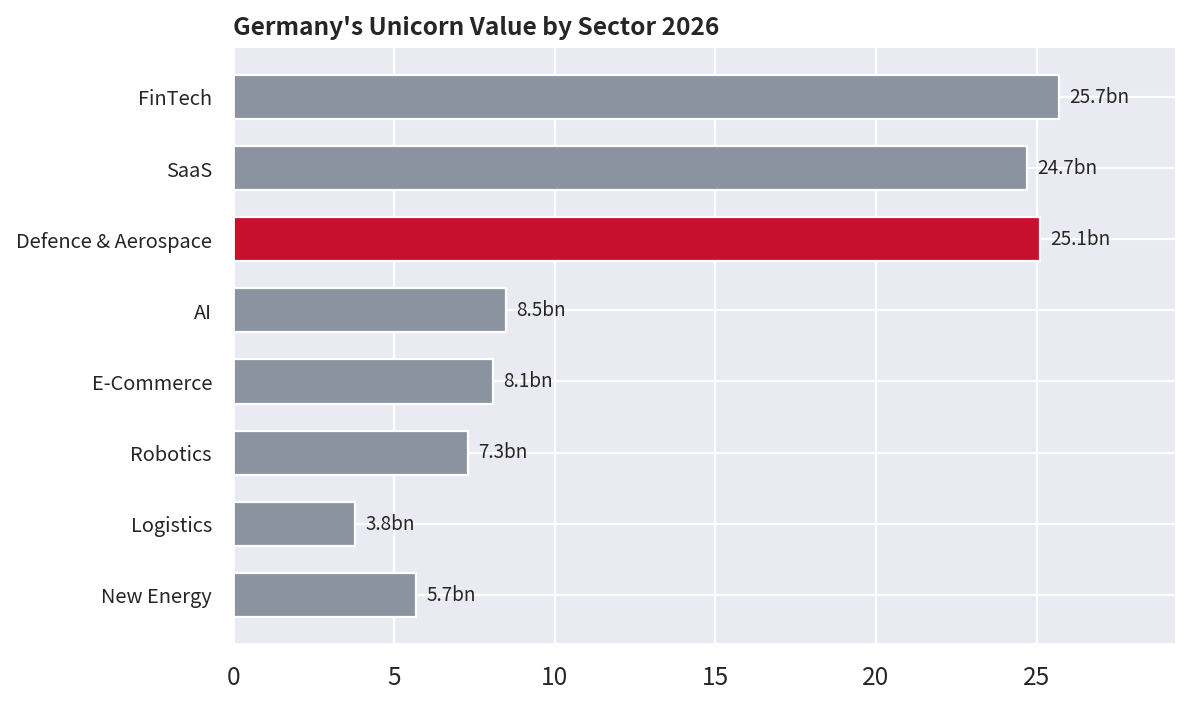
German unicorns by sector, 2026 — Source: Hurun Research Institute, Germany Unicorn Index 2026
Rank | Sector | Count | Total Value (€bn) | % of Total | Key Companies |
1 | FinTech | 6 | €25.7bn | 22.1% | Trade Republic, Mambu, N26 |
2 | SaaS | 6 | €24.7bn | 21.2% | Personio, Celonis, n8n |
3 | Defence & Aerospace | 4 | €25.1bn | 21.5% | Helsing, STARK Defence, Quantum Systems, Isar Aerospace |
4 | AI | 4 | €8.5bn | 7.3% | Black Forest Labs, Parloa, DeepL, Dash0 |
5 | E-Commerce | 4 | €8.1bn | 7.0% | Flix, Autodoc, GetYourGuide |
6 | Robotics | 2 | €7.3bn | 6.3% | NEURA Robotics, Agile Robots |
7 | Logistics | 2 | €3.8bn | 3.3% | Sennder, Forto |
8 | New Energy | 2 | €3.3bn | 2.8% | Enpal, CMBlu Energy |
9 | Blockchain | 1 | €2.8bn | 2.4% | Worldcoin |
10 | ClimateTech | 1 | €2.2bn | 1.9% | 1Komma5 |
11 | Food & Beverages | 1 | €1.1bn | 0.9% | Choco |
12 | Telecommunications | 1 | €1.0bn | 0.9% | Staffbase |
13 | Life Sciences | 1 | €1.0bn | 0.9% | Amboss |
14 | Mobility | 1 | €1.0bn | 0.9% | FINN |
15 | Media | 1 | €0.9bn | 0.8% | OneFootball |
Source: Hurun Research Institute, Germany Unicorn Index 2026.
The verdict: four sectors hold 72% of the value — Germany's unicorn economy is deep tech, not consumer hype.
3.1 SaaS: Germany's Enterprise Software Engine
With 6 unicorns worth €24.7 billion, SaaS is Germany's second-most-valuable sector by unicorn count and total valuation. The sector is led by Personio (€7.8bn), Celonis (€6.6bn), n8n (€4.8bn), Contentful (€2.8bn), commercetools (€1.7bn), and Osapiens (€1.0bn).
6 unicorns | €24.7 billion total value
Company | Valuation (€bn) | Sub-sector | Founded |
Personio | €7.8bn | HR platform | 2015 |
Celonis | €6.6bn | Process mining | 2011 |
n8n | €4.8bn | Workflow automation | 2019 |
Contentful | €2.8bn | Content platform | 2013 |
commercetools | €1.7bn | Cloud commerce | 2010 |
Osapiens | €1.0bn | ESG/compliance | 2014 |
Source: Hurun Research Institute, Germany Unicorn Index 2026.
The verdict: the operating systems of European business — unglamorous, durable, and the talent base for everything else.
Germany's SaaS strength is no accident. The country is home to SAP — the world's largest enterprise software company — and has a deep pool of engineering talent trained in B2B software development. The German Mittelstand (small and medium-sized enterprises) provides a vast customer base for SaaS companies, and the country's manufacturing heritage has created a culture of building tools that solve real operational problems.
Personio (Munich, 2015) and Celonis (Munich, 2011) represent the first wave of German SaaS unicorns — companies that identified genuine market needs, built products that worked, and scaled methodically over many years. Both are headquartered in Munich, reflecting Bavaria's strength as a SaaS hub.
n8n (Berlin, 2019) represents the new wave — an open-source, AI-powered workflow automation platform that has achieved global scale in record time. Its €4.8 billion valuation and blue-chip investor roster signal that German SaaS is evolving from steady, B2B tools to globally competitive infrastructure platforms.
Contentful (Berlin) provides headless content management systems for enterprise websites and applications — a category that has grown explosively as companies seek to deliver content across multiple digital channels. commercetools (Munich) provides cloud-native commerce platforms for enterprise retailers. Osapiens (Mannheim) provides ESG compliance software — a category created by European regulation.
The geographic distribution of German SaaS unicorns is notable: three in Munich (Personio, Celonis, commercetools), three in Berlin (n8n, Contentful, plus others), and one in Mannheim (Osapiens). This reflects the dual-hub nature of German tech — Munich for enterprise SaaS rooted in manufacturing and Bavarian engineering culture, Berlin for developer tools and platforms rooted in the city's creative and startup culture.
3.2 FinTech: Berlin as Europe's Financial Innovation Hub
With 6 unicorns worth €25.7 billion, FinTech is Germany's largest sector by total value and a crucial component of the ecosystem. The sector is led by Trade Republic (€13.8bn), Mambu (€4.9bn), N26 (€2.8bn), Raisin (€2.0bn), Scalable Capital (€1.3bn), and Taxfix (€0.9bn).
6 unicorns | €25.7 billion total value
Company | Valuation (€bn) | Sub-sector | Founded |
Trade Republic | €13.8bn | Discount broking | 2015 |
Mambu | €4.9bn | Banking infrastructure | 2011 |
N26 | €2.8bn | Challenger bank | 2013 |
Raisin | €2.0bn | Savings marketplace | 2012 |
Scalable Capital | €1.3bn | Asset management | 2014 |
Taxfix | €0.9bn | Tax filing | 2016 |
Source: Hurun Research Institute, Germany Unicorn Index 2026.
The verdict: Berlin is the fintech capital of continental Europe by value — four of the six live there, led by Trade Republic.
Berlin is the undisputed capital of German FinTech. Four of the six FinTech unicorns are headquartered in Berlin (the exceptions are Raisin in Hamburg and Scalable Capital in Munich), reflecting the city's status as Europe's most dynamic financial innovation hub after London. Berlin's combination of regulatory openness, technical talent, and relatively low cost of living has made it the natural base for companies seeking to disrupt European financial services.
Trade Republic (€13.8bn) and N26 (€2.8bn) represent the consumer-facing side of German FinTech — companies that have acquired millions of retail customers by offering better user experiences than traditional banks. Mambu (€4.9bn) represents the infrastructure side — the platform that powers other FinTech companies. Raisin (€2.0bn) provides savings marketplace technology, connecting retail depositors with banks across Europe. Scalable Capital (€1.3bn) provides digital wealth management. Taxfix (€0.9bn) automates personal tax filing.
The sector's diversity — from brokerage to banking to wealth management to tax — reflects the breadth of opportunity in European financial services. European consumers and businesses remain significantly underbanked and underserved by digital financial tools compared to their American and Asian counterparts. The market opportunity is measured in the hundreds of billions of euros.
Risers: Trade Republic (+€8.7bn), Raisin (+€1.0bn). Drops: N26 (-€2.4bn), Mambu (-€0.1bn). New entrants: None in pure FinTech this year, but Trade Republic's rise more than compensates.
3.3 AI: Germany's Emerging Strength
With 5 pure AI unicorns worth €25.1 billion, AI is Germany's second-largest sector by value — and its fastest-growing. The sector is led by Helsing (€16.6bn), Black Forest Labs (€3.0bn), Parloa (€2.8bn), DeepL (€1.8bn), and Dash0 (€0.9bn).
5 unicorns | €25.1 billion total value
Company | Valuation (€bn) | Sub-sector | Founded |
Helsing ‡ | €16.6bn | Defence AI | 2021 |
Black Forest Labs | €3.0bn | Generative AI | 2024 |
Parloa | €2.8bn | Conversational AI | 2020 |
DeepL | €1.8bn | Translation | 2017 |
Dash0 | €0.9bn | AI observability | 2023 |
Source: Hurun Research Institute, Germany Unicorn Index 2026.
The verdict: five companies, five different AIs — Germany's AI bet is diversified, not concentrated.
Germany's AI unicorn cohort is remarkable for its diversity. Helsing applies AI to defence — battlefield intelligence, autonomous systems, and sensor fusion. Black Forest Labs applies AI to creative media — generative video, image synthesis, and content production. Parloa applies AI to customer service — conversational interfaces, chatbots, and voice automation. DeepL applies AI to language — machine translation that rivals and often exceeds Google Translate in quality. Dash0 applies AI to software operations — autonomous detection and resolution of production issues.
This diversity reflects Germany's deep AI research base. The country is home to world-class AI research institutions, including the Max Planck Institute for Intelligent Systems, the German Research Center for Artificial Intelligence (DFKI), and AI research groups at Technical University of Munich, Ludwig Maximilian University, and Humboldt University of Berlin. The team behind Black Forest Labs emerged from LMU Munich. DeepL was built by researchers from the University of Cologne. Helsing's founders have backgrounds in AI research and defence policy. Dash0's founders are experienced engineers from the DevOps and observability world.
The investor interest in German AI is unprecedented. n8n's funding round included OpenAI, Microsoft, NVIDIA, and Bezos Expeditions. Black Forest Labs is backed by a16z, General Catalyst, and Lightspeed. Dash0 is backed by Balderton Capital and Accel. Helsing counts Prima Materia and General Catalyst among its investors. This is not regional capital. This is the world's most prestigious technology investors betting on German AI founders.
As EURACTIV Germany reported in November 2023, AI researchers such as Bernhard Schölkopf have framed sovereign AI as an existential question for Germany — whether the country will take the technology seriously enough to play a meaningful role in its development. The 2026 unicorn index suggests that Germany is, indeed, beginning to play that role.
Beyond the five pure AI companies, a significant number of German unicorns are implementing AI in their core products. Celonis uses AI for process intelligence. Personio uses AI for HR analytics. Trade Republic uses AI for trading algorithms and risk management. Contentful is integrating AI for content generation. NEURA Robotics is building cognitive robots. In total, half of Germany's unicorns are AI-related in some form.
Germany's AI sector is the most exciting story in European technology right now. Five unicorns worth €25.1 billion — and that is just the beginning. Helsing is competing with Anduril. Black Forest Labs is competing with OpenAI. DeepL is competing with Google Translate. Parloa is competing with every customer service automation company in the world. Dash0 is building the AI infrastructure that will power the next generation of software operations. These are not German champions in a protected market. These are global competitors. And they are attracting capital from the most prestigious investors in the world. The question is no longer whether Germany can build AI unicorns. The question is how many more it can build.
— Rupert Hoogewerf, Chairman and Chief Researcher, Hurun Research Institute
3.4 Robotics: Germany's Physical AI Revolution
With 2 unicorns worth €7.3 billion, Robotics has emerged as a major new sector in the German unicorn index. The sector is led by NEURA Robotics (€6.4bn) and Agile Robots (€0.9bn).
2 unicorns | €7.3 billion total value
Company | Valuation (€bn) | Sub-sector | Founded |
NEURA Robotics | €6.4bn | Cognitive/humanoid robotics | 2019 |
Agile Robots | €0.9bn | Industrial automation | 2018 |
Source: Hurun Research Institute, Germany Unicorn Index 2026.
The verdict: a €7.3 billion physical-AI sector headquartered in a factory town — the German model in one line.
This is a watershed moment for German robotics. For decades, Germany has been the world's leading industrial robot manufacturer — but the value has accrued to incumbents like KUKA (now Chinese-owned), ABB, and Fanuc. NEURA Robotics represents a new model: a German startup building cognitive, AI-powered humanoid robots that can work alongside humans, not just in cages on factory floors.
NEURA Robotics is building 6,000 humanoid robots in 2026, with a target of 10,000 by 2027. Its MAiRA cobot is the world's first commercially viable cognitive collaborative robot. The company has an order book approaching €1 billion and partnerships with Kawasaki, Delta Electronics, and Omron. Headquartered in Metzingen — the same town as Hugo Boss — NEURA Robotics has 1,200+ employees and a $1.4 billion Series C from Tether, Qualcomm, Amazon, NVIDIA, Bosch, and the EIB.
Agile Robots (Munich, €0.9bn) develops intelligent robotic systems for manufacturing and logistics, using AI-powered vision and control to adapt to dynamic environments.
Together, these two companies represent a €7.3 billion robotics sector that positions Germany as the European leader in physical AI — the application of artificial intelligence to machines that move, manipulate, and interact with the physical world.
3.5 Aerospace & Defence: The Zeitenwende Effect
With 3 unicorns worth €6.6 billion (excluding Helsing's €16.6bn, which is counted under AI/Defence), Aerospace & Defence is Germany's most politically significant sector. The sector is led by STARK Defence (€3.4bn), Quantum Systems (€3.2bn), and Isar Aerospace (€1.9bn).
3 unicorns | €8.5 billion total value (excluding Helsing's €16.6bn, counted under AI/Defence)
Company | Valuation (€bn) | Sub-sector | Founded |
STARK Defence | €3.4bn | Autonomous defence systems | 2024 |
Quantum Systems | €3.2bn | UAS/drones | 2015 |
Isar Aerospace | €1.9bn | Rockets | 2018 |
Source: Hurun Research Institute, Germany Unicorn Index 2026.
The verdict: a sector that did not exist four years ago is now worth €25.1 billion with Helsing included — the Zeitenwende monetised.
The transformation of German defence technology from a taboo subject to a venture-backed sector is the single most important structural shift in the German startup ecosystem since the dot-com era. For decades, German venture capital avoided defence technology on ethical, political, and commercial grounds. Defence was seen as incompatible with the values of progressive technology investors. The German government underinvested in military technology. And the market for European defence startups was seen as too small to support venture-scale returns.
The Zeitenwende — Chancellor Scholz's February 2022 declaration that Russia's invasion of Ukraine represented a turning point in German security policy — changed all of this. The €100 billion special defence fund, the commitment to NATO's 2% GDP defence spending target, and the broader European rearmament have created a market for defence technology that did not exist before.
As the StartingUp DeepTech Watchlist 2026 documented, defence technology was long a taboo theme for German venture investors. That has fundamentally changed.
The results are visible in the unicorn index. Helsing (€16.6bn) is now one of Europe's most valuable companies of any kind. STARK Defence achieved unicorn status at inception. Quantum Systems entered after 11 years of patient development. Isar Aerospace is building rockets for European space independence. Together, these companies represent a new paradigm: European defence technology as a venture-backed, innovation-driven sector.
The investor response has been equally dramatic. Sequoia Capital — which had never invested in European defence before 2024 — now backs both STARK Defence and Helsing. The NATO Innovation Fund has made its first unicorn-level startup investment. General Catalyst, Founders Fund, and Prima Materia have all deployed significant capital into German defence technology. This is not merely a German trend. It is a European trend. But Germany, with its industrial base, engineering talent, and now its political will, is the natural centre of it.
3.6 E-Commerce & Booking: The Travel Giants
With 4 unicorns worth €8.1 billion, the E-Commerce sector reflects Germany's strength in travel technology and online retail. The sector is led by Flix (€3.0bn), GetYourGuide (€1.8bn), Autodoc (€2.4bn), and Omio (€0.9bn).
4 unicorns | €8.1 billion total value
Company | Valuation (€bn) | Sub-sector | Founded |
Flix | €3.0bn | Booking/travel | 2011 |
Autodoc | €2.4bn | Auto parts e-commerce | 2008 |
GetYourGuide | €1.8bn | Travel experiences | 2009 |
Omio | €0.9bn | Travel booking | 2013 |
Source: Hurun Research Institute, Germany Unicorn Index 2026.
The verdict: the travel giants are mature and profitable — the sector's next unicorn will come from elsewhere.
The inclusion of Autodoc at €2.4 billion ($2.6bn) is a significant correction. The company — Europe's leading online auto parts retailer with €1.8 billion in revenue (2025), 5,500+ employees, and 7.8 million SKUs across 27 countries — had been previously associated with an $11 billion proposed IPO range that was never achieved. The real valuation, following the June 2025 cancelled IPO, is €2.3–2.4 billion (~$2.6bn). Apollo Global Management acquired a minority stake in 2024. The company, founded in Berlin in 2008 by Alexej Erdle, Max Wegner, and Vitalij Kungel, remains private and is planning a new IPO.
Flix (€3.0bn), GetYourGuide (€1.8bn), and Omio (€0.9bn) all operate in travel booking — buses, trains, tours, and experiences. This concentration reflects both Germany's geographic position at the heart of Europe and its culture of travel. German consumers are among the most travelled in the world, and German companies have built the platforms that serve them.
The sector's €8.1 billion total value makes it a significant component of the German ecosystem, though it has not produced a new entrant in several years (with Autodoc being a corrected valuation rather than a new unicorn), suggesting that the market may be maturing.
3.7 Other Sectors
Transportation & Logistics (2 unicorns, €3.8bn): Sennder (Berlin, digital freight forwarding) and Forto (Berlin, logistics platform) represent Germany's strength in industrial digitisation. Both companies apply technology to the fragmented European logistics market, connecting shippers with carriers through digital platforms.
Blockchain (1 unicorn, €2.8bn): Worldcoin (Erlangen, $3.0bn), founded by Sam Altman and Alex Blania, operates a cryptocurrency and digital identity project. Its Bavarian headquarters reflect the company's European regulatory strategy.
New Energy (2 unicorns, €3.3bn): Enpal (Berlin, €2.3bn) provides solar leasing for residential customers, while CMBlu Energy (Alzenau, €1.0bn) is Germany's first non-lithium battery unicorn, building SolidFlow organic batteries for grid-scale storage. Together, they represent a €3.3 billion new energy sector.
ClimateTech (1 unicorn, €2.2bn): 1Komma5 (Hamburg, €2.2bn) provides renewable energy solutions and carbon reduction technology for businesses and households.
Life Sciences (1 unicorn, €1.0bn): Amboss (Berlin, €1.0bn) provides medical knowledge platforms for healthcare professionals.
Telecommunications (1 unicorn, €1.0bn): Staffbase (Chemnitz, €1.0bn) provides internal communications platforms for enterprises — notable for being headquartered outside Berlin and Munich.
Food & Beverages (1 unicorn, €1.1bn): Choco (Berlin, €1.1bn) digitises the restaurant supply chain, connecting chefs with suppliers.
Media (1 unicorn, €0.9bn): OneFootball (Berlin, €0.9bn) provides digital football content and streaming.
Mobility (1 unicorn, €1.0bn): FINN (Munich, €1.0bn) is Germany's leading car subscription platform, with 50,000+ active subscriptions and €300M+ ARR.
What this means for you. --- For founders: deep tech, not deep hype — pick a sector where Germany's industrial base is the moat. For investors: 72% of value sits in four sectors; the tail — energy, logistics, climate — is where the next cohort is mispriced. For policymakers: defence went from taboo to €25 billion in four years — procurement speed is sector policy. |
So the sectors are deep tech, not deep hype. Where they are built is Section 4.
SECTION 4: GEOGRAPHICAL DISTRIBUTION
Germany's unicorn ecosystem is concentrated in two major hubs — Berlin and Munich — but shows increasing geographic diversity as regional ecosystems mature, with Metzingen, Alzenau, and Solingen now joining the map.
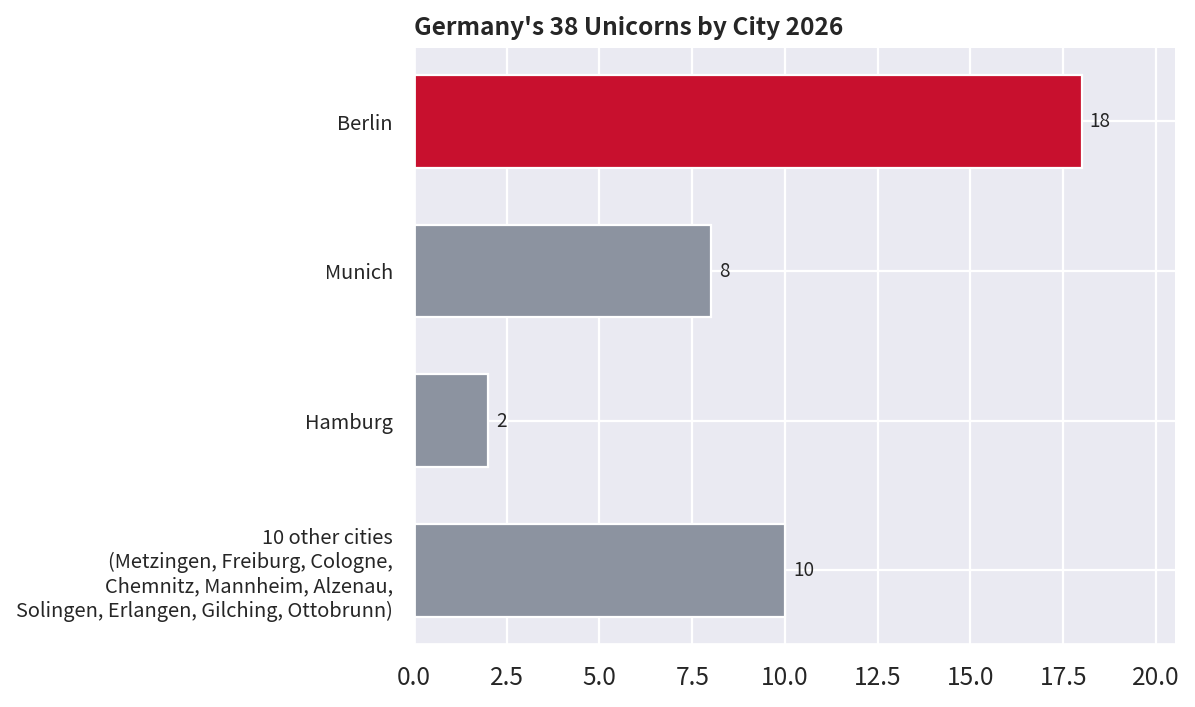
German unicorns by city, 2026 — Source: Hurun Research Institute, Germany Unicorn Index 2026
Rank | City | Unicorns | Total Value (€bn) | % of Total | Key Companies |
1 | Berlin | 18 | €67.0bn | 57.5% | Helsing, Trade Republic, Mambu, n8n |
2 | Munich | 7 | €22.3bn | 19.1% | Personio, Celonis, Flix, commercetools |
3 | Hamburg | 2 | €4.2bn | 3.6% | 1Komma5, Raisin |
4 | Metzingen | 1 | €6.4bn | 5.5% | NEURA Robotics |
4 | Gilching | 1 | €3.2bn | 2.7% | Quantum Systems |
4 | Freiburg im Breisgau | 1 | €3.0bn | 2.6% | Black Forest Labs |
4 | Erlangen | 1 | €2.8bn | 2.4% | Worldcoin |
4 | Ottobrunn | 1 | €1.9bn | 1.6% | Isar Aerospace |
4 | Cologne | 1 | €1.8bn | 1.5% | DeepL |
4 | Chemnitz | 1 | €1.0bn | 0.9% | Staffbase |
4 | Mannheim | 1 | €1.0bn | 0.9% | Osapiens |
4 | Alzenau | 1 | €1.0bn | 0.9% | CMBlu Energy |
4 | Solingen | 1 | €0.9bn | 0.8% | Dash0 |
Source: Hurun Research Institute, Germany Unicorn Index 2026.
The verdict: Berlin and Munich hold three-quarters of the value — but twelve other towns are on the board.
4.1 Berlin: The Unicorn Capital of Continental Europe
Berlin hosts 18 of Germany's 37 unicorns (49%), with a combined value of €67 billion. Berlin is Germany's dominant hub — but not the continent's most concentrated: Paris holds 32 of France's 36 unicorns (89%). Germany's distinction is spread, not concentration: thirteen cities hold unicorns, against five in France.
18 unicorns worth €67 billion — half of Germany's unicorns and 57% of their value, in one city of 3.7 million people. --- |
Berlin's dominance is driven by multiple factors. First, the city's relatively low cost of living (compared to London, Paris, or Munich) attracts young talent and early-stage founders. Second, Berlin's regulatory openness — particularly in FinTech, where BaFin has created a supportive framework for digital financial services — has made it the natural base for financial innovation. Third, the city's creative and international culture attracts founders from around the world, creating a diverse and dynamic startup ecosystem. Fourth, Berlin's venture capital concentration — the city hosts the German offices of most major international VC firms — provides access to capital that regional ecosystems cannot match.
Fifth, Berlin's accelerator and incubator density is unmatched in continental Europe. From Techstars Berlin and Startupbootcamp to corporate accelerators run by Deutsche Telekom, Siemens, and BMW, the city offers structured programmes that help founders validate ideas, secure early customers, and raise seed capital. Factory Berlin, the city's largest co-working and community campus, functions as a physical hub where hundreds of startups share space, talent, and ideas.
Sixth, government support has been deliberate and sustained. The EXIST programme has funded university spin-offs for over two decades. High-Tech Gründerfonds provides public co-investment alongside private venture capital. The German Startup Association has become an effective lobby for founder-friendly policy, including stock option reform and visa simplification. Berlin's Senate Department for Economics runs its own startup grants and co-working subsidies, recognising that the city's future prosperity depends on its ability to nurture new companies.
Berlin's unicorn portfolio spans virtually every sector: AI (Helsing, n8n, Parloa, Dash0), FinTech (Trade Republic, N26, Mambu, Raisin, Taxfix), SaaS (Contentful, n8n), Defence (Helsing, STARK Defence), E-Commerce (GetYourGuide, Omio, Autodoc), New Energy (Enpal), and more. This diversity reflects Berlin's status as a general-purpose startup hub — not dependent on a single sector or industry.
However, Berlin's dominance also represents a risk. If Germany's unicorn ecosystem becomes too concentrated in a single city, it may miss the opportunity to develop regional tech corridors that could transform the broader economy. The German government has recognised this risk and has initiated programmes to support tech development in other regions — but the capital gap between Berlin and the rest of Germany remains significant.
4.2 Munich: Bavaria's Deep Tech Powerhouse
Munich hosts 7 unicorns (19%) with a combined value of €22 billion. While smaller than Berlin in count, Munich's unicorns are among Germany's most valuable — Personio (€7.8bn), Celonis (€6.6bn), and Flix (€3.0bn) are all in the top 10.
Munich's strength reflects Bavaria's deep tech ecosystem. The city is home to Technical University of Munich (TUM) — one of Europe's leading technical universities and the alma mater of multiple unicorn founders. The Bavarian industrial base — BMW, Siemens, Allianz, Munich Re — provides both talent and customers for B2B startups. And the city's quality of life attracts experienced engineers and executives who may be less drawn to Berlin's younger, more chaotic startup scene.
Munich's unicorn portfolio is more concentrated than Berlin's: SaaS (Personio, Celonis, commercetools), travel (Flix), FinTech (Scalable Capital), robotics (Agile Robots), and mobility (FINN). The city has not produced AI or defence unicorns — those sectors have gravitated to Berlin — but its strength in enterprise software, industrial technology, and now mobility reflects the Bavarian economy's manufacturing heritage.
The Munich-Berlin dynamic is one of the most important features of German tech. The two cities represent different models of entrepreneurship: Berlin is faster, more international, more consumer-facing, and more capital-efficient. Munich is deeper, more technical, more B2B-focused, and more patient. Both models work. And the competition between them drives the ecosystem forward.
4.3 Metzingen: The Unicorn Factory Town
Metzingen — a town of 22,000 people in Swabia — now hosts one unicorn worth €6.4 billion. That is €6.4 billion of unicorn value in a town better known for Hugo Boss outlet stores. NEURA Robotics has made Metzingen the highest-value single-unicorn city in Germany, with €6.4 billion of value in a town of 22,000 people.
This is not a coincidence. Metzingen sits in the heart of Baden-Württemberg, Germany's manufacturing heartland. The region's deep pool of mechanical engineers, automation specialists, and industrial craftsmen provided the talent that David Reger needed to build NEURA Robotics. The town's proximity to Stuttgart, Tübingen, and the University of Freiburg gave it access to research and talent without the cost and congestion of a major city.
Metzingen's rise as a unicorn town is a powerful signal: Germany's unicorn ecosystem is not limited to Berlin and Munich. The country's manufacturing towns — places with engineering heritage, industrial infrastructure, and patient capital — can produce billion-dollar companies too.
4.4 Regional Diversity: Beyond the Big Two
Germany's unicorn ecosystem shows encouraging signs of geographic diversity beyond Berlin and Munich.
Hamburg (2 unicorns): Ranked third by number of unicorns, Hamburg is home to Raisin (FinTech) and 1Komma5 (ClimateTech), reflecting the Hanseatic city's strength in trade, finance, and environmental technology. Hamburg's port — Europe's third-largest — has created a logistics and trade expertise that translates into FinTech and ClimateTech innovation.
Freiburg (1 unicorn): Black Forest Labs — Germany's most valuable generative AI company after Helsing — is headquartered in Freiburg im Breisgau, a city of 230,000 people on the edge of the Black Forest. This is not a coincidence. Freiburg is home to the University of Freiburg and close to the Max Planck Institute for Intelligent Systems in Tübingen. The team behind Black Forest Labs chose Freiburg precisely because of its research environment. This is a critical lesson: world-class AI companies do not need to be in Berlin or Munich. They need to be near world-class research.
Cologne (1 unicorn): DeepL — the AI translation company that rivals Google Translate — is headquartered in Cologne. Founder Jaroslaw Kutylowski built the company away from the Berlin hype cycle, focusing on product quality and technical excellence.
Chemnitz (1 unicorn): Staffbase — the internal communications platform — is headquartered in Chemnitz, a former industrial city in Saxony. Staffbase's presence demonstrates that unicorn-scale companies can be built in Germany's former East, provided they have access to talent and capital.
Mannheim (1 unicorn): Osapiens — the first unicorn of 2026 — is headquartered in Mannheim, reflecting the Baden-Württemberg region's strength in industrial technology and compliance software.
Alzenau (1 unicorn): CMBlu Energy — Germany's first non-lithium battery unicorn — is headquartered in Alzenau, Bavaria, with a 1 GWh factory operational since 2024. The city's proximity to Frankfurt and the Bavarian industrial corridor provides the infrastructure and talent for deep energy technology.
Solingen (1 unicorn): Dash0 — the fastest German company ever to reach unicorn status — was founded in Solingen, a city of 160,000 in North Rhine-Westphalia. The company now maintains its headquarters in New York but retains a strong Berlin presence, reflecting the global-from-day-one model of the new generation of German AI startups.
Ottobrunn / Gilching (2 unicorns): Isar Aerospace and Quantum Systems are both located in the Munich metropolitan area's southern corridor — close to the European Space Agency's mission control, Airbus Defence and Space, and the Bavarian aerospace cluster. This concentration reflects the importance of geographic proximity to customers, partners, and talent in deep tech.
Berlin has 18 unicorns. Munich has 7. Together they account for 68% of Germany's unicorn count and an even larger share of value. But what excites me is the geography of the other 12. Metzingen — €6.4 billion from a town of 22,000 people. Black Forest Labs in Freiburg. DeepL in Cologne. Staffbase in Chemnitz. Osapiens in Mannheim. CMBlu Energy in Alzenau. Dash0 from Solingen. These companies prove that German unicorns do not have to be built in the capital. They can be built anywhere there is world-class research, technical talent, and patient capital. The challenge for the next decade is to ensure that the capital, infrastructure, and policy support that Berlin and Munich enjoy are extended to Metzingen, Freiburg, Cologne, Chemnitz, Mannheim, Alzenau, and Solingen.
— Rupert Hoogewerf, Chairman and Chief Researcher, Hurun Research Institute
What this means for you. --- For founders: Berlin for speed and capital, Munich for depth, the provinces for cost and loyalty — all three now have proof points. For investors: 57.5% of value sits in Berlin — the regional unicorns come with less competition for allocation. For policymakers: twelve towns beyond the big two hold unicorns; extending capital and infrastructure there is the cheapest map expansion available. |
So the map is two capitals and twelve provinces. Who builds them is Section 5.
05
WHAT GERMAN FOUNDERS HAVE IN COMMON
Thirty-four years old, degree-complete, overwhelmingly male — the German founder profile.
Germany's unicorn founders share a recognisable profile — educated at a handful of technical universities, older than their American counterparts, overwhelmingly male, and increasingly international. Three statistics only this index has: the average founder was 34 at founding; not one of the 37 companies came out of a DAX boardroom; and the ten-company diaspora is worth more than three times the home list. The founder-level research base behind this section is published as a companion workbook, Germany 2026 Founder Research.xlsx.
34 at founding. Degree-complete. Zero DAX boardrooms. — the German founder profile in one line. --- |
5.1 University Rankings: The Founder Factories
German unicorn founders are, more than their American or British counterparts, products of the country's technical university system. The following table ranks the universities that have produced the most German unicorn founders by number of unicorns founded, demonstrating the academic pipeline that fuels the ecosystem.
Rank | University | Unicorns Founded | Total Value (€bn) | Notable Companies |
1 | Technical University of Munich (TUM) | 6 | €20.0bn | Personio, Celonis, commercetools, Agile Robots, Flix (Schwämmlein), plus numerous alumni |
2 | Ludwig Maximilian University of Munich (LMU) | 4 | €3.0bn | Black Forest Labs team |
3 | Humboldt University of Berlin | 2 | €16.6bn | Helsing co-founders |
3 | Technical University of Berlin | 2 | €5.0bn | Various AI/SaaS founders |
3 | Munich Business School | 2 | €3.0bn | Flix founders |
6 | University of Freiburg | 1 | €3.0bn | Black Forest Labs team |
6 | Karlsruhe Institute of Technology (KIT) | 1 | €1.9bn | Isar Aerospace founder |
6 | University of Cologne | 1 | €1.8bn | DeepL |
Source: Hurun Research Institute, Germany Unicorn Index 2026.
The verdict: the founder factories are technical, public and German — TUM and LMU lead, and Munich is the classroom.
The Technical University of Munich (TUM) leads with 6 unicorn-founded companies — Personio, Celonis, commercetools, Agile Robots, and Flix — with a combined value of €20.0 billion, more than the entire Dutch unicorn ecosystem. TUM's entrepreneurship centre, UnternehmerTUM, is widely regarded as one of Europe's most effective university-based incubators. LMU Munich ranks second with 4 unicorns founded, including the Black Forest Labs team.
Ludwig Maximilian University of Munich (LMU) produced the Black Forest Labs team, with four founders and €3.0 billion in value. Humboldt University of Berlin, Technical University of Berlin, and Munich Business School each produced two unicorn founders, contributing to Helsing, various AI/SaaS companies, and Flix respectively. The University of Cologne gave rise to DeepL, and the Karlsruhe Institute of Technology (KIT) produced Isar Aerospace's founder. This pattern is one of Germany's greatest competitive advantages: while American unicorn founders often drop out of university, German founders typically complete advanced degrees — often PhDs — before starting companies.
This academic pipeline has both strengths and weaknesses. The strength is that German founders build on genuinely differentiated technology — they are not merely applying existing tools to new markets. The weakness is that the path to unicorn status is often slower: German founders spend years in academia before starting companies, and their companies often take longer to reach product-market fit. But the result is companies with deeper technical moats, more durable revenue, and stronger foundations.
5.2 International Founders: Germany as a Magnet
Approximately 40% of German unicorns have at least one non-German founder — a lower proportion than the UK (over 50%) but significant nonetheless. This internationalism reflects Germany's attractiveness as a place to build companies: stable regulation, deep technical talent, access to European markets, and increasingly supportive government policy.
Notable international founders include:
· Eugene Danilkis (Mambu) — Latvian-born, built Mambu in Berlin
· Jaroslaw Kutylowski (DeepL) — Polish background, built DeepL in Cologne
· Zhaopeng Chen (Agile Robots) — Chinese-born roboticist, formerly of the German Aerospace Center (DLR), built Agile Robots in Munich
· André Schwämmlein (Flix) — German but with international education at Munich Business School
· Sam Altman (Worldcoin) — American, chose Erlangen for European operations
Germany's attractiveness to international founders has increased as the UK has faced post-Brexit uncertainties and as France's ecosystem has become more competitive but also more expensive. Berlin, in particular, has become a magnet for Eastern European, Southern European, and Middle Eastern founders who find the city's cost of living, international culture, and regulatory environment more welcoming than London or Paris.
5.3 Serial Entrepreneurs and the Ecosystem Flywheel
Germany's unicorn ecosystem is developing a self-reinforcing dynamic where successful founders and operators build the next generation of companies. The most notable example is Florian Seibel, who founded both Quantum Systems (2015) and STARK Defence (2024) — two simultaneous defence unicorns.
Other examples of serial entrepreneurship and ecosystem flywheels:
· The Celonis Mafia: alumni of Celonis have gone on to found or join multiple startups in the process mining and enterprise software space.
· The Rocket Internet Alumni: several German unicorn founders (including those at HelloFresh, which graduated from the index) have roots in Rocket Internet, the Berlin-based startup incubator that, despite its mixed reputation, trained a generation of German entrepreneurs.
· The Exit Mafia: founders who sold their first companies founded the current list: Torsten Reil (NaturalMotion, sold to Zynga) built Helsing, Mirko Novakovic (Instana, sold to IBM) built Dash0, Ferry Heilemann (DailyDeal, sold to Google) built Forto, and Max-Josef Meier (Stylight) built FINN.
5.4 Founder Factories: The Companies — and the Corporate Paradox
Germany's universities are its best-known founder factories — but companies, research institutes and previous startups factory founders too. The table maps where this index's founders actually came from, by prior employer or institution.
Founder Factory | Founders in This Index | The Connection |
Technical universities (TUM, LMU, TU Berlin) | Celonis, Personio, Flix, Isar Aerospace, Worldcoin | Student founders who went straight from university to the company — the UnternehmerTUM orbit alone is the single most productive founder factory in Germany |
Research institutes | Black Forest Labs, Agile Robots, DeepL | The LMU/Max Planck orbit (the Stable Diffusion team), the German Aerospace Center DLR (Zhaopeng Chen), Cologne's research scene |
The serial founders' own first startups | Helsing, Dash0, Forto, FINN, Enpal, Parloa | NaturalMotion (sold to Zynga), Instana (sold to IBM), DailyDeal (sold to Google), Stylight, Vexcash, voice agency Future of Voice |
Rocket Internet | N26 — plus graduates Zalando, HelloFresh, Jumia and the diaspora's Lazada | Valentin Stalf was an entrepreneur-in-residence; the Samwer brothers' incubator trained a generation of operators |
Global corporates | 1Komma5, Raisin | Philipp Schröder ran Tesla Germany and sonnen; Tamaz Georgadze spent a decade at McKinsey |
The armed forces | Quantum Systems, STARK Defence | Florian Seibel, a former German Air Force officer, founded both |
Source: Hurun Research Institute, Germany Unicorn Index 2026.
The verdict: Germany's founder factories are its universities and its exits — not its boardrooms.
Notice who is missing. Not one of the 37 companies on this index was founded out of SAP, Siemens, Schwarz Group, Aldi or Deutsche Telekom — employers of hundreds of thousands of engineers between them. When corporate Germany does produce unicorn founders, it tends to produce them for abroad: Canoo was founded in California by veterans of BMW and Deutsche Bank (Appendix C). And when corporate Germany meets a breakout software company, it buys rather than breeds: SAP acquired Signavio in 2021 and LeanIX in 2023 — both built independently, outside its walls.
The reasons are structural. Golden handcuffs make leaving a DAX salary expensive. Corporate careers reward risk-averse progression over entrepreneurial leaps. And there is no equity culture — no employee stock-option millionaires recycling their winnings into the next generation, as Silicon Valley and Rocket Internet alumni do. Closing the corporate founder-factory gap is a question for Germany's boardrooms, not just its startup policy.
5.5 Founder Diversity: The Gender Gap
Of the 90 founders of Germany's 37 unicorns, fewer than 5% are women. The German ecosystem has not yet produced a prominent female-led unicorn — a stark contrast to the UK, where Anne Boden built Starling Bank into one of Europe's most celebrated digital banks.
This gap represents the ecosystem's most significant weakness. Research consistently shows that diverse founding teams build better companies, serve broader markets, and generate higher returns. Germany's failure to capture the full potential of its female entrepreneurial talent is not merely a social issue — it is an economic one. If Germany could increase female founder participation to match the general population, the number of unicorns could increase by 20-30%.
Addressing this gap requires action at multiple levels: encouraging girls to study STEM subjects, providing mentorship and capital for female founders, and addressing the structural barriers — childcare, parental leave, and workplace culture — that disproportionately affect women's ability to start companies.
5.6 The Age Question: Experience Before Entrepreneurship
German unicorn founders are, on average, older than their American counterparts. The average age at founding is 34 — compared to 30 in the US and 32 in the UK. This reflects the German pattern of completing advanced education, gaining industry experience, and then starting companies.
The oldest founders in the index — Alexander Rinke (Celonis), Eugene Danilkis (Mambu) — were in their mid-30s when they started their companies. The youngest — Jan Oberhauser (n8n) — was in his late 20s. There is no German equivalent of the 19-year-old Stanford dropout who builds a billion-dollar company in three years.
This pattern has implications for the ecosystem. German founders bring more experience, more technical depth, and more patience to their companies. They are less likely to pivot rapidly, less likely to chase trends, and more likely to build sustainable businesses. But they are also slower to scale, less comfortable with "blitzscaling," and more likely to miss windows of opportunity that require rapid execution.
The average German unicorn founder was 34 when they started their company. They did not drop out of university. They did not move to Silicon Valley. They completed their degrees, often their PhDs, gained industry experience, and then built companies based on genuine technical differentiation. This is the German model: slower, deeper, more patient. It does not produce as many unicorns as the American model. But the unicorns it produces are built on stronger foundations. Celonis, Personio, Helsing — these are not companies that will collapse when the funding cycle turns. They are built to last.
— Rupert Hoogewerf, Chairman and Chief Researcher, Hurun Research Institute
5.7 The Diaspora Ledger: Germany's Second, Parallel Index
The German story does not end at the border — and here the numbers are uncomfortable. Taken together, the billion-dollar companies built abroad by German-born founders are worth more than every unicorn on this home index combined: Palantir alone, founded by Frankfurt-born Peter Thiel, is worth more than twice the entire list. And Arista Networks, co-founded by Bavaria-born Andy Bechtolsheim, is worth over US$200 billion — the second name on the ledger. The diaspora is small in headcount — ten confirmed cases — but it contains the two most valuable companies ever founded by German-born entrepreneurs, and that fact is the sharpest available measure of Germany's retention problem. The full ledger — Tobias Lütke's Shopify, Konstantin Guericke's LinkedIn, Sebastian Thrun's Udacity and the rest — with the stories behind it, is Appendix C. The Hurun Nordic Unicorn Index 2026 told the story of a region that sells its champions; Germany's ledger is starker — its biggest champions were never built at home at all.
What this means for you. --- For founders: 34, degree-complete, deep in one domain — the German profile is a feature, not a bug. For investors: the founder factories — TUM, LMU, TU Berlin — are the deal-flow map; the gender gap is the arbitrage. For policymakers: fewer than 5% women is not a statistic — it is the cheapest unicorn-growth policy available. |
So the founder is 34, degree-complete, and overwhelmingly male. Who funds them is Section 6.
SECTION 6: INVESTORS AND THE ECOSYSTEM ARCHITECTS
Germany's unicorn ecosystem is sustained by a network of investors, mentors, institutions, and government policies that provide capital, expertise, and connections. This section examines the full picture of who and what is building Germany's startup landscape.
6.1 The Investor Landscape: Global Capital, German Companies
The following table ranks the investors that have backed the most German unicorns. The landscape is dominated by international — particularly American — venture capital firms, with a growing presence of defence-focused and AI-focused funds.
Rank | Investor | German Unicorns Backed | Notable German Investments |
1 | Accel | 5+ | Personio, Trade Republic, N26, Celonis, Dash0 |
2 | Index Ventures | 4+ | Personio, Celonis, Contentful |
3 | Lightspeed Venture Partners | 4+ | Personio, Black Forest Labs |
4 | Sequoia Capital | 4+ | Trade Republic, STARK Defence |
5 | General Catalyst | 3+ | Helsing, Black Forest Labs |
6 | Founders Fund | 3+ | Trade Republic, STARK Defence |
7 | Greenoaks Capital | 2+ | Personio |
8 | Prima Materia | 1+ | Helsing |
9 | NATO Innovation Fund | 1+ | STARK Defence |
10 | OpenAI Startup Fund | 1+ | n8n |
11 | Balderton Capital | 1+ | Dash0 |
12 | Samsung Ventures | 1+ | CMBlu Energy |
Source: Hurun Research Institute, Germany Unicorn Index 2026.
The verdict: the cap tables of Germany's champions are written mostly in American ink.
The investor landscape reveals several important trends:
American VC Dominance: The top investors in German unicorns are overwhelmingly American — Accel, Index, Lightspeed, Sequoia, General Catalyst, Founders Fund. This reflects the global nature of venture capital and the fact that the largest pools of late-stage capital are in the US. German domestic VC remains strong at early stages but drops off significantly at Series C and beyond.
Defence Capital Emergence: The NATO Innovation Fund's investment in STARK Defence and Prima Materia's (Daniel Ek) investment in Helsing signal a new category of defence-focused capital entering the German ecosystem. This is not traditional venture capital. It is strategic capital with national security objectives alongside financial returns.
Corporate Venture Capital: Microsoft's investment in n8n (via M12), NVIDIA's participation in both n8n and NEURA Robotics, Amazon's investment in NEURA Robotics, and Intel Capital's backing of n8n reflect the growing presence of corporate venture capital in German AI. These are not passive financial investments. They are strategic bets on technology that these companies view as critical to their own futures.
Industrial Capital: Bosch's investment in NEURA Robotics, Samsung Ventures' investment in CMBlu Energy, and STRABAG's participation in CMBlu Energy represent a new wave of industrial capital entering the German startup ecosystem. These are not Silicon Valley funds. They are manufacturers and industrial giants investing in the technology that will power their own industries.
The Late-Stage Capital Gap: German domestic investor participation in late-stage rounds is estimated at under 15% — significantly lower than in the US or UK. This forces German scaleups to raise from American investors, which often comes with pressure to relocate, to prioritise US markets, and to accept US-centric governance structures. Closing this gap is one of the most important challenges for German tech policy.
The Domestic Bench. The early money in Germany is German — it is the growth money that is not. The domestic and European funds that got in first:
Investor | HQ | Notable German Unicorn Investments |
Earlybird | Berlin | N26, Isar Aerospace |
HV Capital | Munich | Isar Aerospace, Flix |
Cherry Ventures | Berlin | Dash0 |
Project A | Berlin | Sennder |
Point Nine | Berlin | Contentful |
b2venture | Munich / St. Gallen | 1Komma5 |
UVC Partners | Munich | FINN |
Source: Hurun Research Institute, Germany Unicorn Index 2026.
The verdict: the seed and Series A cheques are written in Berlin and Munich; the Series C cheques are written in New York and Menlo Park.
Capable individuals belong on this map too. Spotify founder Daniel Ek's Prima Materia backed Helsing; Jeff Bezos' Bezos Expeditions backed n8n; the Heilemann brothers invest through Heilemann Ventures; and Klaus Hommels' Lakestar remains one of Europe's most active home-grown funds. The next tier — La Famiglia, 468 Capital, Cavalry Ventures, Picus Capital, Visionaries Club, and Frank Thelen — is a bench any of which could lead the next German unicorn round.
6.2 Government Policy: From Start-Up to Scale-Up
The German government has, in recent years, made significant efforts to support the startup ecosystem. Key policies include:
The Deep Tech & Climate Fonds (DTCF): A €1 billion fund of funds launched by the German government to support deep tech and climate tech startups. The fund provides capital to venture capital firms that invest in German deep tech companies, with the goal of closing the late-stage funding gap.
The Future Fund (Zukunftsfonds): A €10 billion government-backed fund designed to mobilise private capital for German startups. The fund provides matching capital to private investors, effectively de-risking investments in early-stage German companies.
The Research Allowance (Forschungszulage): A tax credit for research and development spending that benefits startups as well as established companies. German AI and deep tech startups can claim up to 25% of their R&D costs back from the government.
The WIN Initiative: Launched in September 2024 by the Federal Ministry for Economic Affairs and KfW together with Allianz and other insurers and institutional investors, WIN aims to mobilise €12 billion of public and private capital for German startups and scaleups by 2030 — the most significant late-stage capital effort in German history.
The Future Financing Act (Zukunftsfinanzierungsgesetz, 2023): Improved the tax treatment of employee stock options and modernised capital-market rules — real progress, though founders and investors argue that remaining frictions still push talent and listings abroad.
The Zeitenwende Defence Fund: The €100 billion special defence fund has created a procurement pipeline for defence technology startups that did not exist before. While not a startup policy per se, its effect on the ecosystem has been transformative — as evidenced by Helsing, STARK Defence, and Quantum Systems.
EU-wide Policies: Germany benefits from EU-wide startup support, including the European Innovation Council (EIC) Accelerator, which provides grants and equity investments to deep tech startups, and the Digital Europe Programme, which funds AI and cybersecurity research.
6.3 The Role of Research Institutions
Germany's research institutions are the unsung heroes of the unicorn ecosystem. The Max Planck Institutes, the Fraunhofer Society, the Helmholtz Association, and Germany's technical universities produce the research that underpins many of the country's most valuable startups.
Black Forest Labs emerged from AI research at LMU Munich and the Max Planck Institute for Intelligent Systems. DeepL was built on neural machine translation research from the University of Cologne. Helsing's founders have backgrounds in AI research from leading German institutions. Quantum Systems was founded by aerospace engineers from the Munich technical university ecosystem. CMBlu Energy spent a decade in R&D before commercialisation, reflecting the Fraunhofer model of patient technology development.
The German model of startup creation — research → spinout → venture funding → scale — is distinct from the American model and, in deep tech, potentially more durable. American startups often begin with a market insight and hire researchers to build the technology. German startups often begin with a research breakthrough and hire business talent to commercialise it. Both models work. But the German model produces companies with deeper technical moats.
Germany's research institutions are the secret weapon of its unicorn ecosystem. The Max Planck Institutes, the Fraunhofer Society, TUM, LMU — these are not just universities. They are the R&D labs of Germany's future unicorns. Black Forest Labs came from LMU. DeepL came from Cologne. Helsing's founders came from German AI research. CMBlu Energy spent a decade in development before raising its first venture round. The German model is research first, commercialisation second. It is slower than the American model. But it produces companies with deeper technical moats. In the AI era, where the winners will be determined by technical differentiation, that moat matters.
— Rupert Hoogewerf, Chairman and Chief Researcher, Hurun Research Institute
6.4 Incubators and Accelerators
Germany's incubator and accelerator ecosystem has matured significantly in recent years. Key institutions include:
Factory Berlin: A campus-based community for startups, corporates, and creatives that has hosted multiple unicorn founders and provided early workspace for companies that later achieved significant scale.
UnternehmerTUM: The entrepreneurship centre of Technical University of Munich, which has supported Personio, Celonis, and dozens of other startups. UnternehmerTUM is widely regarded as one of Europe's most effective university entrepreneurship programmes.
The Berlin Startup Academy: Early-stage accelerator programmes that provide mentorship, capital, and connections to Berlin-based founders.
Corporate Accelerators: Siemens, Bosch, SAP, and Deutsche Telekom all operate corporate accelerator programmes that provide startups with access to customers, technology, and capital. While the track record of corporate accelerators is mixed, they have played a role in connecting startups with Germany's industrial base.
What this means for you. --- For founders: the early money is at home — HTGF, EXIST, UnternehmerTUM; plan the growth round bilingually. For investors: under 15% domestic participation in late-stage rounds is the widest open door in European venture. For policymakers: the WIN Initiative and the Deep Tech & Climate Fonds exist; the gap says they are not yet big enough. |
So the early money is German and the growth money is American. What happens when they win is Section 7.
07
THE GRADUATES — GERMAN STARTUPS THAT WENT PUBLIC
Twelve graduates, honestly graded on Germany's own school scale.
Not every German startup stays in the unicorn index forever. Some grow up, go public, and "graduate" from the Hurun Unicorn Index to the public markets. This section celebrates the German-founded companies of the 2000s that have completed an IPO, grading them using the German university grading system — the same system that educated many of Germany's unicorn founders.
All graduate market capitalisations as of early July 2026, converted at USD 1.00 = EUR 0.92; Hurun Research Institute estimates.
In Germany, university grades are:
Grade Range | Description | Meaning |
1.0 – 1.3 | Sehr Gut (Very Good) | Outstanding achievement |
1.7 – 2.3 | Gut (Good) | Above average |
2.7 – 3.3 | Befriedigend (Satisfactory) | Average |
3.7 – 4.0 | Ausreichend (Sufficient) | Barely passed |
4.3+ | Nicht Genügend (Insufficient) | Failed |
Source: Hurun Research Institute, Germany Unicorn Index 2026.
The verdict: Germany grades hard — and this report applies the same honesty to Germany's own champions.
We apply these grades not as a criticism, but as a cultural lens. German founders are products of this system. They understand what it means to strive for a 1.0. And they know that a 3.0 is not failure — it is average. The question is whether Germany's tech graduates have achieved the grades that their education demanded. The master list of the class — and the full graduate stories, band by band — are in Appendix B.
The Class of 2026: Graded
Graduate | Grade | Teacher's Comment |
BioNTech | 1.0 | Changed the world from Mainz; the class's defining graduate. |
Symrise | 1.0 | A quiet €12 billion — proof that German value creation is not only software. |
Zalando | 1.0 | Germany's only global consumer champion; still compounding. |
Delivery Hero | 2.0 | Global footprint, honestly volatile; respectable. |
SUSE | 2.0 | Open-source infrastructure, quietly essential. |
TeamViewer | 2.0 | Profitable, global, unglamorous — very German. |
Carl Zeiss Meditec | 2.0 | Precision engineering translated to the public market. |
HelloFresh | 2.0 | A real consumer business that survived its own hype cycle. |
AUTO1 Group | 2.0 | Ground its way to profitability the hard way. |
ABOUT YOU | 2.7 | Solid, not spectacular. |
Jumia | 3.0 | Ambitious geography, difficult arithmetic. |
CureVac | 3.0 | Brilliant science, outrun by its Mainz neighbour. |
Source: Hurun Research Institute, Germany Unicorn Index 2026. Grades on the German university scale; market capitalisations as of early July 2026.
The verdict: two 1.0s and seven respectable 2.0s — a solid class, but no world-beater yet.
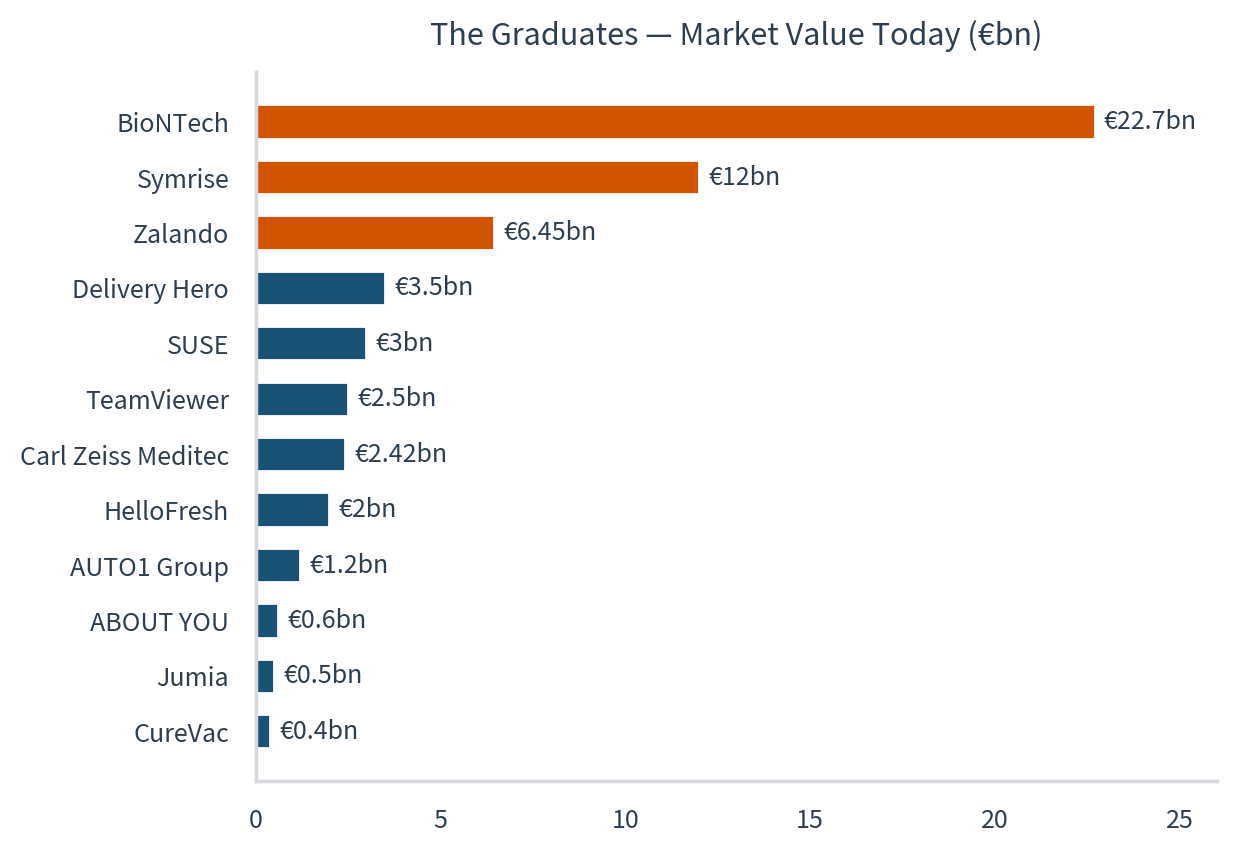
Germany's listed graduates — market capitalisation, € billion, July 2026 — Source: Hurun Research Institute, Germany Unicorn Index 2026
We are encouraging unicorns to graduate. An IPO or a landmark acquisition is not a loss to our index — it is the point of the ecosystem. We count a region's champions so that the world can watch them become giants.
— Rupert Hoogewerf, Chairman and Chief Researcher, Hurun Research Institute
The Grade Report: What It Means for Germany
Germany's tech graduates have not achieved the top grades that American graduates (Apple, Amazon, Google, Microsoft, NVIDIA) have achieved. But the class of 2026 is working harder than ever. The pipeline of 37 unicorns — the largest in German history — suggests that the next decade of German IPO graduates will be the strongest yet.
The question is not whether Germany can produce more graduates. It can. The question is whether the Frankfurt Stock Exchange can become a destination worthy of them. German founders currently face a choice: list in Frankfurt and accept lower valuations and less liquidity, or list in New York and accept American governance and market prioritisation. That is not a choice that German founders should have to make.
Germany's tech graduates have not achieved the top grades that American graduates have achieved. But Germany now has two 1.0s: BioNTech, the most valuable German graduate in history at €22.7 billion, and Zalando, the country's only global consumer champion. Symrise at €12 billion and Carl Zeiss Meditec at €2.42 billion show that German value creation extends far beyond software. Delivery Hero, SUSE, TeamViewer, HelloFresh, AUTO1 Group — these are solid 2.0s. They are respectable. They are genuine value creators. But they are not world-beaters. The pipeline of 37 unicorns suggests that the next decade will produce stronger graduates. Helsing at €16.6 billion, Trade Republic at €13.8 billion, NEURA Robotics at €6.4 billion — these are companies that could list at valuations that would make Frankfurt proud. The question is whether Frankfurt will be ready for them.
— Rupert Hoogewerf, Chairman and Chief Researcher, Hurun Research Institute
The Hundred-Billion Question
Can Germany produce a hundred-billion-dollar company? The honest arithmetic: the listed class leader, BioNTech, holds €22.7 billion; the private list's leader, Helsing, is at €16.6 billion and rising faster than any German company ever has; Trade Republic, at €13.8 billion, has the consumer scale. To reach $100 billion, one of them must multiply five times over — BioNTech did nearly that in eighteen months when the world needed it. The structural obstacles are the ones this report keeps returning to: late-stage capital that is still written in New York and London, and a Frankfurt exchange that has not yet held a decacorn IPO.
The verdict: a way off — but no longer unthinkable. Five years ago the honest answer was no. Today Germany has three credible candidates and a pipeline of 37. The question has moved from "whether" to "when — and where it lists".
Two graduates hold 1.0s — BioNTech and Zalando. The whole listed class is worth €57 billion: half of today's private list, built by the generation the sceptics wrote off. --- |
What this means for you. --- For founders: graduation is the goal, not the exit — the index wants to lose you to the public markets. For investors: the listed class proves German tech can survive public-market scrutiny; the solid 2.0s are the compounding zone. For policymakers: every champion that lists abroad, or below its potential, is a Frankfurt problem — not a founder problem. |
So the class is graded, honestly, on Germany's own scale — and the next cohort is the strongest yet. What it all means is Section 8.
08
FINDINGS FOR OUR READERS — WHAT THIS REPORT MEANS FOR YOU
What 37 unicorns mean for policymakers, founders, investors and doubters.
Germany has built this index — 37 companies worth €116.5 billion — because of five pillars that no other continental European country can replicate in combination: world-class engineering education, a deep manufacturing base, the *Zeitenwende* defence opportunity, an increasingly supportive regulatory environment, and access to the European single market. This report opened with the readers it was written for; it closes with what each should take from the evidence of 2026 — and the predictions the Hurun Research Institute will grade itself against at next year's Index.
8.1 For Policymakers and Government
The first Zeitenwende — triggered by Russia's invasion of Ukraine — transformed German defence policy and, in four years, produced a €25 billion defence unicorn sector. Germany now needs a second Zeitenwende: one that transforms its capital markets, talent policy, and scale-up environment with the same urgency. The agenda, condensed from this report's evidence and ordered by expected impact:
1. Double the WIN Initiative beyond its €12 billion target and open it to pension money (Federal Government, KfW): even a 1% allocation from the Versorgungswerke would dwarf every programme currently in existence. Target: €24 billion mobilised by 2030.
2. Import France's Tibi Initiative (Federal Ministry of Finance, with the insurers): channel insurance money into late-stage technology funds — France has moved more than €7 billion since 2019, as documented in the Hurun France Unicorn Index 2026. Target: €7 billion by 2029.
3. Finish stock-option reform (Federal Government): employee equity taxed at sale, not exercise. Target: enacted in 2027.
4. Match defence procurement to startup speed (Defence Ministry): Helsing, STARK Defence and Quantum Systems proved it possible; make startup-speed procurement the default.
5. Make Frankfurt listable (Deutsche Börse, BaFin): a dedicated technology segment, fast-track DAX entry, genuine retail access. Target: a first decacorn IPO by 2028.
6. Issue AI talent visas at scale (Interior Ministry): processing measured in weeks, not months.
7. Standardise university spinout terms nationally (Education and Research Ministry): the UnternehmerTUM model, everywhere.
8. Fund regional ecosystems beyond Berlin and Munich (the Länder): eleven more cities already host the remaining twelve unicorns.
9. Close the female-founder gap (all of the above): fewer than 5% of German unicorn founders are women — the ecosystem's largest untapped talent pool.
10. Measure all of it publicly (Hurun Research Institute): progress reported back at every annual Index.
The first Zeitenwende built Germany's defence unicorns. The second Zeitenwende must build Germany's capital markets. The most valuable company ever built by a German-born founder — Palantir, worth over $300 billion — is American, and worth more than twice all 37 German unicorns combined. That is the cost of inaction, measured in a single number. The policies that produced 37 unicorns are working. The policies that will produce 100 — pension capital in venture funds, a Frankfurt that can hold a decacorn IPO, visas at the speed of talent, and spinout terms at the speed of research — are known, proven in France and Britain, and waiting. Germany has the founders. Now it needs the framework.
— Rupert Hoogewerf, Chairman and Chief Researcher, Hurun Research Institute
8.2 For Young Entrepreneurs and Founders
Build on substance, then move at whatever speed your product allows. Germany's founders are not nineteen-year-old dropouts with a deck — the average German unicorn founder started at 34, often after years of academic research or corporate experience. n8n went from founding to €4.8 billion in a year; Dash0 did it in three; Quantum Systems took eleven years, and STARK Defence was born at the mark. Every tempo on that spectrum now has a German proof point. Pick a problem rooted in German strength — industrial process, manufacturing, defence, energy — and you will find engineering talent, pilot customers, and, increasingly, capital. And look beyond Berlin and Munich: Metzingen, Freiburg, Solingen, Alzenau, and Chemnitz all host unicorns. Two predictions for your planning horizon: climate tech, robotics, quantum computing and energy storage will grow into significant unicorn sectors on Germany's industrial base, and the next cohort will be founded well beyond the Berlin–Munich axis.
8.3 For International Investors
The inefficiency is the opportunity. German domestic investors participate in fewer than 15% of late-stage rounds — the growth stage is open to outsiders at prices more disciplined than Silicon Valley's. The re-priced names are the entry points: Celonis at €6.6 billion, down from €12.0 billion, with 2,500 employees and hundreds of Fortune 500 customers; N26 at €2.8 billion with its regulatory constraints lifted and a path back to growth. The direction of travel is deep: this report projects 60 German unicorns by 2029 and 100 by 2032. Growth cheques are still written in New York and London — that gap is precisely where a patient entrant will find the value. Three predictions: the total value of German unicorns passes €200 billion by 2030; at least three AI unicorns stand above €10 billion by 2030; and at least five German unicorns will IPO on European exchanges in the next five years — if Frankfurt reforms. If it does not, they will list in New York, and the return will accrue to whoever owned the round before the listing.
8.4 For Doubters and Skeptics
The data settles it. Fifth in the world, ahead of France (36), more than the Netherlands (11), Switzerland (8), and Sweden (6) combined. Eleven new entrants in a single year, the largest cohort in German history. A defence technology sector worth €25.1 billion that was a taboo subject four years ago. Two decacorns. And the graduates — BioNTech at €22.7 billion, Symrise at €12 billion, Zalando at €6.45 billion — prove that Germany can take companies public and keep them world-class. The country that was written off as "old economy" now builds humanoid robots, rockets, and defence AI. Two closing predictions: Germany becomes the European capital of defence technology, with ten or more defence unicorns by 2030; and its unicorns' combined value passes €200 billion before the decade is out. Underestimating Germany has never been a good trade.
Old economy? 37 unicorns, €116.5 billion, the fastest minting rate in continental Europe, and a €25 billion defence sector that did not exist four years ago. The data has moved; the cliché has not. --- |
Germany has 37 unicorns today. By 2032, I predict it will have 100. The drivers are clear: the Zeitenwende has unlocked defence technology as a venture category, AI has matured from research to commercial application, and robotics has emerged as a genuine industrial category. The question is not whether Germany can produce more unicorns — it is whether it builds the capital markets, the IPO pipeline, and the talent policies those unicorns need to scale.
— Rupert Hoogewerf, Chairman and Chief Researcher, Hurun Research Institute
SECTION 9: METHODOLOGY
The Hurun Germany Unicorn Index 2026 uses the same methodology as the Hurun Global Unicorn Index, ensuring consistency and comparability across countries and over time.
Scope. This report covers Germany: companies headquartered in Germany, founded in 2000 or later, and valued at US$1 billion or more. Companies examined and watchlisted or excluded on the latest public evidence are named in the Ones-to-Watch passage of Section 2.
Definition of a Unicorn. The index includes unlisted companies founded in 2000 or later with a current valuation of US$1 billion or more. Companies founded before 2000 are excluded, regardless of current valuation. Unicorns leave the index in one of two ways: by graduating — listing on a public exchange (IPO) or being acquired — or by being demoted, when their value falls below US$1 billion. Graduates are tracked separately and graded, on the German school scale, in Section 7 and Appendix B.
Time Period. The cut-off for this year's index was 1 January 2026, with significant changes in valuation updated up to the date of publication. The Hurun Research Institute has been tracking unicorns since 2017; this is the eighth year of the Global Unicorn Index.
Valuation Methodology. Valuing unicorns can be tricky. The very nature of these super-fast-growing companies makes valuations hard to pin down, but to ensure consistency of the valuations, Hurun Research used the most recent valuation based on a sizeable round. Where it becomes harder is when a unicorn is underperforming or on its way down, since founders and investors are mostly loath to announce a down-round. In this case, Hurun Research used industry comparatives to ascertain a new, lower valuation.
Currency Conversion. All valuations are converted to EUR using an exchange rate of USD 1.00 = EUR 0.92 as of September 2026. Totals may not sum exactly due to rounding.
Data Sources. Many of the world's top investment houses provided details of their portfolios, which the Hurun Research team cross-checked against specialised investment databases (including Dealroom and PitchBook), industry experts, media sources (including TechCrunch, Sifted, Bloomberg and Reuters), and unicorn co-founders. The research team contacts companies directly to verify valuations, funding dates and founder information; the verification window for this edition ran from February to September 2026. Where data is not publicly available, expert estimates are used and clearly identified.
Sector Classification. Sectors are classified based on the company's primary business activity. Where a company operates across multiple sectors, the dominant revenue source is used. Sub-sectors are identified where relevant. Sector classifications are reviewed annually and may be adjusted if a company's business model has evolved significantly.
Employment and Sales Estimates. Direct employment figures are Hurun Research Institute estimates based on company disclosures, professional-network headcounts, press reports, and industry benchmarks; indirect employment applies a conservative multiplier. These figures are estimates and should be cited as such.
Founder Analysis. Founder information is based on publicly available data including company websites, LinkedIn profiles, press releases, and founder interviews. University attendance is based on publicly stated educational backgrounds. Founder ages are estimated from graduation dates and career timelines. Nationality is based on publicly stated birthplace or citizenship. Where information is not available, it is noted as such.
Country Assignment. Companies are assigned to countries based on headquarters and founding base. Worldcoin (Tools for Humanity) is assigned to Germany on the basis of its German co-founder Alex Blania and its Erlangen operational base. Dash0 is assigned to Germany on the basis of its founding base in Solingen and its continued Berlin presence, notwithstanding its current New York headquarters.
Limitations. Private market valuations are inherently uncertain. Funding-round valuations reflect the price paid by a specific investor at a specific time and may not represent the price at which the company could be sold. Companies that do not raise external funding may reach US$1 billion in value without a clear valuation event, and may not be captured by the index. Companies with complex corporate structures (multiple subsidiaries, cross-border operations) may be difficult to classify by country or sector. The Hurun Research Institute welcomes corrections and additional data.
Acknowledgements and Disclaimer. The Hurun Research Institute thanks the founders, investors and institutions who assisted with this research. This report is for information only and does not constitute investment advice.
Publication Date. This report was published in September 2026, as part of the Hurun global unicorn series for 2026.
APPENDIX A: COMPANY PROFILES
The following profiles tell the story of the German startup ecosystem through the individual journeys of its 37 unicorns, in ranking order — from Helsing at €16.6 billion to Taxfix at €0.9 billion. Each profile covers the company's founding story, what it built, why it matters, and what it reveals about the German ecosystem. Rankings and valuations follow the master table in Section 2, whose Change column explains every riser, new face and re-pricing.
Story | Company | Valuation | Sector | City |
A1 | Helsing | €16.6bn | AI/Defence | Berlin |
A2 | Trade Republic | €13.8bn | Discount Broking | Berlin |
A3 | Personio | €7.8bn | HR | Munich |
A4 | Celonis | €6.6bn | Process Mining | Munich |
A5 | NEURA Robotics (NEW) | €6.4bn | Cognitive/Humanoid Robotics | Metzingen |
A6 | Mambu | €4.9bn | Banking | Berlin |
A7 | n8n (NEW) | €4.8bn | Workflow Automation | Berlin |
A8 | STARK Defence (NEW) | €3.4bn | Defence Technology | Berlin |
A9 | Quantum Systems (NEW) | €3.2bn | UAS/Drones | Gilching |
A10 | Flix | €3.0bn | Booking/Travel | Munich |
A11 | Black Forest Labs (NEW) | €3.0bn | Generative AI | Freiburg im Breisgau |
A12 | Contentful | €2.8bn | Content Platform | Berlin |
A13 | N26 | €2.8bn | Challenger Bank | Berlin |
A14 | Parloa (NEW) | €2.8bn | Conversational AI | Berlin |
A15 | Worldcoin | €2.8bn | Crypto/Identity | Erlangen |
A16 | Autodoc | €2.4bn | Auto Parts E-Commerce | Berlin |
A17 | Enpal | €2.3bn | Solar Leasing | Berlin |
A18 | 1Komma5 | €2.2bn | Renewable Energy | Hamburg |
A19 | Raisin | €2.0bn | Savings Marketplace | Hamburg |
A20 | Forto | €1.9bn | Logistics Platform | Berlin |
A21 | Isar Aerospace (NEW) | €1.9bn | Rockets | Ottobrunn |
A22 | Sennder | €1.9bn | Digital Freight | Berlin |
A23 | DeepL | €1.8bn | Translation | Cologne |
A24 | GetYourGuide | €1.8bn | Travel Experiences | Berlin |
A25 | commercetools | €1.7bn | Cloud Commerce | Munich |
A26 | Scalable Capital | €1.3bn | Asset Management | Munich |
A27 | Choco | €1.1bn | Supply Chain | Berlin |
A28 | Amboss | €1.0bn | Medical Knowledge | Berlin |
A29 | CMBlu Energy (NEW) | €1.0bn | Non-Lithium Batteries | Alzenau |
A30 | FINN (NEW) | €1.0bn | Car Subscription | Munich |
A31 | Osapiens (NEW) | €1.0bn | ESG/Compliance | Mannheim |
A32 | Staffbase | €1.0bn | Internal Communications | Chemnitz |
A33 | Agile Robots | €0.9bn | Industrial Automation | Munich |
A34 | Dash0 (NEW) | €0.9bn | AI Observability/Agent0 | Solingen |
A35 | Omio | €0.9bn | Travel Booking | Berlin |
A36 | OneFootball | €0.9bn | Football Content | Berlin |
A37 | Taxfix | €0.9bn | Tax Filing | Berlin |
Source: Hurun Research Institute, Germany Unicorn Index 2026.
The verdict: the map before the territory — 37 stories, from a €16.6 billion defence-AI champion to a €0.9 billion tax app.
Story A1 — Helsing: Europe's Defence AI Crown Jewel
Helsing — founded in 2021 in Berlin by Gundbert Scherf, Niklas Köhler, and Torsten Reil — has become one of the most valuable AI companies in Europe and the world's most valuable defence technology unicorn outside the United States. Valued at €16.6 billion ($18.0bn), Helsing has risen from €1.6 billion in 2024 and €5.0 billion in 2025 — a staggering 10x increase in just two years.
The company's trajectory is unprecedented in European tech. Founded just four years ago, Helsing reached unicorn status in five years — remarkably fast for a company building military-grade AI systems. The founders — all with backgrounds in technology and defence policy — recognised before most that the Zeitenwende would create a generational opportunity for European defence technology. Their AI systems process sensor data from fighter jets, drones, and ground vehicles to provide real-time battlefield intelligence — capabilities that were once the exclusive domain of American defence contractors.
Helsing's investors read like a who's who of global tech and defence capital: Prima Materia (the investment vehicle of Spotify founder Daniel Ek), General Catalyst, and Saab (the Swedish defence giant). The company has secured contracts with multiple European governments and NATO allies, positioning itself as the continent's answer to Anduril and Palantir.
What makes Helsing remarkable is not just its valuation but its mission. In a Europe that has historically underinvested in defence technology, Helsing is building the AI infrastructure that will power European military capability for decades. Its systems are already being integrated into the Eurofighter Typhoon and the Future Combat Air System (FCAS). The company employs over 500 people across Berlin, Munich, London, and Paris, and its hiring velocity shows no signs of slowing.
As deutsche-startups.de recorded in January 2026, Germany now counts three decacorns — and Helsing's rise to that rank within four years was the fastest of them all.
Story A2 — Trade Republic: The Brokerage That Disrupted a Continent
Trade Republic — founded in 2015 in Berlin by Christian Hecker, Marco Cancellieri, and Thomas Pischke — is now Europe's most valuable consumer FinTech company and Germany's second-most-valuable unicorn at €13.8 billion ($15.0bn). The company added €8.7 billion in value year-on-year — the second-largest absolute increase in the German index — rising from €5.1 billion in 2025.
Trade Republic's model is disarmingly simple: a mobile-first brokerage offering commission-free trading of stocks, ETFs, and cryptocurrencies across Europe. But beneath that simplicity lies a sophisticated technology platform that has processed millions of trades for over 4 million customers across 17 European countries. The company's growth has been fuelled by a generation of European retail investors who discovered financial markets during the pandemic and have never looked back.
The founding team — Hecker (a former McKinsey consultant), Cancellieri (a former investment banker), and Pischke (a former project manager) — met while working in Berlin's burgeoning startup scene. Their combined expertise in finance, technology, and operations has proven formidable. Trade Republic is backed by Sequoia Capital, Founders Fund, Accel, and TCV — a roster of investors that signals global confidence in the company's trajectory.
Trade Republic's €13.8 billion valuation places it in rare company. It is now more valuable than N26 (€2.8bn), Scalable Capital (€1.3bn), and Raisin (€2.0bn) combined. The company has achieved this scale while maintaining profitability — a rarity among European consumer FinTech companies. Its path to an eventual IPO, whether in Frankfurt or New York, will be one of the most watched listings in European tech.
Story A3 — Personio: The HR Platform Powering European SMEs
Personio — founded in 2015 in Munich by Hanno Renner, Roman Schumacher, Arseniy Vershinin, and Jonas Rieke — is Germany's most valuable SaaS company and the third-most-valuable unicorn overall at €7.8 billion ($8.5bn). The company's valuation is unchanged year-on-year, reflecting a mature business that has already achieved significant scale.
Personio provides all-in-one HR software for small and medium-sized enterprises — a market segment that has been historically underserved by enterprise software giants. The platform covers recruiting, onboarding, payroll, time tracking, and performance management, becoming the operating system for HR departments across Europe. The company serves over 12,000 customers in more than 40 countries, employing over 2,000 people across Munich, Berlin, London, and Madrid.
The founding story is characteristic of German entrepreneurship: four friends met while studying at the Technical University of Munich (TUM) and recognised that SMEs — the backbone of the German economy — lacked modern HR tools. They built the product, sold it to local businesses, and grew methodically. Personio's investors include Index Ventures, Lightspeed Venture Partners, Accel, and Greenoaks Capital — a mix of European and American funds that reflects the company's global ambition.
Personio's significance extends beyond its valuation. It represents the maturation of Germany's SaaS ecosystem — proof that German companies can build world-class enterprise software and compete with American giants like Workday and SAP SuccessFactors. The company's Munich headquarters anchors Bavaria's position as Germany's SaaS capital.
Story A4 — Celonis: From Decacorn to Rebuilding
Celonis — founded in 2011 in Munich by Alexander Rinke, Bastian Nominacher, and Martin Klenk — is Germany's original process mining unicorn and, for years, its most valuable startup. Valued at €6.6 billion ($7.2bn), Celonis has seen its valuation decline from €12.0 billion in 2025 — a drop of €5.3 billion that represents the largest absolute decline in the German index.
Celonis invented the category of process mining — using data analytics to visualise and optimise business processes. The company's technology extracts data from enterprise systems (SAP, Oracle, Salesforce) to create a digital twin of organisational workflows, identifying bottlenecks, inefficiencies, and automation opportunities. It is genuinely transformative technology that has been adopted by hundreds of Fortune 500 companies.
The valuation decline reflects a combination of factors: increased competition from both established players (SAP, Microsoft) and new entrants, a slowdown in enterprise software spending as interest rates rose, and the natural correction of a valuation that may have peaked during the 2021 funding bubble. Celonis remains a formidable company — it was Germany's first decacorn, reached unicorn status in 2018, and employs over 2,500 people globally. But its story is a reminder that even the most innovative companies face market cycles.
The three founders — Rinke, Nominacher, and Klenk — all met while studying at the Technical University of Munich. Their story exemplifies the German academic-to-entrepreneur pipeline: world-class technical education, recognition of a genuine market need, and methodical execution over many years. Celonis may have fallen from its peak valuation, but its impact on the German ecosystem is immeasurable — it proved that German startups could reach decacorn status and compete at the highest global level.
Story A5 — NEURA Robotics (NEW): Germany's Physical AI Revolution
NEURA Robotics — founded in 2019 in Metzingen by David Reger — has entered the German unicorn index at €6.4 billion ($7.0bn), making it the country's most valuable robotics company and the fifth-most-valuable unicorn overall. The company reached unicorn status in just one year — one of the fastest rises in German history — on the back of a $1.4 billion Series C in June 2026 from Tether, Qualcomm, Amazon, NVIDIA, Bosch, and the European Investment Bank.
NEURA Robotics is building cognitive humanoid robots — machines that can perceive, understand, and interact with their environment in ways that traditional industrial robots cannot. The company's flagship product, MAiRA, is the world's first commercially viable cognitive cobot (collaborative robot), capable of working alongside humans in manufacturing, logistics, and healthcare settings. In 2026, NEURA Robotics is building 6,000 humanoid robots, with a target of 10,000 by 2027. Its order book is approaching €1 billion.
Headquartered in Metzingen — the same Swabian town as Hugo Boss — NEURA Robotics employs over 1,200 people and has established white-label partnerships with industrial giants including Kawasaki, Delta Electronics, and Omron. The company represents what founder David Reger calls "the physical AI revolution" — the application of artificial intelligence to machines that move, manipulate, and interact with the physical world.
Story A6 — Mambu: Banking Infrastructure for the Digital Age
Mambu — founded in 2011 in Berlin by Eugene Danilkis — provides the core banking platform that powers over 200 financial institutions worldwide. Valued at €4.9 billion ($5.3bn), Mambu has seen a slight decline from its peak but remains one of Europe's most important FinTech infrastructure companies.
Danilkis, a Latvian-born entrepreneur who moved to Berlin to build Mambu, recognised early that the banking industry was undergoing a fundamental technological transformation. Legacy core banking systems — built in the 1970s and 1980s — could not support the real-time, mobile-first, API-driven banking that customers demanded. Mambu's cloud-native platform allows banks, neobanks, and lenders to launch products in weeks rather than years.
Mambu's customer base reads like a directory of European digital banking: N26, Trade Republic, OakNorth, and dozens of others run on Mambu's infrastructure. The company has processed over €100 billion in transactions and serves clients in over 65 countries. Its Berlin headquarters anchors Germany's position as Europe's FinTech infrastructure hub.
Story A7 — n8n (NEW): The Fastest Rise in German History
n8n — founded in 2019 in Berlin by Jan Oberhauser — is the most remarkable new entrant in the 2026 German index. Valued at €4.8 billion ($5.2bn), n8n went from unicorn to its current mark within a year — the fastest re-rating ever recorded in Germany.
n8n (pronounced "n-eight-n") is an open-source workflow automation platform that allows technical teams to connect APIs, automate processes, and build integrations without writing code. In a world where every company uses dozens of SaaS tools, n8n provides the connective tissue that makes them work together. The platform has been adopted by over 200,000 organisations worldwide, from startups to Fortune 500 companies.
What makes n8n's rise extraordinary is its investor roster: the OpenAI Startup Fund, Microsoft, NVIDIA, Bezos Expeditions (Jeff Bezos' family office), and Intel Capital. This is not a regional funding round. This is global validation from the most important technology companies in the world. The message is clear: n8n is not just a German success story. It is a global platform that the world's largest technology companies believe in.
Oberhauser, a self-taught developer who built the first version of n8n in his Berlin apartment, represents a new generation of German founder: technically brilliant, globally ambitious, and unafraid to compete with American giants. n8n's open-source model — the core platform is free, with paid enterprise features — has built a community of over 100,000 developers who contribute to and evangelise the product.
Story A8 — STARK Defence (NEW): Born Unicorn
STARK Defence — founded in 2024 in Berlin by Florian Seibel — entered the index at €3.4 billion ($3.65bn), achieving unicorn status in zero years — it was valued above $1 billion immediately upon founding.
STARK Defence builds autonomous defence systems — drones, unmanned ground vehicles, and AI-powered surveillance platforms — for European military and security forces. The company's immediate unicorn valuation reflects both the extraordinary demand for European defence technology and the track record of its founder. Florian Seibel is also the founder of Quantum Systems (Story A9), making him one of the most prolific defence technology entrepreneurs in Europe.
STARK Defence is backed by Sequoia Capital, Founders Fund, and the NATO Innovation Fund — a powerful combination of Silicon Valley venture capital and institutional defence capital. The NATO Innovation Fund's participation is particularly significant: it signals that NATO itself views European startup defence technology as critical to alliance security.
As the StartingUp DeepTech Watchlist 2026 documented, defence technology was long a taboo theme for German venture investors — a taboo that has fundamentally changed. Co-founder Florian Seibel has set the company's ambition for 2026 as nothing less than Europe's first fully autonomous defence line.
Story A9 — Quantum Systems (NEW): The Drone Pioneer
Quantum Systems — founded in 2015 in Gilching, Bavaria, by Florian Seibel, Michael Kriegel, Tobias Kloss, and Armin Busse — entered the index at €3.2 billion ($3.5bn). The company builds unmanned aerial systems (UAS) — electric vertical take-off and landing (eVTOL) drones — for military, government, and commercial applications.
Quantum Systems' drones are already deployed by the German military, European border agencies, and international humanitarian organisations. The company's technology enables long-endurance surveillance, mapping, and reconnaissance missions without the need for runways or extensive infrastructure. Its flagship Vector drone can stay airborne for over two hours, transmitting real-time video and sensor data to ground stations.
The company's entry into the unicorn index alongside STARK Defence makes Florian Seibel one of the most remarkable founders in global tech: two simultaneous defence unicorns, both founded in Germany, both addressing the Zeitenwende opportunity. This is not merely a personal achievement. It is evidence of a structural shift in German entrepreneurship — the emergence of defence technology as a genuine venture-backed sector.
Story A10 — Flix: The Travel Platform Conquering Continents
Flix — founded in 2011 in Munich by André Schwämmlein and Daniel Krauss — is Germany's most valuable travel technology company at €3.0 billion ($3.3bn), unchanged year-on-year. The company operates FlixBus (long-distance bus services) and FlixTrain (rail services) across Europe, North America, and Brazil, carrying over 60 million passengers annually.
Flix's business model is asset-light: the company partners with independent bus and rail operators, providing the brand, technology platform, pricing algorithms, and customer acquisition, while partners provide the vehicles and drivers. This model has allowed Flix to scale rapidly across continents without the capital intensity of traditional transportation companies.
The founders — Schwämmlein and Krauss, both Munich Business School graduates — have built one of Europe's most recognised travel brands. Flix's green buses, with their distinctive green and yellow livery, are a familiar sight on European highways. The company employs over 1,000 people and operates in 42 countries.
Story A11 — Black Forest Labs (NEW): Europe's Generative Video Champion
Black Forest Labs — founded in 2024 in Freiburg im Breisgau by Robin Rombach, Andreas Blattmann, Patrick Esser, and Dominik Lorenz — entered the index at €3.0 billion ($3.3bn), making it Germany's most valuable AI company after Helsing.
The founding team is legendary in AI research: all four were core members of the team that developed Stable Diffusion at Stability AI and Ludwig Maximilian University of Munich. When they left to form Black Forest Labs, they took with them the expertise that had created one of the world's most important open-source AI models. Their new company focuses on generative video AI — technology that creates realistic video from text prompts, a capability that promises to transform film production, advertising, gaming, and media.
Black Forest Labs is backed by Andreessen Horowitz (a16z), General Catalyst, Lightspeed Venture Partners, and M12 (Microsoft's venture fund). This roster of investors — arguably the most prestigious in AI venture capital — signals that the world's leading technology investors believe Europe can build generative AI companies capable of competing with OpenAI, Google, and Runway.
The StartingUp DeepTech Watchlist 2026 recorded that Black Forest Labs had become Germany's most valuable AI company — proof, in its words' substance, that Europe has not lost touch in generative AI. Co-founder Robin Rombach expects generative video AI to become an industrial standard in media production during 2026.
Story A12 — Contentful — €2.8bn | Content Platform | Berlin
Paolo Negri and Sascha Konietzke built the invisible backbone of modern websites. Contentful's headless content management system enables thousands of enterprises to deliver content across web, mobile, and emerging channels without rebuilding their technology stacks. The company reached unicorn status and maintains a €2.8 billion valuation, representing Berlin's strength in developer tools and content infrastructure. Contentful is proof that German founders can build platforms that power the digital experiences of the world's largest brands.
Story A13 — N26 — €2.8bn | Challenger Bank | Berlin
Valentin Stalf and Maximilian Tayenthal were among the first to prove that Berlin could challenge Europe's banking establishment. N26 grew rapidly to millions of customers with a sleek mobile app and transparent pricing, reaching a peak valuation of €7.5 billion. But regulatory headwinds from BaFin and profitability challenges have seen its valuation fall to €2.8 billion — a cautionary tale that being first is not the same as being best. N26 remains one of Europe's most significant digital banks, but its journey reveals the brutal reality of the FinTech race.
Story A14 — Parloa (NEW) — €2.8bn | Conversational AI | Berlin
Malte Kosub and Stefan Ostwald built Parloa to solve a problem every enterprise faces: customer service costs that grow faster than revenue. Their conversational AI platform enables businesses to deploy chatbots and voice assistants across multiple languages and channels, reducing costs while improving experience. At €2.8 billion, Parloa reflects the explosive demand for enterprise AI automation in 2026. The company's Berlin headquarters place it at the centre of Europe's AI development ecosystem, with access to talent from Germany's leading technical universities.
Story A15 — Worldcoin — €2.8bn | Crypto/Identity | Erlangen
Worldcoin is Sam Altman and Alex Blania's ambitious project to create a global digital identity and cryptocurrency system using iris-scanning technology. Its European headquarters in Erlangen, Bavaria, reflect a deliberate strategy to anchor in a jurisdiction with clear regulatory frameworks. The project has faced scrutiny across multiple continents, but its €2.8 billion valuation demonstrates that even controversial ideas can find a home in Germany's structured ecosystem. Worldcoin is a reminder that German cities can attract global technology projects seeking regulatory clarity.
Story A16 — Autodoc — €2.4bn | Auto Parts E-Commerce | Berlin
Alexej Erdle, Max Wegner, and Vitalij Kungel founded Autodoc in Berlin in 2008 and have built Europe's leading online auto parts retailer. With €1.8 billion in revenue (2025), 5,500+ employees, 7.8 million SKUs, and operations across 27 countries, Autodoc is a genuine industrial e-commerce platform. Apollo Global Management acquired a minority stake in 2024. The company's proposed IPO in June 2025 was cancelled due to weak investor appetite, with a real valuation of €2.3–2.4 billion — not the $11 billion proposed range. Autodoc is planning a new IPO and remains one of Germany's most significant e-commerce companies. Its €2.4 billion valuation reflects genuine industrial scale, not hype.
Story A17 — Enpal — €2.3bn | Solar Leasing | Berlin
Jochen Ziervogel, Mario Kohle, and Viktor Wingert made solar panels accessible to ordinary German homeowners through a simple leasing model. Instead of requiring tens of thousands of euros in upfront investment, Enpal lets households install rooftop solar for a monthly fee. As German energy prices rose and climate consciousness deepened, the company grew into a €2.3 billion unicorn. Enpal is a reminder that some of the most valuable German companies solve very German problems — in this case, the energy transition.
Story A18 — 1Komma5 — €2.2bn | Renewable Energy | Hamburg
Jannik Schall, Micha Grueber, Philip Liesenfeld, and Philipp Schröder merged climate ambition with entrepreneurial speed in Hamburg. Their company provides renewable energy solutions and carbon reduction technology for businesses and households, riding a wave of European regulation that turns green targets into market mandates. At €2.2 billion, 1Komma5 represents Hamburg's strength in environmental technology and reflects the growing market for climate solutions. It is proof that German founders can build billion-dollar companies by making the energy transition profitable.
Story A19 — Raisin — €2.0bn | Savings Marketplace | Hamburg
Frank Freund, Michael Stephan, and Tamaz Giorgadze created a pan-European savings marketplace that connects depositors with higher interest rates across borders. Founded in Hamburg in 2012, Raisin took advantage of the EU's deposit guarantee framework to let consumers shop for the best rates in Europe. The company's valuation rose to €2.0 billion in 2026 — a €1.0 billion increase that makes it one of the year's notable risers. Raisin is a reminder that not all German unicorns are headline-grabbing AI companies; some are methodical, regulated financial businesses that compound value over years.
Story A20 — Forto — €1.9bn | Logistics Platform | Berlin
Erik Muttersbach, Fabian Heilemann, and Ferry Heilemann turned international freight forwarding from a fax-and-phone industry into a real-time digital platform. Forto provides visibility, pricing, and booking tools that replace the opaque workflows of traditional freight forwarders. At €1.9 billion, the company is a leader in logistics digitisation, serving shippers across Europe and beyond. Forto's story reflects Germany's manufacturing and export heritage: when you build things, you need to ship them, and Berlin founders are building the technology to do that better.
Story A21 — Isar Aerospace (NEW) — €1.9bn | Rockets | Ottobrunn
Daniel Metzler, Josef Fleischmann, and Markus Brandl are building Europe's answer to SpaceX from a workshop in Ottobrunn, Bavaria — in the shadow of the European Space Agency's mission control. Their Spectrum rocket is designed to carry small satellites to low Earth orbit, addressing a critical gap in European space independence. Isar Aerospace's €1.9 billion valuation reflects the strategic importance of domestic launch capability. The company is proof that Germany's aerospace heritage, combined with entrepreneurial ambition, can produce world-class space technology.
Story A22 — Sennder — €1.9bn | Digital Freight | Berlin
David Nothacker, Julius Koehler, and Nicolaus Schefenacker digitised the European trucking market, replacing phone calls and paper manifests with algorithms that connect shippers directly with carriers. Sennder's platform reduces empty miles and improves pricing transparency in a fragmented industry that moves the physical economy. At €1.9 billion, the company represents Germany's strength in industrial digitisation and logistics technology. It is proof that even the most traditional industries can be transformed by Berlin-based founders with patience and technical skill.
Story A23 — DeepL — €1.8bn | Translation | Cologne
Jaroslaw Kutylowski, a researcher with Polish roots, trained neural networks in Cologne to translate better than Google. DeepL's neural machine translation is widely regarded as the most accurate available, and the company has expanded from consumer tools to enterprise APIs and document translation. At €1.8 billion, DeepL is proof that you do not need Silicon Valley to win in AI — you need technical excellence, patience, and a clear product vision. The company's Cologne headquarters demonstrate that world-class AI companies can thrive outside Germany's major startup hubs.
Story A24 — GetYourGuide — €1.8bn | Travel Experiences | Berlin
Johannes Reck and Tao Tao built the world's largest marketplace for travel experiences from a Berlin apartment, turning local tours and cooking classes into a global enterprise. Their platform connects millions of travellers with local activity providers in destinations worldwide. At €1.8 billion, GetYourGuide is a testament to Berlin's creative energy and its ability to build consumer brands that compete with global travel giants. It is proof that you do not need to be in San Francisco to build a world-class travel platform.
Story A25 — commercetools — €1.7bn | Cloud Commerce | Munich
Denis Werner and Dirk Hoerig built the headless commerce platform that lets retailers sell anywhere, decoupling front-end customer experience from back-end infrastructure. Their cloud-native architecture enables enterprises to build flexible, API-driven shopping experiences across web, mobile, and emerging channels. At €1.7 billion, commercetools represents Munich's strength in enterprise SaaS and reflects the German manufacturing tradition of building tools that solve real operational problems. It is a reminder that B2B infrastructure can be just as valuable as consumer apps.
Story A26 — Scalable Capital — €1.3bn | Asset Management | Munich
Erik Podzuweit, Florian Prucker, Patrick Poschl, and Stefan Mittnik built an automated wealth manager that brings institutional-grade portfolio management to European retail investors. Scalable Capital combines digital brokerage with automated investment advice, competing with traditional private banks at a fraction of the cost. At €1.3 billion, the company is Munich's contribution to the democratisation of European finance. Its story reflects Bavaria's deep expertise in financial services and engineering.
Story A27 — Choco — €1.1bn | Supply Chain | Berlin
Daniel Khachab, Julian Hammer, and Rogério Da Silva Yokomizo digitised the restaurant supply chain, connecting chefs directly with food suppliers through a mobile platform. In an industry that still runs on WhatsApp and paper invoices, Choco reduces waste, improves pricing transparency, and streamlines ordering. At €1.1 billion, the company is proof that Berlin founders can find billion-dollar opportunities in the most traditional industries. Choco's story is one of applying technology where it is needed most — not where it is most glamorous.
Story A28 — Amboss — €1.0bn | Medical Knowledge | Berlin
Madjid Salimi built a clinical knowledge platform that helps doctors make better decisions at the point of care, combining medical reference content with interactive decision support. In a healthcare system where outdated information can cost lives, Amboss provides real-time, evidence-based guidance to clinicians and medical students. At €1.0 billion, the company is a leader in medical education technology and reflects Berlin's growing strength in health tech. It is a story of using technology to improve outcomes in one of the world's most critical professions.
Story A29 — CMBlu Energy (NEW) — €1.0bn | Non-Lithium Batteries | Alzenau
Dr. Peter Geigle and Constantin Eis spent a decade developing SolidFlow organic battery technology in Alzenau, Bavaria, before commercialising it. Their water-based, non-flammable batteries can store energy for 10+ hours — addressing the grid-scale storage gap that lithium-ion cannot fill. With a 1 GWh factory operational since 2024, a 5 GWh supply deal with Uniper, and 250+ employees (150 in R&D), CMBlu Energy represents German deeptech patience. A €50 million Series C from Samsung Ventures and STRABAG brought the company to unicorn status in 2026. It is proof that the German model of long-term R&D can produce billion-dollar companies.
Story A30 — FINN (NEW) — €1.0bn | Car Subscription | Munich
Maximilian Wühr, Max-Josef Meier, Nikolai Schröder, Andreas Stryz, Max Beyer, and Hans-Peter Ringer founded FINN in Munich in 2019 to build Germany's leading car subscription platform. With 50,000+ active subscriptions, €300 million+ ARR, and 25+ car brands, FINN has proven that the car subscription model works at scale. Revenue grew from €3.2 million in 2022 to €444 million in 2024 — a 1,078% CAGR. A €140 million Series D at €1 billion+ valuation in June 2026, led by Portage, made FINN a unicorn. It is proof that German mobility innovation can scale beyond traditional automotive manufacturing.
Story A31 — Osapiens (NEW) — €1.0bn | ESG/Compliance | Mannheim
Alberto Zamora, Stefan Wawrzinek, and Matthias Jungblut turned the flood of European ESG regulation into a billion-dollar compliance software business. Osapiens provides platforms for supply chain transparency and sustainability reporting, helping companies meet the requirements of CSRD and the German Supply Chain Due Diligence Act. As the first German unicorn of 2026, the company reflects the Baden-Württemberg region's strength in industrial technology. Osapiens is proof that regulation can create markets, and that German founders are uniquely positioned to capture them.
Story A32 — Staffbase — €1.0bn | Internal Communications | Chemnitz
Frank Wolf, Lutz Gerlach, and Martin Bohringer built an internal communications platform for enterprises from Chemnitz, a former industrial city in eastern Germany. Staffbase enables companies to communicate with deskless workers, distributed teams, and global workforces through mobile-first tools. At €1.0 billion, Staffbase is one of the few unicorns headquartered in Germany's former East, proving that world-class companies can emerge from any region with access to talent and capital. It is a story of resilience and the distributed potential of German tech.
Story A33 — Agile Robots — €0.9bn | Industrial Automation | Munich
Peter Meusel and Zhaopeng Chen merged advanced robotics with AI-powered vision and control systems to build intelligent machines that adapt to dynamic industrial environments. Agile Robots' systems can perform complex tasks in manufacturing and logistics without reprogramming, addressing the skilled labour shortages facing German industry. At €0.9 billion, the company represents Munich's strength in robotics and industrial automation. It is a story of building the machines that will keep German manufacturing competitive for decades to come.
Story A34 — Dash0 (NEW) — €0.9bn | AI Observability/Agent0 | Solingen
Mirko Novakovic, Benjamin Blackmore, Marcel Birkner, Michele Mancioppi, and Miel Donkers founded Dash0 in Solingen in 2023 and reached unicorn status in just three years — the fastest German path ever. Their AI observability platform, built on OpenTelemetry, uses AI agents to autonomously detect and resolve production issues. With 600+ customers including Zalando, Taco Bell, and The Telegraph, and a $110 million Series B at $1 billion valuation led by Balderton Capital, Dash0 is the second German unicorn of 2026. Now headquartered in New York with a strong Berlin presence, Dash0 represents the new generation of German AI infrastructure companies that are global from day one.
Story A35 — Omio — €0.9bn | Travel Booking | Berlin
Naren Shaam created a multi-modal travel search engine that lets Europeans compare trains, buses, and flights in one place, simplifying a journey planning process that had long been fragmented. Omio's platform serves millions of travellers across Europe, providing transparency and convenience in a market historically dominated by national incumbents. At €0.9 billion, the company is proof that Berlin founders can build consumer platforms that compete with global travel giants. Omio's story is one of making European travel work as seamlessly as it should.
Story A36 — OneFootball — €0.9bn | Football Content | Berlin
Lucas Cranach built the digital home for football fans, aggregating news, scores, video content, and streaming services for a global audience obsessed with the beautiful game. OneFootball reaches hundreds of millions of users worldwide, capitalising on the universal passion for football. At €0.9 billion, the company demonstrates that Berlin can build media platforms with global reach. It is a story of understanding what the world loves and delivering it seamlessly across every screen.
Story A37 — Taxfix — €0.9bn | Tax Filing | Berlin
Lino Teuteberg and Mathis Buchi turned the annual nightmare of German tax filing into a mobile app that lets users complete their taxes in minutes. By photographing documents and answering simple questions, millions of customers have avoided the complexity of Germany's tax code. At €0.9 billion, Taxfix is a reminder that the most valuable products often solve the most mundane problems. Its success reflects Berlin's strength in consumer FinTech and the universal appeal of simplicity.
Valuations as of September 2026. Profiles draw on company disclosures, investor statements and press reporting verified between February and September 2026.
APPENDIX B: THE GRADUATES — STATUS, ROLES AND STORIES
Since 2000, twelve German-founded companies have graduated from the private ecosystem by going public — from BioNTech's Nasdaq debut to ABOUT YOU's Frankfurt listing. Their roles map the ecosystem's strengths: Berlin consumer platforms (Zalando, Delivery Hero, HelloFresh, AUTO1), deep science (BioNTech, CureVac, Carl Zeiss Meditec), industrial and open-source software (SUSE, TeamViewer), one global champion built from Berlin for Africa (Jumia), and one industrial-chemical champion (Symrise). The stories follow, band by band; the grading system is explained in the section "German Startups That Went Public".
B.1 The Graduate Class at a Glance
Story | Graduate | Founded | IPO | Value | Grade | What It Does |
B1 | BioNTech | 2008 | Nasdaq 2020 | €22.7bn | 1.0 | mRNA vaccines / biotech |
B2 | Symrise | 2003 | Frankfurt 2006 | €12.01bn | 1.0 | Flavours & fragrances |
B3 | Zalando | 2008 | Frankfurt 2014 | €6.45bn | 1.0 | E-commerce / fashion |
B4 | Delivery Hero | 2011 | Frankfurt 2017 | €3.5bn | 2.0 | Food delivery |
B5 | SUSE | 2000 | Frankfurt 2021 | €3.0bn | 2.0 | Open-source enterprise software |
B6 | TeamViewer | 2005 | Frankfurt 2019 | €2.5bn | 2.0 | Remote desktop SaaS |
B7 | Carl Zeiss Meditec | 2002 | Frankfurt 2006 | €2.42bn | 2.0 | Medical technology |
B8 | HelloFresh | 2011 | Frankfurt 2017 | €2.0bn | 2.0 | Meal kits |
B9 | AUTO1 Group | 2012 | Frankfurt 2021 | €1.2bn | 2.0 | Used-car marketplace |
B10 | ABOUT YOU | 2014 | Frankfurt 2021 | €0.6bn | 2.7 | Fashion e-commerce |
B11 | Jumia | 2012 | NYSE 2019 | €0.5bn | 3.0 | E-commerce / Africa |
B12 | CureVac | 2000 | Nasdaq 2020 | €0.4bn | 3.0 | mRNA biotech |
Source: Hurun Research Institute, Germany Unicorn Index 2026.
The verdict: twelve graduates, €57 billion of public-market value — the class the sceptics said Germany could not produce.
B.2 Sehr Gut (1.0–1.3) — Outstanding Achievement
Story B1 — BioNTech — €22.7bn | mRNA Vaccines / Biotech | Mainz | Founded 2008 | IPO 2020 (Nasdaq)
Founded by Uğur Şahin and Özlem Türeci in Mainz in 2008, BioNTech is the most valuable German tech graduate in history. The company pioneered mRNA technology and, in partnership with Pfizer, developed the first COVID-19 vaccine to receive regulatory approval. Its Nasdaq IPO in 2020 valued the company at $11 billion; its market capitalisation peaked at over $100 billion in 2021 — making it briefly the most valuable company in Europe. At its current market cap of $24.7 billion (€22.7 billion), BioNTech remains Germany's most valuable biotech entity and is worth nearly four times Zalando. This is not merely a unicorn that went public. It is a company that changed the course of a global pandemic, saved millions of lives, and demonstrated that German deep science can achieve commercial scale at the highest global level. BioNTech earns a 1.0 — and it is the most consequential German tech graduate since SAP.
Story B2 — Symrise — €12.01bn | Flavours & Fragrances | Holzminden | Founded 2003 | IPO 2006 (Frankfurt)
Symrise was formed in 2003 from the merger of the flavour and fragrance divisions of Haarmann & Reimer and Dragoco, two century-old German chemical companies. Listed on the Frankfurt Stock Exchange in 2006, Symrise has grown into one of the world's leading suppliers of flavours, fragrances, and cosmetic ingredients, with a market capitalisation of €12.01 billion. While not a startup in the classic sense — it is included here as an industrial graduate — Symrise represents a different kind of German success: the disciplined, long-term creation of industrial value through R&D, global supply chains, and deep customer relationships. It serves the world's largest food, beverage, and cosmetics brands — from Procter & Gamble to Nestlé to L'Oréal. Symrise earns a 1.0 — not a world-changing technology company, but a world-class industrial champion that has created more value than all but one German tech graduate. At €12 billion, it is worth nearly twice Zalando and is the second-most-valuable German graduate in history.
Story B3 — Zalando — €6.45bn | E-Commerce/Fashion | Berlin | Founded 2008 | IPO 2014
Europe's largest online fashion platform, founded by Robert Gentz, David Schneider, and Rubin Ritter in a Berlin apartment in 2008. IPO'd on the Frankfurt Stock Exchange in 2014. The quintessential German startup success story — from a Berlin apartment to a €6.45 billion market cap. Together with BioNTech and Symrise, Zalando is one of three German tech graduates to achieve genuinely global scale — competing with Amazon in its category and building a brand recognised across Europe. It is not merely a German success. It is a global champion. For that, it earns the top grade.
B.3 Gut (1.7–2.3) — Above Average
Story B7 — Carl Zeiss Meditec — €2.42bn | Medical Technology | Jena | Founded 2002 | IPO 2006 (Frankfurt)
Spun off from the legendary Carl Zeiss optical group in 2002, Carl Zeiss Meditec is a global leader in ophthalmic medical devices, surgical microscopes, and intraocular lenses. Listed on the Frankfurt Stock Exchange in 2006 and the TecDAX, the company serves eye surgeons and clinics in over 100 countries. With a market capitalisation of €2.42 billion, it is a genuine deep-tech industrial success — the kind of company that Germany has historically excelled at building. Carl Zeiss Meditec did not chase growth-at-all-costs. It built proprietary technology, protected it with patents, and expanded methodically into global markets. That is the German model — and it works.
Story B4 — Delivery Hero — €3.5bn | Food Delivery | Berlin | Founded 2011 | IPO 2017
Founded by Niklas Östberg and Kolja Weber, Delivery Hero operates food delivery platforms across 70+ countries. IPO'd on the Frankfurt Stock Exchange in 2017. A solid, global business that has built genuine value. Not a world-beater, but a respectable German tech graduate.
Story B5 — SUSE — €3.0bn | Open Source Software | Nuremberg | Founded 2000 | IPO 2021
Enterprise open-source software company founded on the SUSE Linux project. Listed on the Frankfurt Stock Exchange in 2021. The oldest graduate of the German tech ecosystem. A genuine infrastructure company that powers enterprise computing worldwide.
Story B6 — TeamViewer — €2.5bn | SaaS/Remote Desktop | Göppingen | Founded 2005 | IPO 2019
Remote desktop software company founded by Oliver Steil, Andreas Köiger, and others. IPO'd on the Frankfurt Stock Exchange in 2019. One of the world's most widely used remote access tools. A genuine product success, though its public market journey has been volatile.
Story B8 — HelloFresh — €2.0bn | Food Tech | Berlin | Founded 2011 | IPO 2017
Meal kit delivery service founded by Dominik Richter, Thomas Griesel, and Jessica Nilsson. IPO'd on the Frankfurt Stock Exchange in 2017. One of the world's largest meal kit companies. A solid consumer business with global reach.
Story B9 — AUTO1 Group — €1.2bn | E-Commerce/Automotive | Berlin | Founded 2012 | IPO 2021
Europe's largest online wholesale platform for used cars, founded by Mark Peter Brand and Christian Bertermann. IPO'd on the Frankfurt Stock Exchange in 2021. A genuine industrial platform that has transformed European used car trading.
All of these companies are solid, respectable German tech graduates. They have built genuine value, gone public, and employ thousands of people. They are not world-beaters on the scale of Apple, Amazon, or Google. But they are genuine German tech graduates that any ecosystem would be proud of. They earn a solid "Gut" — above average, but not outstanding.
B.4 Befriedigend (2.7–3.3) — Satisfactory / Average
Story B10 — ABOUT YOU — €0.6bn | E-Commerce/Fashion | Hamburg | Founded 2014 | IPO 2021
Fashion e-commerce platform founded by Tarek Müller and Sebastian Betz. IPO'd on the Frankfurt Stock Exchange in 2021. Listed but has struggled to maintain momentum. ABOUT YOU's IPO was at the peak of the 2021 bubble, and the stock has since fallen significantly. The company is not in danger of collapse, but its public market journey has been disappointing. A 2.7 — satisfactory, but barely.
Story B11 — Jumia — €0.5bn | E-Commerce/Africa | Berlin (African focus) | Founded 2012 | IPO 2019
Africa's largest e-commerce platform, founded by Sacha Poignonnec and Jeremy Hodara in Berlin. IPO'd on the NYSE in 2019. Demonstrates that German founders can build global platforms from Berlin, but its public market journey has been volatile. Focused on Africa, which is a high-growth but challenging market. A 3.0 — average, with potential for improvement if the African e-commerce market matures.
Story B12 — CureVac — €0.4bn | mRNA Vaccines / Biotech | Tübingen | Founded 2000 | IPO 2020 (Nasdaq)
Founded by Ingmar Hoerr in Tübingen in 2000, CureVac was one of the pioneers of mRNA technology alongside BioNTech. It went public on the Nasdaq in August 2020 at a valuation of $2.8 billion, and its market capitalisation peaked at nearly $15 billion during the COVID-19 vaccine race. However, CureVac's vaccine candidate failed in Phase 3 trials, and the company's valuation collapsed to €400 million — well below the $1 billion unicorn threshold. CureVac remains listed and continues to develop mRNA therapies for other diseases, but its public market journey is a cautionary tale: in biotech, being first to science is not enough if clinical execution falls short. A 3.0 — a satisfactory grade for a company that survived, but a stark contrast to BioNTech's triumph.
These companies went public and have maintained their listings. But they have not achieved the momentum that their IPOs promised. They are not failures. They are simply average performers in a world that demands excellence. A "Befriedigend" is not a badge of shame. It is a reminder that going public is not the finish line. It is the beginning of a new race.
B.5 Ausreichend (3.7–4.0) — Sufficient / Barely Passed
No German tech graduates currently sit in this category. This is the grade for companies that went public but have barely maintained their listing, or that have seen their market capitalisation fall so far that they are at risk of delisting. It is a warning zone. The German ecosystem has not yet produced a graduate that has fallen into this category, which is a positive sign. But it is a category that exists for a reason.
B.6 Nicht Genügend (4.3+) — Insufficient / Failed
No German tech graduate of the 2000s cohort currently sits in this category. This grade is reserved for companies that went public and then collapsed, were delisted, or went bankrupt. It is the grade that no founder wants to receive. Wirecard — founded in 1999 and therefore outside this report's founding criterion — remains the cautionary tale: its 2020 collapse after the disclosure of a €1.9 billion accounting hole was the gravest governance failure in German tech history, and a reminder that graduation to the public markets demands scrutiny, not celebration. The good news is that no graduate of the 2000s cohort has followed it. The bad news is that the list of graduates is still short — and the Frankfurt Stock Exchange has not yet become the destination that German founders dream of.
APPENDIX C: THE GERMAN DIASPORA — FOUNDERS WHO BUILT UNICORNS ABROAD
Deeper research for this edition has more than doubled the ledger: ten confirmed cases of German-born founders who built billion-dollar companies abroad, two of them — Palantir and Arista Networks — among the most valuable companies on earth. The table lists the cases; the stories follow, keyed C1 to C10.
C.1 The Master Diaspora Table
Story | German Founder | Born | Company | Founded | Built In | Status & Value |
C1 | Peter Thiel | Frankfurt, 1967 | Palantir (also PayPal, Founders Fund) | 2003 | Palo Alto | Listed NYSE 2020 — over US$300 billion |
C2 | Andy Bechtolsheim | Bavaria, 1955 | Arista Networks (also co-founded Sun) | 2004 | Santa Clara | Listed NYSE 2014 — over US$200 billion |
C3 | Tobias Lütke | Koblenz, 1980 | Shopify | 2006 | Ottawa, Canada | Listed NYSE/TSX 2015 — over US$100 billion |
C4 | Konstantin Guericke | Hamburg, 1967 | 2002 | Mountain View | Acquired by Microsoft 2016 — US$26.2 billion | |
C5 | Mario Schlosser | Hochheim am Main | Oscar Health | 2012 | New York | IPO NYSE 2021 at US$7.1 billion; US$5.8 billion revenue in 2025 |
C6 | Maximilian Bittner | Germany | Lazada | 2012 | Singapore | Alibaba control 2016 — US$3.15 billion valuation |
C7 | Stephan Schambach | Jena | Demandware | 2004 | Burlington, MA | Acquired by Salesforce 2016 — US$2.8 billion |
C8 | Bastian Lehmann | Germany | Postmates | 2011 | San Francisco | Acquired by Uber 2020 — US$2.65 billion |
C9 | Stefan Krause & Ulrich Kranz | Germany | Canoo | 2017 | Los Angeles | SPAC 2020 at US$2.4 billion — bankrupt 2025 |
C10 | Sebastian Thrun | Solingen, 1967 | Udacity | 2012 | Mountain View | Unicorn 2015; acquired by Accenture 2024 |
Source: Hurun Research Institute, Germany Unicorn Index 2026. Diaspora values are market values of the companies founded, at confirmed prices; they are not the personal wealth of the founders.
The verdict: ten confirmed cases worth more than three times the home list — retention is the national question.
C.2 Diaspora Stories
Story C1 — Peter Thiel: The Most Valuable German-Born Founder in History
Born in Frankfurt in 1967, Peter Thiel emigrated to the United States with his family as an infant and was raised in California. He co-founded PayPal, taking it from a 1998 startup to a US$1.5 billion sale to eBay in 2002; founded Palantir Technologies in 2003, which listed on the NYSE in 2020 and is now worth more than US$300 billion; created Founders Fund; and made the first outside investment in Facebook in 2004. His career demonstrates what German-born talent can achieve when it finds the capital, culture, and risk appetite of Silicon Valley — and the scale of the loss: Palantir alone is worth more than twice all 37 German unicorns on this index combined.
Story C2 — Andy Bechtolsheim: The Engineer America Compounded
Born in Bavaria in 1955, Andy Bechtolsheim studied at Carnegie Mellon and Stanford before co-founding Sun Microsystems in 1982. In 2004 he co-founded Arista Networks in Santa Clara — the data-centre networking company that listed on the NYSE in 2014 and, riding the AI build-out, is now worth over US$200 billion. He was also Google's first outside investor: the US$100,000 cheque he wrote to two Stanford students in 1998 is among the most famous angel investments ever made. Germany produced the engineer; America compounded him.
Story C3 — Tobias Lütke: The Koblenz Kid Who Built Shopify
Born in Koblenz in 1980, Tobias Lütke emigrated to Canada in his teens. In 2004 he opened an online snowboard store; unhappy with the software available, he wrote his own storefront. Two years later that software became Shopify — the commerce platform that now powers millions of merchants worldwide and listed on the NYSE and TSX in 2015. At a market capitalisation of more than US$100 billion, Shopify is the most valuable company ever founded by a German-born entrepreneur still leading his company — and it is Canadian.
Story C4 — Konstantin Guericke: The Hamburg Man Behind LinkedIn
Born in Hamburg in 1967 and raised in Zeven, Konstantin Guericke followed his Stanford classmate Reid Hoffman to co-found LinkedIn in 2002. The professional network listed on the NYSE in 2011 and was acquired by Microsoft in 2016 for US$26.2 billion — at the time the largest acquisition of a social network ever. The world's professional graph has a German co-founder; the value was booked in America.
Story C5 — Mario Schlosser: From Hochheim to Oscar Health
Born and raised in Hochheim am Main near Frankfurt, Mario Schlosser studied in Hannover and at Harvard, worked at McKinsey and Bridgewater, and co-founded Oscar Health in New York in 2012. The health-insurance disruptor listed on the NYSE in 2021 at a US$7.1 billion market capitalisation and generated US$5.8 billion of revenue in 2025.
Story C6 — Maximilian Bittner: The Lazada Route Through Singapore
German-born Maximilian Bittner spent years at McKinsey before joining Rocket Internet to found Lazada in Singapore in 2012 — the e-commerce platform Alibaba took control of in 2016 at a US$3.15 billion valuation. He went on to lead Vestiaire Collective in Paris. The German diaspora does not only run through America.
Story C7 — Stephan Schambach: From Jena to the Salesforce Empire
Stephan Schambach founded Intershop in Jena in 1992 — one of Germany's first e-commerce software companies — and took it public during the dot-com boom. He then moved to the United States and founded Demandware in Burlington, Massachusetts, in 2004: the retail cloud platform that Salesforce acquired for US$2.8 billion in 2016. Schambach's two-act career spans both eras of the diaspora: Germany can produce the founder, and America can scale the company.
Story C8 — Bastian Lehmann: Postmates and the On-Demand Wave
German-born Bastian Lehmann co-founded Postmates in San Francisco in 2011 — the anything-delivered service that helped define the on-demand economy. The company was acquired by Uber in 2020 for US$2.65 billion. Lehmann's path — from Germany to San Francisco, from idea to a multibillion-dollar exit in nine years — is the path Germany's ecosystem wants its founders to believe they can walk at home.
Story C9 — Krause and Kranz: Canoo, the Cautionary Tale
Canoo was founded in California in 2017 by two German auto-industry veterans — Stefan Krause, formerly Deutsche Bank's CFO, and Ulrich Kranz, formerly the head of BMW's electric-car programme; ex-Opel chief Karl-Thomas Neumann joined a year later. The electric-van maker went public via SPAC in December 2020 at a US$2.4 billion valuation and filed for Chapter 7 bankruptcy in January 2025. The diaspora ledger has a warning as well as a leaderboard — and note where corporate Germany's best talent goes to found: not Munich, but Los Angeles.
Story C10 — Sebastian Thrun: The Professor Who Never Came Home
Born in Solingen in 1967, Sebastian Thrun took his PhD in Bonn, became a Stanford professor, founded Google's self-driving-car team and Google X, and co-founded Udacity in 2012 — a unicorn by 2015, acquired by Accenture in 2024. The world's most famous German computer scientist has spent his entire career in California.
The pattern is not parochial brain-drain panic — global companies need global footprints. But each departure moves the late-stage jobs, the equity upside, and the next generation's mentors abroad. The full analysis of why Germany's founders leave — and what would keep them — is in Section 5.7.
ABOUT HURUN INC.
Promoting Entrepreneurship Through Lists and Research
Oxford, Shanghai, Mumbai
Established in the United Kingdom in 1999, Hurun is a research and media group, promoting entrepreneurship through its lists and research. Widely regarded as an opinion-leader in the world of business, Hurun generated 8 billion views on the Hurun brand in 2025, mainly in China and India, and recently expanded to the UK, US, Canada, and Australia.
Best known for the Hurun Rich List series, telling the stories of the world's successful entrepreneurs in China, India, and the world, Hurun's other key series focus on young businesses and entrepreneurs, through the Hurun Unicorns Index and the Hurun Uth series.
Hurun ranks more than 3,000 unicorns and future unicorns around the world, making Hurun Research the world’s largest ranker of unicorns. The Hurun unicorn universe is a three-step pipeline: the annual Hurun Global Unicorns Index (startups valued at US$1Bn+) and two Hurun Future Unicorn Indexes — Gazelles, most likely to ‘go unicorn’ within three years, and Cheetahs, most likely to ‘go unicorn’ within five years.
The animal names tell the story. The cheetah is the fastest land animal on earth, sprinting at speeds of over 100km/h, but can only last for 400 metres, so has to catch its prey before then. Cheetah startups are the same: they must strike fast and ‘go unicorn’ before their early momentum runs out. The gazelle, the second-fastest land animal, has far greater endurance — it can run at speeds of close to 100km/h for up to 5km — and is famously nimble, surviving by outrunning and outmanoeuvring the cheetahs. Gazelles are the startups with the stamina and agility to go the distance.
The Hurun Uth series includes the Under25s, Under30s, Under35s, and Under40s awards, representing the cream of each generation of young entrepreneurs who have founded businesses with a social impact and worth US$1m, US$10m, US$50m, and US$100m, respectively.
Other key IPs include the Hurun 500 series, ranking the most valuable companies in the world, China and India, the Hurun Global High Schools List, ranking the world's best independent high schools, the Hurun Philanthropy List, ranking the biggest philanthropists and the Hurun Art List, ranking the world's most successful artists alive today.
Hurun provides research reports co-branded with some of the world's leading financial institutions and regional governments.
Hurun hosts high-profile events across China and India, as well as London, Paris, New York, LA, Toronto, Vancouver, Sydney, Luxembourg, Istanbul, Dubai, and Singapore.
The Hurun Germany Unicorn Index 2026 is the fourth report in the Hurun global unicorn series for 2026, following the Hurun Global Unicorn Index 2026 (released 25 June 2026) and country reports on the United Kingdom and the United States.
For further information, see www.hurun.net or www.hurun.co.uk
For media inquiries, please contact:
Hurun Report
Alexandra Sanne
Mobile: +353-89 213 8626
Email: Alexandra.sanne@hurun.co.uk
Report compiled by the Hurun Research Institute | Published: 2026 | © Hurun Research Institute 2026